

# How to Handle Long Car Trips During Pregnancy

Pregnancy is a period full of changes – not only physical, but logistical as well. While many women manage the first trimesters without major complications, the arrival of a larger bump brings new challenges – and one of the practical ones is travelling by car. Whether it's daily commuting to work, visiting family at the weekend, or a longer trip before maternity leave begins, travelling by car with a big bump requires a little more planning and attention to your own comfort.
The good news is that travelling by car during pregnancy is safe and manageable with the right approach – even in the third trimester. You just need to know what to watch out for, how to prepare for the journey, and what to take with you.
Try our natural products






Safety first: seatbelt and correct position
One of the most frequently asked questions from pregnant women is how to fasten a seatbelt correctly when the bump is growing. Many feel that the belt presses or is uncomfortable, and sometimes they even stop wearing it altogether – but this is a fundamental mistake. Seatbelts save lives, and this principle applies doubly during pregnancy.
Wearing a seatbelt correctly during pregnancy differs from the usual method. The lower part of the belt should run across the thighs and under the bump, never over it. The upper part of the belt then runs between the breasts and along the side of the bump. This approach ensures that in the event of an accident, there is no direct pressure on the uterus. This recommended technique is confirmed by, for example, the Royal College of Obstetricians and Gynaecologists, which has issued clear guidelines for pregnant travellers.
If the belt still presses uncomfortably, there are special adapters for pregnant women that help guide the lower part of the belt under the bump. These aids are available in baby shops and online, and can significantly increase both comfort and safety while driving.
Just as important as the seatbelt is the seating position. The seat should be adjusted so that there is sufficient space between the steering wheel (or dashboard) and the bump – ideally at least 25 to 30 centimetres. If you are sitting behind the wheel, move the seat as far back as possible without losing comfortable reach of the pedals. The backrest should be slightly reclined, not completely upright, so that the spine has natural support.
How to plan your journey so it isn't an ordeal
Planning is the key to a successful journey during pregnancy. An experienced mother from Zlín, who made a car journey to Vienna for a family celebration in her eighth month of pregnancy, sums it up simply: "I thought it would be a disaster. But thanks to stopping every sixty kilometres, I managed surprisingly well. The key was not to underestimate the breaks."
And breaks are precisely the be-all and end-all of travelling with a large bump. Doctors recommend stopping every 60 to 90 minutes, because sitting in one position for a long time worsens blood circulation, causes swelling of the legs and ankles, and can lead to an unpleasant feeling of tension in the back. At each stop, it is advisable to get out of the car, walk around for a few minutes, and stretch your legs. Even a short walk around a petrol station car park does more for the body than many people realise.
It is worth planning the route in advance with toilet availability in mind – pregnancy brings a more frequent need to use the toilet, especially in the third trimester when the baby is pressing on the bladder. Apps such as Google Maps or Mapy.cz allow you to search for rest areas and petrol stations along the route, so stops can be planned in advance and you won't be caught off guard.
The length of a daily journey during pregnancy should not exceed four to five hours of driving – including breaks. If the destination is further away, it is worth splitting the journey over two days and staying overnight halfway. This investment in comfort pays off many times over in the form of a less tired and less sore mother at the destination.
Timing the journey is also not to be overlooked. Morning, when traffic is calmer and the body is still rested, tends to be significantly more pleasant for travelling during pregnancy than afternoon or evening hours, when fatigue sets in and any morning sickness is long past its peak.
What to take with you: equipment that will save the day
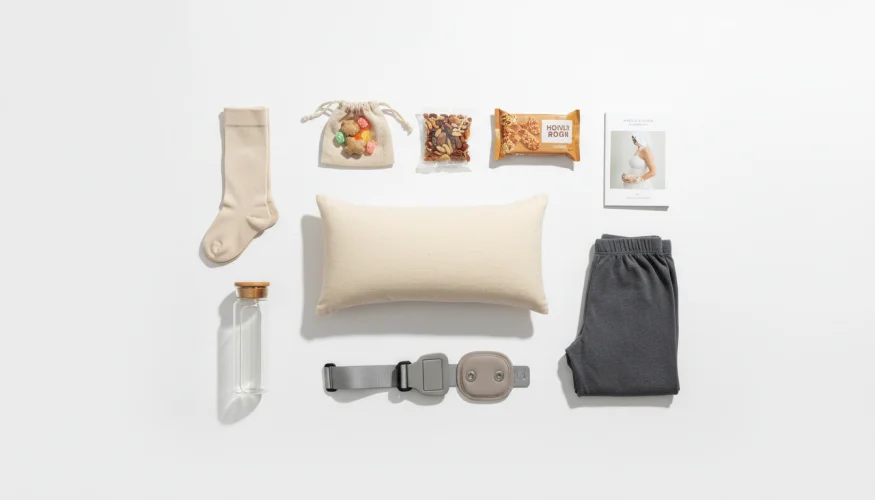
The right equipment can transform a car journey during pregnancy from an ordeal into a pleasant experience. The foundation is comfortable clothing – loose, non-restrictive, and ideally with an elasticated waist. Tight jeans or trousers with a stiff waistband can press uncomfortably on the bump when sitting and cause digestive discomfort.
A back support cushion or pillow is a great help. Lumbar pillows specially designed for pregnant women support the natural curve of the spine and significantly reduce back pain, which is almost inevitable during longer periods of sitting in a car. A rolled-up towel or blanket can serve a similar function. In the range of eco-friendly shops such as Ferwer, you can find ergonomic aids for pregnant women made from natural and sustainable materials that are gentle on both the body and the environment.
Compression of the lower limbs is addressed by special maternity compression stockings. These are particularly important on longer journeys, as they reduce the risk of swelling and the formation of blood clots – a condition known during pregnancy as deep vein thrombosis, the risk of which is demonstrably increased by prolonged sitting in a car. According to the American College of Obstetricians and Gynecologists, preventing thrombosis while travelling is one of the key priorities for pregnant women.
It is advisable to always have plenty of water and light snacks to hand in the car. Pregnancy increases the body's metabolic demands and blood sugar levels can fluctuate rapidly, leading to nausea, dizziness, or irritability. Nuts, dried fruit, wholegrain biscuits, or small portions of fruit are ideal travel snacks that satisfy hunger, provide energy, and are easy on digestion.
In case of nausea – which can affect women in the second or third trimester, not just the first – it is worth having ginger sweets or tea to hand. Ginger is a natural remedy with a proven effect on reducing pregnancy nausea and, unlike many medications, is safe for expectant mothers.
When it comes to the temperature in the car, pregnant women tend to overheat more quickly than others. Air conditioning or an open window are therefore a necessity, not a luxury. Overheating during pregnancy is not only unpleasant but can also have health consequences, so it is important to actively regulate the temperature in the car.
A practical list of basic equipment for a car journey during pregnancy looks roughly like this:
- lumbar pillow or back support
- maternity compression stockings
- plenty of water and light snacks
- ginger sweets or tea for nausea
- comfortable, loose clothing
- seatbelt adapter for pregnant women
- medical documentation and maternity notes
When it's better to stay home: situations where travel is inadvisable
Although travelling by car during pregnancy is generally safe, there are situations where it is better to consult a doctor before travelling or to postpone the journey altogether. High-risk pregnancies, placenta praevia, threatened premature labour, or severe swelling are conditions in which a doctor may advise against travelling. It is also advisable to limit longer journeys in the final weeks of pregnancy – from approximately 36 weeks – when labour can start unexpectedly.
Every woman should discuss her travel plans during pregnancy with her gynaecologist or midwife. This consultation takes only a few minutes but can prevent unnecessary complications. The doctor knows the specific health situation and can provide tailored recommendations.
It is also important to know what to do in the event of complications on the road. The number for your maternity unit or gynaecologist should always be to hand – ideally saved in your phone in an easily accessible place. In the event of any unusual bleeding, severe abdominal pain, irregular contractions, or a significant reduction in the baby's movements, you must stop immediately and seek medical attention.
Travelling by car with a large bump is neither an achievement for heroines nor unnecessary risk-taking. It is the everyday reality of many pregnant women, and the better planned, more comfortable, and more adapted to the body's current needs it is, the more smoothly it goes. Pregnancy is not an illness – it is a condition that requires a little more attention, self-consideration, and a willingness to accept that the pace of the journey will simply slow down for a while. And that is perfectly fine.