
Proper jewelry storage will extend their beauty and lifespan
Anyone who has ever spent ten minutes untangling a delicate gold chain right before heading out to a party knows how frustrating a poorly organized jewelry collection can be. Necklaces get knotted up, earrings lose their partners, and a favorite ring simply disappears – only to turn up at the bottom of a handbag three months later. Yet all it takes is a little system, and proper jewelry storage becomes a routine that saves time, nerves, and money.
Jewelry is more than just decoration. For many people, it represents memories, family heritage, or investments. All the more reason it deserves care that extends its life and preserves its beauty. And while the market offers dozens of different organizers and jewelry boxes, the basic principles of proper storage are surprisingly simple – and truly anyone can master them.
Try our natural products


Why Jewelry Tangles and How to Prevent It
Tangled necklaces and chains are probably the most common problem jewelry lovers face. Physically, it makes sense: the fine links of chains catch on each other and on surrounding objects when moved, and the more pieces of jewelry lying loosely together, the greater the chaos. The key to preventing tangles is a simple rule – every piece of jewelry should have its own place.
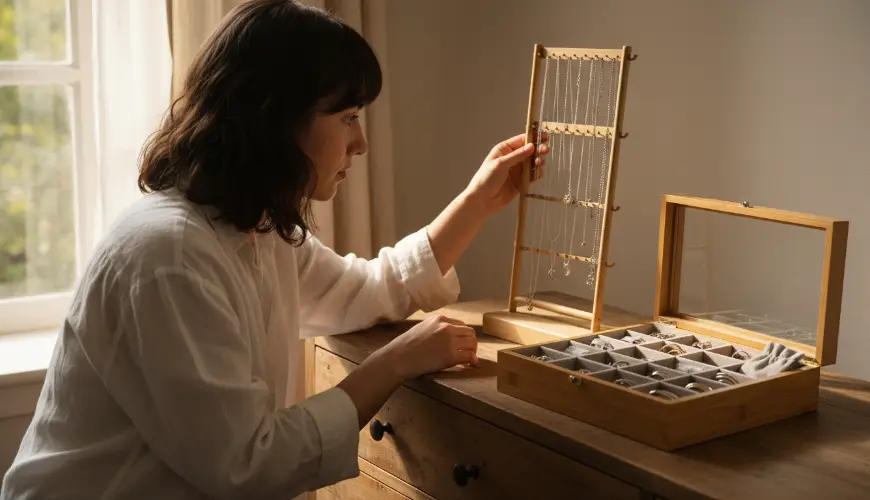
The most effective solution for necklaces is vertical hanging. A jewelry stand, wall hook, or even a decorative grid on the wall allows each necklace to hang separately, without contact with others. This approach also has aesthetic value – the jewelry becomes part of the interior décor and looks beautiful on display. Those without space for a wall-mounted solution can opt for a jewelry box with individual hooks or compartments, where each piece lies separately.
A practical trick that few people know involves using drinking straws. A necklace is threaded through a straw and fastened – the chain cannot form a knot because it is supported along its entire length. Small zip-lock bags work equally well, in which a necklace is stored fastened. This method is especially useful when traveling, when jewelry travels in a suitcase or toiletry bag.
Earrings present their own category of problems. Paired earrings have an unfortunate tendency to become separated – one ends up in a drawer, the other somewhere in the bathroom. The solution is to always store them as a pair, ideally in a compartmentalized organizer with small sections or in a special board with holes through which post earrings are simply pushed. Such a board can be made from cardboard, cork, or foam material, and anyone can make one at home in a few minutes.
Proper Storage Conditions Will Extend the Life of Your Jewelry
Tangling and loss are not the only enemies of jewelry. Moisture, direct sunlight, chemicals from cosmetics, and friction between different materials can cause irreversible damage. Silver oxidizes and blackens, gold jewelry can be scratched by harder stones, pearls lose their luster, and silk cords tear. Proper storage conditions are therefore not just a matter of tidiness, but genuine protection of the value of jewelry.
The basic rule is: jewelry should be stored in dry, dark conditions and separated from each other. The bathroom, although it presents itself as a convenient place to store jewelry, is in fact one of the worst possible environments. Steam, moisture, and temperature fluctuations accelerate the oxidation of metals and damage sensitive materials such as pearls, coral, or enamel.
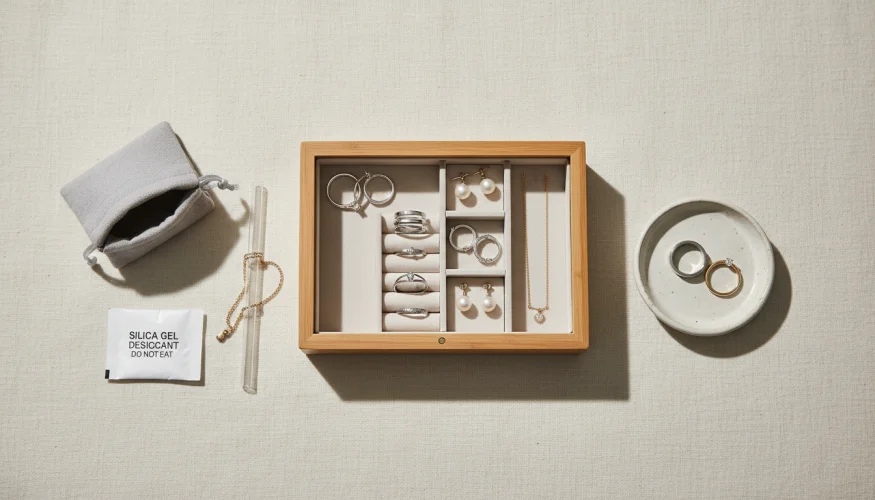
The ideal place for a jewelry box is a bedroom or dressing room – spaces with stable temperature and low humidity. If the home has higher air humidity, placing a small silica gel packet in the jewelry box will help absorb moisture. These packets are widely available and once saturated, simply need to be dried in the oven and reused.
Each material requires a slightly different approach. Silver jewelry benefits from storage in anti-tarnish fabric pouches or paper that slows oxidation. Pearls, on the other hand, are an organic material that needs slight moisture – an overly dry environment dries them out and causes cracking. Gold jewelry is more resilient, but it too will scratch if it lies in contact with other metals or stones.
Imagine a situation experienced by someone like Markéta from Brno: she inherited a beautiful silver bracelet with a filigree pattern from her grandmother and stored it on a bathroom shelf next to perfumes. After six months, the bracelet was black and the surface was dull. Only after moving it to a dry drawer in the bedroom and regular cleaning was it possible to partially restore the original luster. It is a common story – and yet so easily preventable.
Organizational Systems That Actually Work
The market for jewelry organizers is enormous today and the choice can be confusing. Jewelry boxes, trays, wall panels, travel cases, glass jars, and DIY solutions from natural materials – everyone can find a variant that suits them both spatially and aesthetically. More important than any specific product, however, is the fundamental approach: an organizer should correspond to the size and composition of the jewelry collection.
Those who primarily own earrings and rings will appreciate a shallow jewelry box with many small compartments. Those who collect necklaces and bracelets need vertical space or hooks. And those who travel and don't want to leave their jewelry at home should invest in a quality travel case with firm compartments and a fastening that prevents the contents from moving.
An interesting and sustainable alternative is organizers made from natural materials – bamboo trays, cork boards, or linen pouches. These materials are environmentally friendly, aesthetically pleasing, and at the same time meet functional requirements. Bamboo, for example, is naturally antibacterial and moisture-resistant, making it an excellent choice for jewelry boxes.
For those who prefer a DIY approach, there are many creative solutions. An old picture frame covered with wire mesh becomes a wall panel for necklaces. A wooden coat rack serves as a stand for bracelets. Ceramic or wooden bowls are an elegant place for everyday rings and earrings on a nightstand. Creativity truly pays off here.
As stylist and author of a book on sustainable fashion Marie Kondo says: "When you tidy your space, you tidy your mind." And while Kondo is speaking about tidying in general, this thought applies doubly to jewelry – a clear, well-organized jewelry collection brings joy every morning instead of frustration.
Special attention should be paid to jewelry that is not worn every day – family heirlooms, gold jewelry for formal occasions, or precious pieces with significant sentimental value. These should be stored separately from the everyday collection, ideally in individual pouches or boxes with cotton padding. Some experts recommend a safe or bank safety deposit box for very valuable pieces, especially if they have insurable value. The Czech Trade Inspection Authority and insurance companies recommend having a documented description and photograph of valuable jewelry in case of an insurance claim.
Traveling with jewelry is a chapter in itself. Air travel, hotel rooms, and various environments present increased risk of loss and damage. The basic advice is: travel only with jewelry you will actually wear, and store it in a firm travel case with solid compartments. Valuable jewelry is always better kept in carry-on luggage than in checked baggage. And for peace of mind – before every trip, it is a good idea to photograph your jewelry so that in case of loss, it is clear what to look for.
A digital inventory of a jewelry collection may sound like an excessive measure, but for those who own a larger collection, it is a very practical tool. A simple spreadsheet or photo album on a phone with a description of each piece – material, origin, approximate value – can be invaluable when insuring jewelry or in the event of theft. Apps like Sortly or a simple cloud album work great for private purposes as well.
Regular care of jewelry goes hand in hand with proper storage. Jewelry should be cleaned before storing, not just after unpacking – dirt, sweat, and cosmetic residue accelerate corrosion and surface dulling. For most metal jewelry, a soft microfiber cloth is sufficient; for silver, a special cleaning agent; and for gold jewelry with stones, careful cleaning with a soft brush in warm water with a drop of dish soap. Ultrasonic cleaners, now available for home use, are an excellent aid for more regular care.
A sustainable approach to jewelry storage also includes thinking about how much jewelry one actually needs. A minimalist collection of quality, thoughtfully chosen pieces is not only easier to organize, but also more in line with the principles of slow fashion and conscious consumption. Instead of dozens of cheap costume jewelry pieces that deteriorate quickly and clutter drawers, a few pieces can have genuine value – aesthetic, emotional, and material.
Ultimately, storing jewelry is an act of respect – for the things we love, for the craftsmanship of those who created them, and for ourselves. A well-organized collection, where every piece has its place and is protected from damage, brings everyday joy and the certainty that a favorite necklace will be exactly where it should be at the next occasion – without a single knot.