

How to survive motherhood when you're an introvert
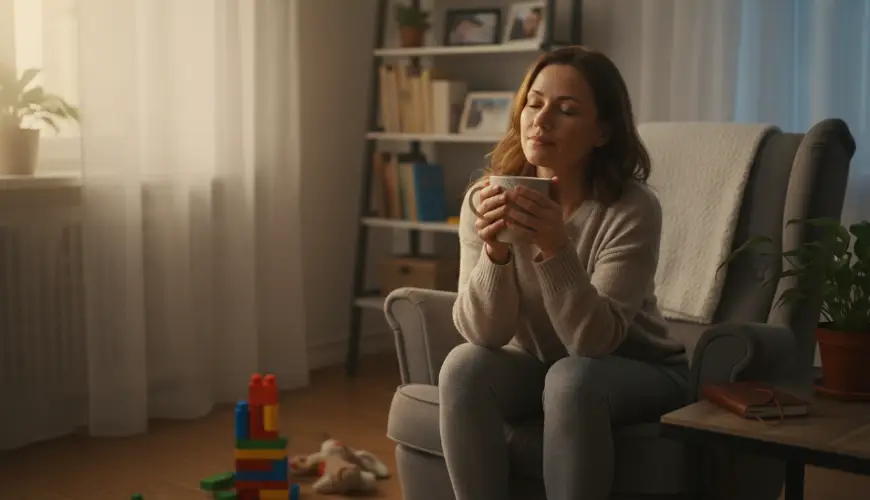
Every parent knows that moment when, after a demanding day, they finally sit in silence and feel their energy slowly returning. And it's precisely then that a child comes running with a question, a toy, or simply a need to be close. For extroverted parents, this is a natural joy. For an introverted mother, this moment can be filled with both love and quiet exhaustion – and it's exactly this combination that tends to be the source of unnecessary guilt.
Introverted mothers are not less loving, less present, or less good. They are simply wired differently. Their nervous system needs quiet to recharge, and that is a biological reality, not a personality flaw. Yet many of them find themselves caught in a trap, trying to meet the expectations of those around them – to be constantly available, playful, patient, and energetic – while their battery slowly drains inside. So how do you manage parenthood when mum is an introvert and the child comes every other moment with a new need for attention?
Try our natural products


Introvert doesn't mean someone who doesn't like people
First, it's important to dispel one of the most widespread myths. Introversion doesn't mean that a person dislikes company or doesn't want to spend time with their children. Psychologist Carl Jung, one of the first to describe these personality types, explained introversion as the way a person draws energy – not as a measure of their sociability. Introverts recharge in solitude and quiet, while extroverts gain energy from company and external stimulation.
In practical terms, this means that an introverted mother can love her child deeply and unconditionally, and yet feel completely mentally exhausted after an hour of playing with building blocks. This exhaustion is not a failure – it is a physiological response of the brain to sensory overload. Research suggests that the brains of introverts process social interactions more intensely and deeply than those of extroverts, which naturally leads to faster depletion. An interesting overview of this topic can be found at Psychology Today, where a number of expert articles on the introverted personality and its manifestations in everyday life are available.
The problem arises when a mother begins to perceive her feeling of exhaustion as proof that she isn't good enough. This inner critical voice is very common among introverted parents and equally destructive. It pushes them to stretch beyond their own limits until genuine burnout sets in – and that helps neither the mother nor the child.
Take the example of Kateřina, a mother of two children aged four and seven. After a full day of working from home, spending the entire day communicating with colleagues over video calls, she would arrive at dinner exhausted in a way her partner, a natural extrovert, couldn't fully understand. "I was sitting at the table and both children were talking to me at the same time, my husband was asking what was for dinner, and I could feel my eyes closing – not from sleepiness, but from overload," she described. It was only when she began actively communicating her need for quiet and planning for it that the situation changed. Every evening after dinner, she sets aside thirty minutes for herself – and the whole family respects this.
How to find a balance between a mother's needs and a child's needs
The key is not to suppress one's own nature, but to consciously establish boundaries and routines that work for the whole family. Introverted mothers have one major advantage over their past selves: today there is far more information available on this topic, along with communities of support and practical tools.
The first step is to name what is happening – not only for yourself, but also for your child. Children are surprisingly capable of understanding that their mum sometimes needs a moment of quiet, if it is explained in a way appropriate to their age. "Mummy needs a moment to recharge, like when a phone charges. In twenty minutes I'll be here for you again," is a sentence that even a four-year-old can understand. At the same time, this teaches the child a valuable lesson that every person has their own needs and boundaries – and that it is normal to talk about them.
Another important tool is quality of attention over quantity. Introverted mothers have a natural tendency towards deeper, focused contact – and that is a tremendous advantage. Twenty minutes of truly present play, with the phone put away and mum genuinely listening, has greater value for a child than an hour of semi-distracted presence. Research in the field of attachment and early child development consistently shows that what is key to a child's healthy emotional development is the sensitive and responsive presence of a parent – not its length in hours.
Introverted mothers also benefit from activities that are less stimulating but still meaningful. Reading together, quietly drawing side by side, a walk in nature, cooking together – these are situations where the child receives attention and closeness, but the mother is not overwhelmed by a barrage of loud stimuli. Nature also has a proven restorative effect specifically on introverted types, so a walk in the forest or to a pond can be a win for both sides.
Planning is quite literally a lifeline for introverted mothers. Knowing in advance what the day will bring allows for mental preparation and avoids wasting energy on unexpected situations. Routines – morning, afternoon, evening – give the child a sense of security and the mother predictability. If she knows that every day from six to six-thirty she will play a game with the child, she can save her energy for that moment and be truly present then, rather than spending the whole day fighting with herself over when that moment will come.
It is equally important not to plan too many social activities in a single weekend. A birthday party, a visit to grandparents, and an afternoon at the playground may be an ideal weekend for an extroverted family, but for an introverted mother it can be a nightmare. Choosing and prioritising are essential, and there is nothing selfish in that. A child who has a balanced, fulfilled mother by their side is better off than a child whose mother pushes beyond her limits and then reacts irritably or withdraws.
Guilt is unnecessary, but understandable
Perhaps the greatest challenge introverted mothers face is not the exhaustion itself – that can be managed. The greatest challenge is the inner conviction that they are bad mothers. This conviction is fed by social norms that idealise the image of a mother as always available, always energetic, always willing to play and chat. This image is unrealistic for many women, and for introverts especially.
Susan Cain, author of Quiet: The Power of Introverts in a World That Can't Stop Talking, writes: "The introvert's world is rich and exciting, but it exists behind a veil, invisible to others." And it is precisely this invisibility that is the source of the problem. Introverted mothers appear calm on the outside, sometimes even distant, while inside they are processing an enormous amount of emotions, impressions, and needs – both their own and their children's.
Guilt is understandable, but unnecessary. A child doesn't need a perfect mother. They need a mother who is present, sensitive, and able to be herself. And it is precisely introverted mothers who learn to work with their nature rather than fight against it who can offer their children something exceptional: depth of relationship, the ability to listen, calm, and space for silence – which is a rarity in today's overstimulated world.
Communities of introverted parents, such as various online groups or forums focused on mindful parenting, can be a valuable source of support. Sharing experiences with people who understand how you feel when your child brings you a third puzzle in a row on a Friday afternoon and you feel like disappearing into a wardrobe is a relief that should not be underestimated. A therapist or coach specialising in introverted personalities can also help establish specific tailored strategies.
It is worth noting that introverted mothers are also role models for their children. If a child sees that mum says "I need a moment for myself" and then returns refreshed and loving, they learn that self-awareness and self-care are values, not weaknesses. That is a lesson that will serve them throughout their lives – regardless of whether they turn out to be an introvert or an extrovert.
And what to do in those hardest moments, when the child is crying, the household is calling, and energy is at zero? Accept that this day will not be perfect. Hug the child, even when it is hard. And remind yourself that tomorrow brings a new opportunity – and that love is not measured by the number of games played, but by the depth of presence you are able to offer, even when you are tired.