

Practical meals you can manage to eat even with a baby in your arms
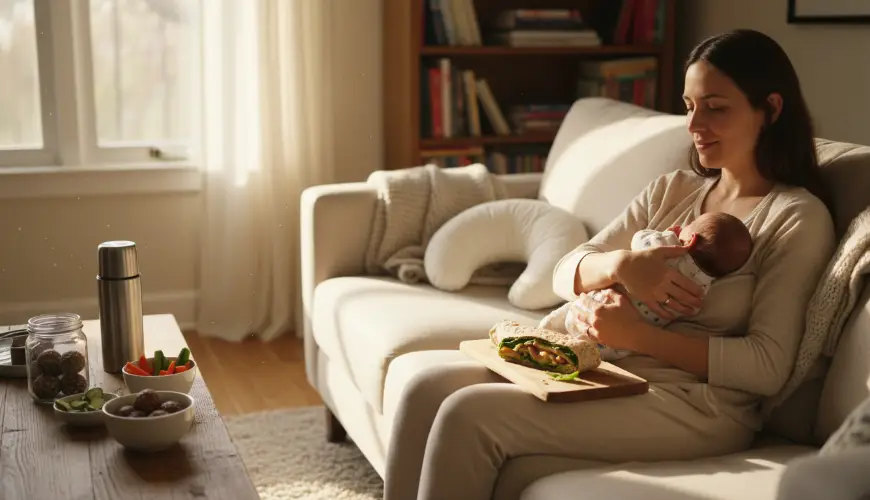
Every parent of a small child knows it. You're sitting at the table, holding a contentedly sleeping baby in one hand, and in front of you sits a plate of food that is absolutely impossible to eat with one hand. A fork, a knife, a sauce that needs constant stirring – and you're wondering whether it's okay to put the baby down for a moment, or whether you'll simply stop eating hot food for the next year. This situation is one of the most universal experiences of parenthood, one that isn't talked about enough, yet the vast majority of caregivers go through it.
Especially in the first months of a baby's life, when the child needs to be in almost constant contact with a parent, eating becomes a surprisingly logistical challenge. Breastfeeding, carrying in a sling, falling asleep on someone's chest – these are all situations where one hand is occupied and you're trying to get through the day with the other. And yet it's important not to forget your own nutrition, because a tired and hungry parent is not a good parent for anyone.
Try our natural products
Why we so easily forget to eat
Research and the experience of postpartum care professionals have long highlighted the fact that new parents – especially breastfeeding mothers – very often neglect their nutrient intake. The body needs intensive recovery after childbirth, breastfeeding alone burns approximately 300 to 500 extra calories per day, and yet many mothers admit that they spent the first months in a more or less permanent calorie deficit – not by intention, but out of sheer lack of time. The food simply went uneaten before the baby woke up, started crying, or needed a nappy change.
This isn't a matter of poor planning or incompetence. It's the reality of caring for a newborn, which comes with its own set of rules – and those rules bear no resemblance whatsoever to life before a child. That's precisely why many families gradually build up a repertoire of foods that are tasty, nutritious, and can easily be eaten with one hand, standing up, on the sofa with a baby at the breast, or even during a walk.
As American midwife and author of books on newborn care Kimberly Ann Johnson once wittily remarked: "Feeding yourself is just as important as feeding the baby. One simply doesn't work without the other."
Practical foods you can eat with one hand
Thinking about what to eat with a baby in your arms doesn't mean giving up on flavour or nutrition. On the contrary, these constraints can be a great opportunity to discover new recipes and approaches to eating that are simple, quick, and yet full of the nutrients a postpartum body truly needs.
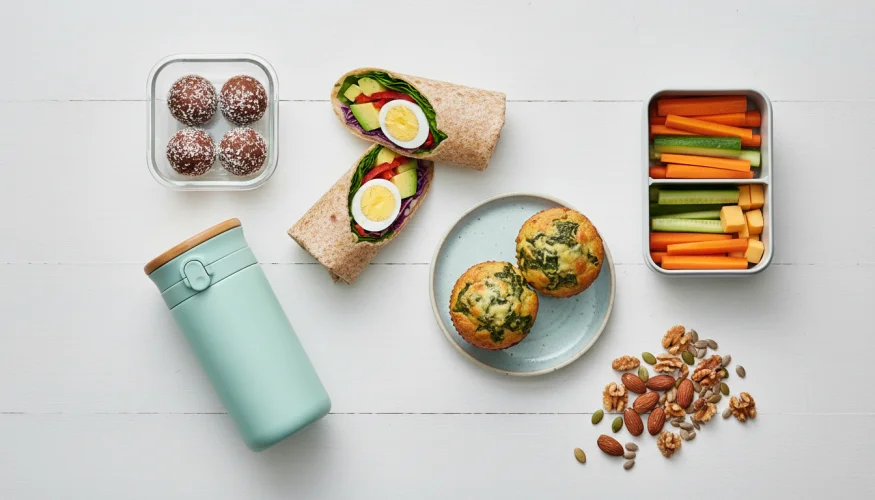
Various types of wrap sandwiches and filled tortillas are an excellent choice. A tortilla rolled tightly around its filling holds its shape, doesn't leak sauce, and can be bitten into without any need for cutting. The fillings can be varied – avocado with egg and vegetables, hummus with grilled vegetables, tuna with yoghurt and herbs, or slices of roasted meat with salad. The advantage is that they can be prepared in advance and stored in the fridge, where they'll keep for a whole day.
Similarly practical are various balls, bars, and bite-size snacks. Energy balls made from oats, dates, nuts, and cocoa are a great example – they can be made in large batches, keep in the fridge for up to a week, and are a packed source of energy. If you're interested in recipes made from natural ingredients without unnecessary additives, you can find inspiration on the BBC Good Food blog, which offers hundreds of quick and nutritious recipes for busy people.
Muffins and savoury bakes are another category worth paying attention to. Unlike sweet desserts, savoury muffins can be a complete meal – with added spinach, cheese, eggs, or vegetables, they become a filling snack or a light lunch. They're baked once and keep for several days, which is exactly what a tired parent needs.
Smoothies and nutritious drinks shouldn't be overlooked either. A glass or thermos is technically a drinking vessel, but a thicker smoothie with banana, oats, nut butter, and protein can be a complete breakfast or snack. You can drink with a baby in your arms, and if you invest in a bottle with a wide neck and a secure lid, you've got it sorted.
Boiled eggs are also very practical. A hard-boiled egg can be eaten whole without cutlery, is rich in protein and healthy fats, and keeps in the fridge for several days. Similarly, sliced vegetables – carrots, cucumber, peppers, or celery – make a quick and healthy snack that requires no preparation at the moment of eating.
Cheese cut into cubes or slices, various types of nuts and seeds, or olives follow the same logic. These aren't complete meals, but as part of a larger snack spread they do an excellent job. The key is to have these foods prepared and accessible – in small containers in the fridge, within arm's reach, without needing to prepare anything complicated.
If you fancy something warmer, soups and thicker broths in a mug or thermos are a great option. A thick lentil, sweet potato, or broccoli soup with coconut milk can be drunk straight from a mug and is nutritious and warming. Preparing such a soup once every few days and storing it in the fridge or freezer is one of the smartest strategies new parents can adopt.
How to make it all even easier
Knowing the recipes is one thing, but real change comes with having a system. Parents who manage best with food during the demanding early period usually don't have more energy or more time – they simply have better-established habits and environments.
One of the most effective strategies is batch cooking, i.e. cooking in larger quantities at once. Dedicating two hours once a week to preparing the basics – boiling eggs, making a batch of energy balls, baking savoury muffins, cooking a large pot of soup – means that for the remaining six days you have food to hand without having to think about it. For inspiration on how batch cooking works in practice, Healthline offers very good overviews; the portal has long focused on topics of healthy eating and practical nutrition.
Ergonomic kitchen equipment is also a great help. Containers that can be opened with one hand, thermoses with simple lids, small snack boxes prepared the evening before – these are all small things that, taken together, significantly ease everyday functioning. Similarly, a sling or ergonomic baby carrier can help by freeing up both hands, allowing parents to eat normally without putting the baby down.
Take Markéta, the mother of a three-month-old son from Brno, as an example. For the first six weeks after giving birth, she ate haphazardly, her food went cold, and she admits she felt increasingly exhausted. Then she decided to change her approach: every Sunday, she and her partner prepared a supply of food for the whole week. Energy balls, filled tortillas in the fridge, soup in the freezer, and sliced vegetables in boxes. "It changed absolutely everything," she says. "I didn't have to think about what I was going to eat. I just reached into the fridge and had food."
Of course, support from those around you is irreplaceable. If a parent has a partner, friends, or family who can help with food preparation, it's a shame to refuse that help. Many cultures have a deeply rooted tradition of bringing food to new families in the first weeks after birth – and it's no coincidence that this tradition has survived for centuries. It's one of the most practical ways to support new parents.
It's also important not to forget about hydration. Breastfeeding mothers should drink approximately three litres of fluids per day, but even non-breastfeeding parents tend to forget to drink amid the demands of caring for a baby. A large bottle of water or herbal tea within arm's reach is a simple but effective solution.
Food prepared in advance, smart ingredient choices, and a little organisation can transform one of the most demanding aspects of early parenthood into something manageable. Self-care is not a luxury – it is a necessary condition for a parent to be able to care for others. And a parent treating themselves to a nutritious meal with a baby in their arms is not a compromise. It is simply a smart adaptation to a new reality that only lasts a little while – even if it doesn't always feel that way.