
How to Find Crayons and Markers for Kids Free of Harmful Substances
Every parent wants the best for their child. Healthy food, safe toys, clean air in the bedroom. Yet there is one area that is surprisingly often overlooked when choosing children's supplies – and that is art supplies. Coloured pencils, markers, watercolours or oil pastels spend whole hours each day with children. Young artists hold them in their hands, smell them, and sometimes even taste them. And yet most parents, when shopping, pay attention mainly to the price or how vivid the colours a product offers. The question of ingredients is left aside.
Yet the composition of children's art supplies can have a significant impact on children's health – especially the youngest ones, whose bodies are far more sensitive to chemical substances than those of adults.
Try our natural products
What is hidden in ordinary coloured pencils and markers?
Conventional art supplies, especially cheap and unbranded ones, can contain a range of substances that are undesirable for children. These include, for example, phthalates – plasticisers associated with hormonal disorders – or heavy metals such as lead, cadmium and chromium, which were traditionally used as part of pigments. Today their limits are strictly regulated in Europe, but for products originating from countries with less stringent standards, the situation may be different.
Organic solvents contained in some markers and felt-tip pens are also a problem. These are responsible for the characteristic sharp smell that everyone remembers from childhood. Short-term exposure to these substances can cause headaches or irritation of the mucous membranes, and with long-term and repeated inhalation, the effects can be more serious. The World Health Organization (WHO) repeatedly warns that children are more vulnerable to chemical substances in the environment than adults, due to their higher metabolic rate, greater lung surface area relative to body weight, and a natural tendency to put objects in their mouths.
Another, less discussed problem is synthetic dyes and preservatives added to watercolours or finger paints. Some of these belong to the group of azo dyes, which under certain conditions can break down into aromatic amines classified as potentially carcinogenic. European REACH regulation and the Toy Safety Directive (EN 71) do set strict limits, but knowing these terms gives parents a powerful tool: knowing what to ask about when shopping.
Parents who are aware of this issue then react similarly to Jana, a mother of two preschoolers from Brno. "When I found out that my daughter was putting markers in her mouth and sniffing them, I started researching the ingredients. I was surprised by how much information was missing from the packaging. I switched to natural alternatives and the difference in smell was immediately noticeable," she describes her experience.
How to recognise safe art supplies for children?
Navigating the labelling of children's art supplies is not complicated if you know what to look for. The most important indicator is certification. The CE mark confirms compliance with European standards, but on its own it is not enough – it is more of a basic minimum. Much greater assurance comes from certificates such as ASTM D-4236 (the American standard for the safety of art materials), EN 71 (the European toy safety standard) or the AP Certified designation from the Art & Creative Materials Institute, which guarantees that the product contains no substances in amounts toxic to humans.
In addition to certificates, it is important to pay attention to the composition and method of production. Coloured pencils and markers free from harmful substances are generally made on a natural basis – they use waxes of plant origin (such as carnauba or soy wax), natural pigments or mineral dyes. Such production is more expensive, but the result is a product that is gentle not only to the child, but also to the environment.
Common sense and simple sensory testing also help when choosing. Safe markers and watercolours do not have an intense chemical smell. If a product smells strongly immediately after opening, that is a warning sign. Similarly, quality natural coloured pencils have a softer, less saturated colour – a compromise that many parents will appreciate in exchange for peace of mind.
Wax Lyrical, an independent guide to natural products for children, sums up the situation aptly: "The safest art supplies are those whose manufacturer has nothing to hide – and proves it through transparent ingredient lists and third-party certification."
Natural alternatives that work
The good news is that the market for eco-friendly and non-toxic art supplies has grown significantly in recent years. Parents today have a wide range of products available that meet strict safety standards while also offering excellent artistic results.
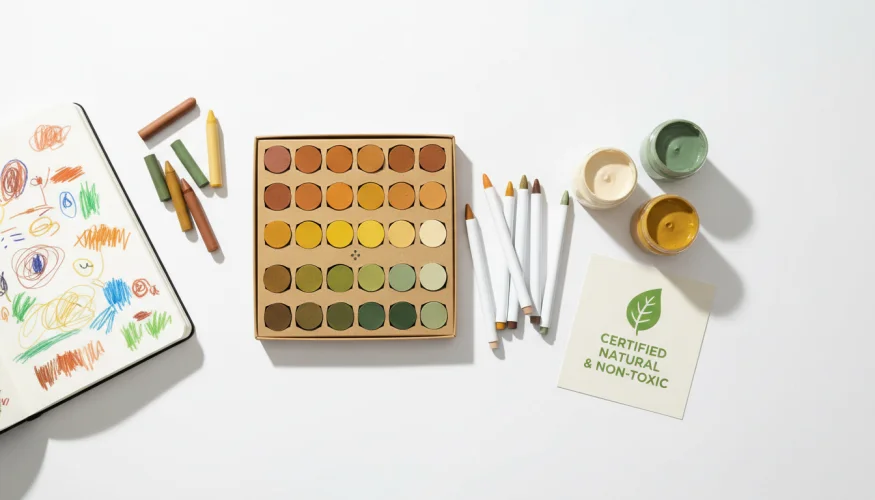
Among the most popular are wax crayons made from beeswax or plant-based wax. Compared to classic paraffin crayons, they contain no petroleum derivatives and the colours are naturally more vibrant thanks to higher-quality pigments. Brands such as Stockmar or Lyra Waldorf are considered the gold standard in this segment and are used by Waldorf schools around the world. Their crayons are made exclusively from natural raw materials, contain no phthalates or heavy metals, and are certified according to strict European standards.
For the youngest children from the age of one, natural-based finger paints are ideal. The best ones are made from starch, natural dyes and water – so even if a child swallows some paint, there is no danger. Manufacturers such as Clementoni or Djeco offer certified versions of these paints, which are safe even for children with sensitive skin.
Water-based markers are another great alternative to solvent-based markers. They contain no organic solvents, have no sharp smell, and are much gentler in the event of contact with mucous membranes. They also wash off hands, clothing and floors more easily – a bonus that every parent of a young artist will appreciate.
An interesting category is also natural chalks and charcoals made from minerals without the addition of synthetic binders. These traditional art materials are experiencing a renaissance in children's rooms, because they are inherently simple and safe. They can be easily washed off with water and develop fine motor skills in a different way than classic coloured pencils.
For parents who want to shop responsibly and be sure they are purchasing truly safe products, it is useful to follow a few basic criteria:
- EN 71, ASTM D-4236 or AP Certified certification – guarantees of independent testing
- Natural-based composition – plant-based or beeswax, mineral pigments
- No or minimal smell – absence of organic solvents
- Transparent composition – the manufacturer lists precise raw materials, not just general terms
- Eco-friendly packaging – recyclable or compostable materials
It is worth noting that choosing safe art supplies is not only a health decision, but also an ecological one. Conventional paraffin crayons are a petroleum product whose production burdens the environment. In contrast, crayons made from soy or carnauba wax are biodegradable and their production has a significantly lower carbon footprint. Families who choose natural alternatives thus contribute to a more sustainable future – and at the same time lead children towards a natural respect for nature.
Research repeatedly confirms that artistic activity is extraordinarily important for a child's development. According to studies published in the Early Childhood Education Journal, drawing and painting supports the development of fine motor skills, spatial thinking, creativity and the ability to express oneself. It would be a shame if this natural and beneficial activity were burdened by unnecessary health risks arising from poorly chosen materials.
The market for eco-friendly art supplies for children is also growing in the Czech Republic. Specialist online shops focused on healthy living and ecological products, such as Ferwer, offer a carefully selected range of art supplies where the safety of ingredients is a priority. Shopping can thus be done conveniently online with the confidence that the selection has been verified in advance.
Parents who choose natural art supplies very often describe a similar experience: they initially hesitate due to the higher price, but after the first purchase they no longer return to conventional products. The reason is simple – the difference is noticeable. Quality natural coloured pencils glide beautifully across paper, the colours can be mixed and layered, and most importantly, there is no unpleasant smell during drawing. The child paints, the parent has peace of mind. And that is ultimately what it is all about.
The world of children's artistic expression should be a place of joy, experimentation and freedom – not a source of hidden risks. Making an informed choice of art supplies is one of the simplest steps to ensure that it truly is.