
How to maintain friendships after having a baby
The arrival of a child into the world is one of the most beautiful and at the same time most demanding turning points in life. Sleep patterns change, priorities change, daily routines change – and friendships often change too. Many new parents find themselves in a situation where they gradually lose touch with people who were close to them, without anyone actually wanting that to happen. And conversely – friends without children sometimes don't know how to behave, how to be helpful, or simply how to maintain a relationship that used to work differently. Maintaining friendships after the birth of a child requires conscious effort from both sides, but the result – a deep, mature friendship that survives even the most demanding stages of life – is definitely worth it.
It is not uncommon for a woman who, before giving birth, used to go out for drinks with her girlfriends every Friday, to suddenly stop answering the phone. Or for a man who used to play football with a group of friends every Wednesday to disappear from their lives overnight. This is not out of ill will. It is about complete exhaustion, new responsibility, and the fact that a newborn simply cannot wait. Friends who don't understand this may feel rejected. And the new parent, who doesn't have the energy to explain, may feel guilty. This creates a quiet estrangement that none of them wished for.
Try our natural products





Why friendships so easily fall apart after childbirth
Psychologists and sociologists have long pointed out that the transition to parenthood is one of the greatest social transitions in an adult's life. According to research published in the Journal of Social and Personal Relationships, the birth of a first child leads to a significant narrowing of social networks – particularly among mothers. The reasons are entirely understandable: a newborn requires constant care, sleep comes in fragments, and the energy that previously flowed into social life now flows elsewhere.
Added to this is a change in identity. A new parent ceases to be just "Kateřina" or "Martin" and becomes primarily "mum" or "dad." This transformation can be surprising for those around them. Friends who knew the person in a different life role suddenly don't know how to talk to them. What to talk about? Should they only ask about the baby, or will that be annoying? Should they, on the contrary, ignore the baby and talk "normally"? This uncertainty leads some friends to simply stop making contact – not because they stopped caring, but because they don't know what to do.
The key to understanding the whole situation is empathy – and that goes both ways. The new parent needs to understand that their friends cannot read minds and don't know exactly what they need. And friends need to understand that a new parent's silence doesn't mean they don't care about them.
Let's take a specific example: Jana and Petra have been friends since secondary school. When Petra got pregnant, Jana was excited about being a wonderful aunt. After the birth, however, Petra stopped responding to messages, cancelled two meetings, and when they finally met, she was so exhausted that Jana felt Petra wasn't really present. Jana began to feel unnecessary and stopped reaching out. Meanwhile, Petra thought Jana had lost interest because she didn't have children and couldn't understand her new life. Both were waiting for the other, both felt rejected – and the friendship began to fall apart, without either of them wanting it to happen.
There are thousands of stories like this. And most of them share one common solution: an open conversation and a willingness to adapt to a new reality.

What specifically helps – and what is harmful
Maintaining friendships after the birth of a child doesn't mean keeping everything the same as before. It means finding a new way to be together – or at least to stay in touch. And that requires creativity, patience, and a willingness to accept that things will be different from before.
One of the most important things is realistic expectations. Friends of new parents should accept that planning needs to be flexible. A cancelled meeting is not a personal attack – it is the reality of life with a small child. Conversely, new parents should accept that their friends also have their own lives and cannot wait indefinitely. Compromise and mutual tolerance are the foundation.
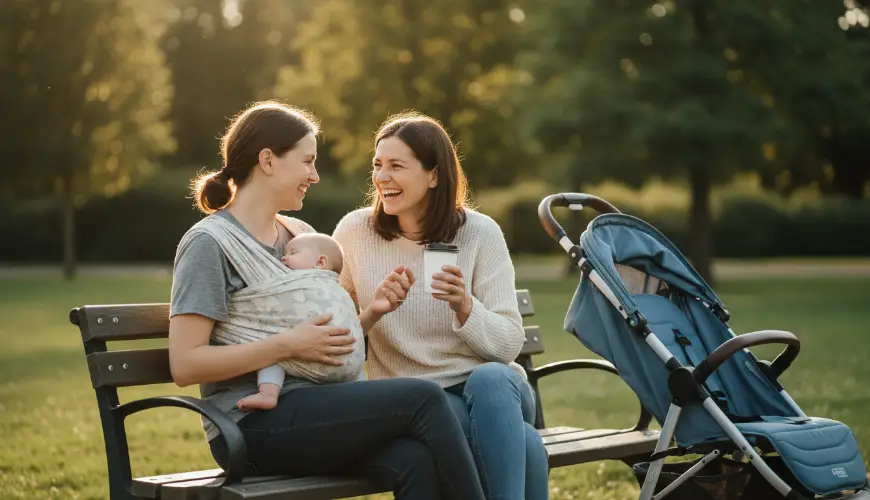
A very practical step is to adapt the form of get-togethers. Instead of an evening out at a restaurant, a friend might come for a morning coffee while the baby sleeps. Instead of a weekend trip, a walk together with the pram might be enough. Seemingly small gestures – coming to the parent's home with food, offering to babysit, or simply coming and being present – can make an enormous difference. As American author and researcher Brené Brown says: "Connection is why we're here. We are literally wired to be in connection with others." And that is exactly the point – finding a way to stay connected, even when circumstances have changed.
Another important element is communication without assumptions. Instead of friends guessing what a new parent needs, it is better to ask directly. "What would help you most right now?" or "When would it suit you to meet?" are questions that show interest while also respecting the new reality. And new parents, in turn, should not be afraid to say what they need – whether that is help, or simply a moment when they can talk about something other than breastfeeding and sleep regressions.
What is harmful, on the other hand? Above all, judgements and comparisons. Friends who feel that the parent "has changed for the worse" or "is obsessed with the baby," and make this known, do not help the friendship. Equally, parents who expect their childless friends to share their enthusiasm for every new tooth or first step may inadvertently put friends off. A healthy friendship can encompass different worlds – and that is its beauty.
Consciously alternating topics during get-togethers can also help. The parent can ask about the friend's work project, travels, or relationship – and the friend can ask about the baby, but also about how the parent themselves is feeling, what they enjoy, what they miss. Such a conversation is enriching for both sides and is a reminder that the friendship existed long before the baby and will continue to exist afterwards.
Friendships between parents and childless friends deserve special attention, as they tend to be the most vulnerable. A childless friend may feel that the parent has "escaped into another world" – and they are right, to some extent they have. But that doesn't mean this world cannot be visited. Coming to visit, getting to know the child, seeing the everyday reality of a new parent – this can paradoxically deepen a friendship. And a parent who occasionally ventures into the "adult world" without their child will return feeling fresher and more grateful.
There are also practical tools that can help maintain contact even at a distance or during demanding periods. A short voice message sent while changing a nappy, a funny meme shared in a group chat, or simply a message saying "thinking of you, how are you?" – these are all small but effective ways of showing that a friendship is alive. There is no need to wait for grand gestures or perfect conditions.
Websites such as Psychology Today repeatedly point out that the quality of a friendship depends more on mutual care and authenticity than on the frequency of meetings. In other words – even a friendship that "survives" on two get-togethers a year can be deeper and more valuable than one that meets every week but lacks genuine understanding.
It is also worth mentioning that the birth of a child can actually deepen a friendship. Many parents describe how their friends showed their best side during difficult moments – they came to help, listened without giving advice, and were simply present. Such experiences create a bond that cannot be built any other way. And conversely – friends who disappear during a difficult period provide important information about the depth of the relationship.
For parents who find themselves in isolation and feel they have lost their social circle, it is important to know that they are not alone. There are communities, parent groups, online forums, and local gatherings where new friendships can be formed with people in the same life situation. But this does not mean they should give up their old ones – quite the opposite. Old friendships provide continuity of identity, reminding a person of who they were and who they still are – just in a new role.
Friendship after the birth of a child does not need to be the same as before. It needs to be honest, flexible, and willing to grow together with the people who make it. And that is actually the most beautiful thing – discovering that a friendship which survives breastfeeding, sleepless nights, and first teeth has something truly solid within it. Something that can be relied upon in the further stages of life that are yet to come.