
Sorting Glass Correctly: What to Do with Lids, Labels and Corks
Anyone who tries to sort waste responsibly knows that moment of hesitation in front of the glass container. In their hand they hold an empty preserving jar with a metal lid, a label stuck all the way around it, and perhaps even a remnant of a rubber seal. What actually belongs in there? The whole jar? Just the glass itself? And what about a wine bottle with a cork stopper? Surprisingly many people ask themselves these questions, yet the correct answer has a significant impact on whether recycling actually works the way it should.
Sorting waste is not merely a symbolic gesture. According to data from the European Commission, glass is among the most recyclable materials of all – it can be processed endlessly without losing quality. But this ideal cycle only works when truly clean glass arrives at the container, free of impurities that would complicate or degrade the entire process.
Try our natural products
What belongs in the glass container and what does not
The basic rule is simpler than it might seem: green or white glass containers are for glass packaging – bottles from wine, beer, soft drinks, jars from preserves, jams, sauces or cosmetics. The colour of the glass does not matter, unless the municipality has separate containers for clear and coloured glass. What does not belong there, however, is ceramics, porcelain, mirrors, window panes, glass-ceramic hob plates or light bulbs. These materials may look like glass, but they have a different chemical composition and cause problems when processed together with an entire batch.
But the story does not end there – and this is precisely where the aforementioned jar with all its components comes into play.
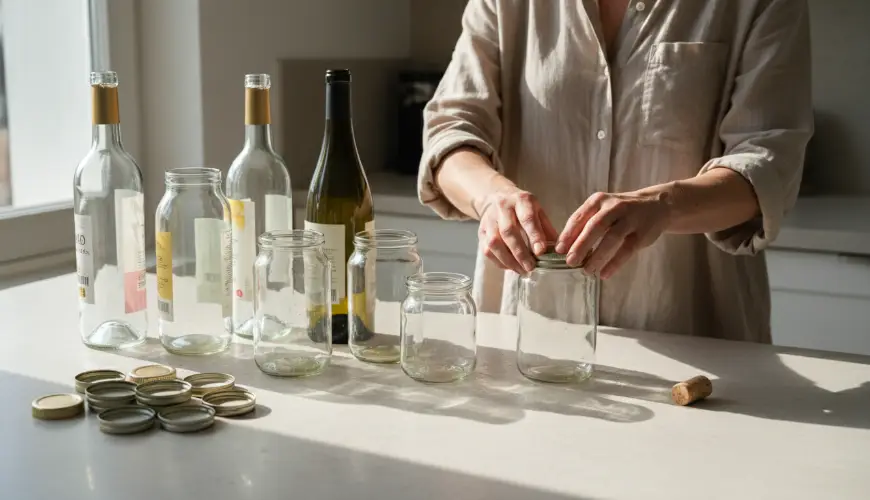
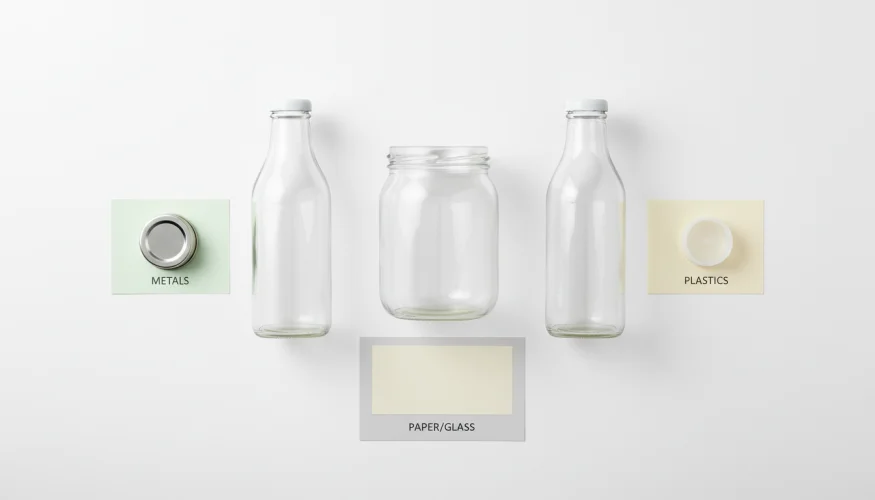
Metal lids are one of the most common sources of confusion. Most people either leave the lid on the jar or throw it into the glass container along with it. Yet the correct procedure is surprisingly simple: unscrew the lid and throw it separately into the metals container. The reason is straightforward – when glass is processed, the raw materials are melted at temperatures exceeding one thousand degrees Celsius, and while metal lids survive this process, they leave behind impurities that reduce the quality of the resulting recyclate. Modern sorting lines can separate metals using magnets and eddy currents, but the fewer impurities that enter the process at the start, the more efficient the whole operation is.
The situation with lids is further complicated by the fact that not all of them are metal. Plastic lids – such as those from mineral water or juice bottles – belong in the yellow plastics container. It therefore depends on the material, not on where the lid came from. A simple rule of thumb: metal lid into metals, plastic lid into plastics, jar into glass.
As for labels, there is somewhat less cause for concern here. Paper labels on glass bottles or jars do not need to be removed before disposal. During industrial glass processing, labels are burned off or washed away in a water bath before the actual melting process. So if someone spends ten minutes peeling a label off an olive oil bottle, they are doing so unnecessarily – at least from a recycling perspective. Of course, if the label comes off easily, there is no reason to leave it on, but it is certainly not a requirement for correct sorting.
Cork stoppers and other closures: surprising exceptions
And now for what surprises most people – cork stoppers do not belong in the glass container. Cork is a natural material obtained from the bark of the cork oak, and although it is biodegradable, it does not belong in the glass container. During industrial glass melting, cork would burn away, but it would leave behind organic residues that compromise the purity of the melt. The correct approach is to separate the cork and either dispose of it in the organic waste (it is biodegradable), or – an even better option – place it in a cork collection point, which many shops, libraries or community centres operate.
Cork stoppers, in fact, have an interesting second life. They are processed into insulation materials, floor coverings, sports equipment and accessories. Organisations such as Corticeira Amorim and various local initiatives collect used corks and give them new purpose. It is a fine example of how seemingly worthless waste can be a valuable raw material – it just needs to end up in the right place.
A similar logic applies to the rubber seals that form part of jars with bail-top closures. These rubber seals belong in general waste, not in glass. The jar itself – provided it is undamaged – can be reused repeatedly and does not need to be thrown away at all.
Consider Martina, for example, who every autumn preserves tomatoes and plums. She carefully washes the jars from the previous year and fills them again – and this approach is the best possible from a sustainability perspective. The best waste is, after all, waste that never arises in the first place. Only when a jar has served its purpose – it cracks, the rim chips, or she simply has no room to store it – does the glass container come into play, this time without the lid, without the cork and without food residue.
Food residue is, incidentally, another reason why jars should be rinsed before disposal. There is no need to wash them as thoroughly as before using them in the kitchen, but larger residues could attract insects or cause odours in the container. A quick rinse with water is sufficient.
As German waste management expert Werner Bosmans once aptly put it: "Recycling is not about what we throw into the container, but about what can actually be reused from the container." And this perspective changes the way we see things – sorting is not merely fulfilling an obligation, but an active contribution to ensuring that materials genuinely get a second life.
A special case is presented by so-called composite glass – that is, glass with wire reinforcement (known as wired glass), glass with film, or safety laminated glass from vehicles. These materials do not belong in the ordinary glass container and must be taken to a recycling centre. The same applies to glass from screens, monitors or solar panels. A rule that works reliably: if in doubt, it is better to call the local recycling centre or check the relevant municipality's website.
Most Czech towns and municipalities today have clear information about sorting available online. For example, Eko-kom, which operates the packaging take-back system in the Czech Republic, offers detailed guides and interactive sorting assistants for various types of waste. It is a resource well worth bookmarking.
When one takes a broader view of the whole matter, it becomes clear that correct glass sorting is not rocket science, but it does require a few minutes of attention. Separate lids by material, set corks aside, deal with labels only when they come off easily, and rinse the jar before disposal. These small steps together make the difference between recycling that works and recycling that merely appears to work.
Perhaps the greatest paradox of the whole situation lies in the fact that glass is a material that practically invites recycling – it is durable, chemically inert, hygienic and repeatedly processable without any loss of quality. Yet every year a large proportion of glass waste ends up in landfills or incinerators because it arrived at the container contaminated or mixed with unsuitable material. And yet so little is required: knowing what goes where.
A sustainable lifestyle is not about grand gestures or expensive products. It is often about small, everyday decisions – such as whether, before disposing of a wine bottle, you unscrew the lid and pull out the cork. These small things count, and when enough people do them, the result shows up in real recycling figures and in the state of the environment. And that is worth those few extra seconds at the container.