

What Is Fattoush and How to Make Lebanese Pita Salad
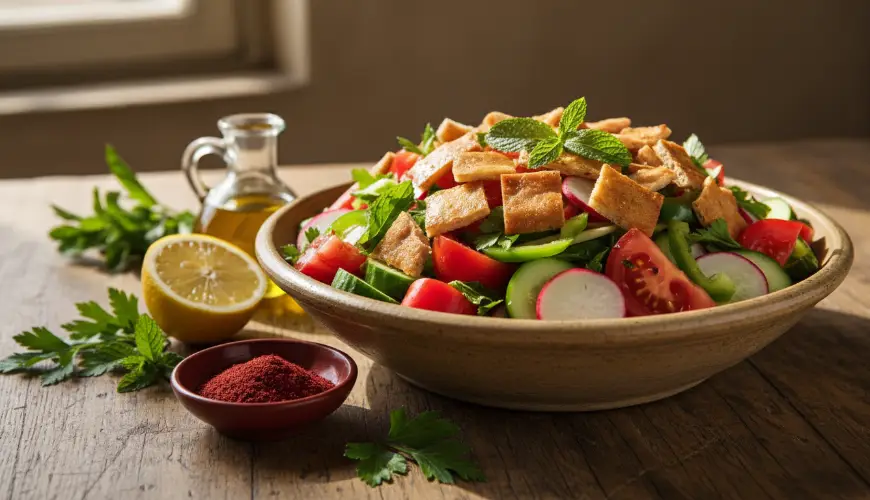
Some dishes look unassuming at first glance, but captivate you completely after the first bite. Fattoush is exactly that kind of dish. This Lebanese salad with crispy pita is one of the most beloved dishes in Levantine cuisine, and its appeal lies in a surprising simplicity that conceals an extraordinary depth of flavor. It is more than a salad—it is a philosophy of cooking that says you can create something truly exceptional from whatever you have on hand.
Imagine a typical Lebanese evening. Dozens of small bowls filled with different dishes—known as meze—cover the table, and at their center sits a radiant bowl of colorful vegetables, golden pieces of toasted pita, and herbs fragrant with fresh summer aromas. Fattoush is more than a side dish. It is the heart of the table, around which the whole family gathers. This tradition stretches back centuries and has survived to the present day in almost unchanged form, a testament in itself to how well conceived the recipe was.
Try our natural products

What exactly is fattoush, and where does it come from?
The word “fattoush” comes from the Arabic word fatt, meaning to crumble or break bread into pieces. And that is the key to understanding the dish. Fattoush began as a dish born of necessity—Lebanese farmers and rural families added leftover stale, dried-out bread or pita to salad so that nothing went to waste. What began as a purely practical solution gradually became an iconic dish throughout the region.
Levantine cuisine is generally considered one of the oldest and most sophisticated culinary traditions in the world. Lebanon, Syria, Jordan, and Palestine share a long history of agriculture, trade, and cultural exchange that has left a distinct mark on their cuisines. As the Oxford Companion to Food notes, Levantine cuisine is characterized by an emphasis on fresh herbs, tart flavors, and a combination of textures—and fattoush embodies all three perfectly.
Interestingly, fattoush varies from village to village and family to family. There is no single “correct” recipe. Some versions contain cucumbers; others do not. Some cooks add radishes or green onions, while others prefer tomatoes and peppers. This flexibility is one of the dish’s greatest strengths—it adapts to whatever is available at the market or in the garden.
Yet there is one ingredient that defines fattoush, without which it would no longer be what it is: toasted or fried pieces of Arabic bread or pita. These give the salad its characteristic crunch and texture, setting it apart from any other salad in the world. It is the contrast between juicy, fresh vegetables and golden, crispy pieces of bread that keeps people coming back for more.
Sumac: fattoush’s secret weapon
If fattoush had one single ingredient that elevates it from a good dish to an unforgettable experience, it would be sumac. This dark red spice, made from the dried and ground berries of the Rhus coriaria shrub, is essential in Mediterranean and Middle Eastern cooking, even though it remains relatively unfamiliar in Europe.
Sumac has a distinctive, tart flavor with a slightly fruity undertone that is reminiscent of lemon, but more complex and deeper. It is used as a natural alternative to vinegar or lemon and also gives dishes a beautiful, rich red color. In fattoush, sumac plays a key role in the dressing—together with olive oil, lemon juice, and sometimes a little pomegranate molasses, it creates a dressing that is fresh, tangy, and full-bodied.
As cook and Middle Eastern food expert Anissa Helou writes in her book Feast: Food of the Islamic World, sumac is “a spice that can transform a simple dish into something extraordinary.” And that is exactly right. Adding sumac to fattoush dressing brings a distinctive layer of flavor that makes this salad unforgettable.
Today, sumac can be purchased at specialty Middle Eastern food stores or well-stocked delicatessens. It is becoming more readily available in the Czech Republic every year, and if you have not tried it yet, fattoush is the perfect opportunity. You only need a little—but the difference is enormous.
Fattoush dressing is made from a few basic ingredients: good-quality extra virgin olive oil, fresh lemon juice, sumac, salt, pepper, and optionally a clove of garlic. Some cooks add a little pomegranate syrup for a sweet-and-sour note, while others prefer a cleaner, fresher version. The important thing is for the dressing to be sufficiently bold—the vegetables and pita absorb some of it, so if the dressing is too mild, the salad will be bland.
How to prepare fattoush properly
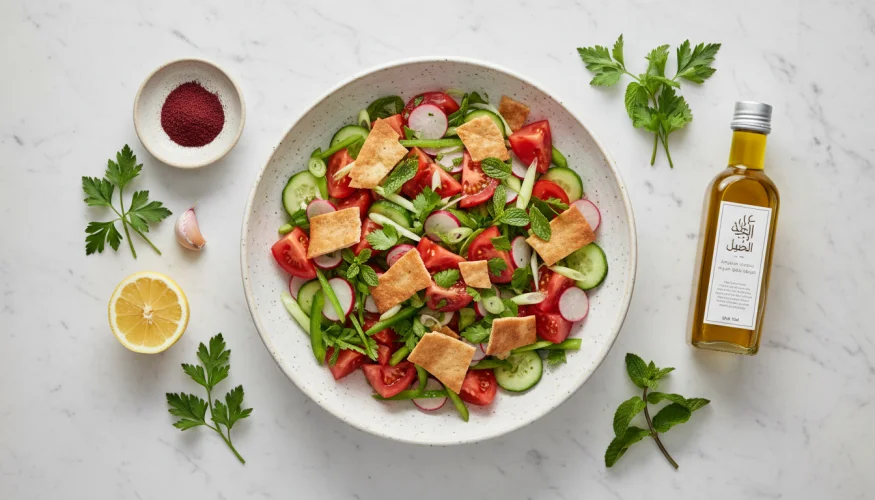
Preparing fattoush is a pleasure because it requires no complicated techniques or special equipment. The foundation is good-quality fresh vegetables—tomatoes, cucumbers, radishes, green bell pepper, and green onions are the most common choices. The vegetables are cut into larger pieces rather than finely diced as in other salads. This coarser cut contributes to the dish’s rustic character and ensures that every bite is full of flavor.
Herbs are an essential part of the dish—and in quantities that would surprise cooks in many European cuisines. Fresh mint and parsley are added generously, as whole leaves or roughly torn, rather than finely chopped. The herbs give fattoush its characteristic freshness and aroma.
A key step is preparing the pita. Arabic bread or pita is either cut into pieces and toasted in a dry pan, brushed with olive oil and toasted in the oven, or fried in oil until golden. Each method produces a slightly different result—the oven yields lighter, crispier pieces, while frying gives them a richer, more intense flavor. It comes down to personal preference. The important thing is that the pita pieces are genuinely crispy—if they remain soft, fattoush loses its characteristic contrast of textures.
This brings us to one of the most important aspects of preparing fattoush: the pita is added to the salad just before serving. If mixed in too early, the dressing would soften it, turning the crispy pieces into soggy leftovers. Fattoush is meant to be eaten immediately—and this fleeting quality is part of its charm.
An experienced Lebanese cook would offer you one more trick: lightly salt the vegetables before mixing in the dressing and leave them to rest for five minutes. The salt draws a little juice from the tomatoes and cucumbers, which then mixes with the dressing to create a natural, more intensely flavored sauce. This simple step takes the flavor of fattoush to the next level.
There are countless fattoush recipes. A good starting point is BBC Good Food, where you can find a tried-and-tested version with detailed instructions suitable even for beginners.
Fattoush as part of a healthy and sustainable diet
At a time when more and more people are interested in healthy eating and sustainable living, fattoush naturally takes a prominent place. It is a dish full of vegetables, herbs, and healthy fats from olive oil, with no industrially processed ingredients. The Mediterranean diet, of which Levantine cuisine is an integral part, has long been considered one of the healthiest in the world.
Research published in the prestigious The New England Journal of Medicine has repeatedly confirmed that a Mediterranean diet rich in olive oil, vegetables, legumes, and herbs significantly reduces the risk of cardiovascular disease and supports overall health. Fattoush embodies these principles in every forkful.
Fattoush also perfectly illustrates the philosophy of zero food waste. As mentioned, it was originally created as a way to use up stale bread. Today, as sustainable cooking becomes an increasingly important topic, this approach is more relevant than ever. Leftover pita, bread that is beginning to go stale, pieces of vegetables from the fridge—all can find new life in a bowl of fattoush.
Consider the story of Petra, a Czech student who spent a semester in Beirut. She recalls how, on her first evening, her host family welcomed her with a large table full of food, with an enormous bowl of fattoush at its center. At first, the salad seemed too simple to be the centerpiece of dinner. But after the first bite—that combination of juicy vegetables, tangy dressing, and crispy pita—she understood what it was all about. “It was like eating summer,” she says. Since then, she has regularly made fattoush at home in Prague, and the friends she invites over always come back for more.
There are thousands of stories like this. Fattoush has the rare ability to transport you somewhere else—to a laid table in the Lebanese mountains, a market in Beirut, or a garden fragrant with fresh herbs. It is food that brings people and cultures together, asking for nothing more than fresh ingredients, a little care, and a desire to savor every bite.
Fattoush is neither a passing fad nor a restaurant trend. It is a dish with a deep history, a clear identity, and a timeless flavor. At a time when we are looking for food that is good for us, the planet, and our taste buds, this unassuming Lebanese salad with crispy pita offers an answer that existed long before we even began asking the questions.