
A Child's Bodily Autonomy: Kissing Grandma Is Not Mandatory
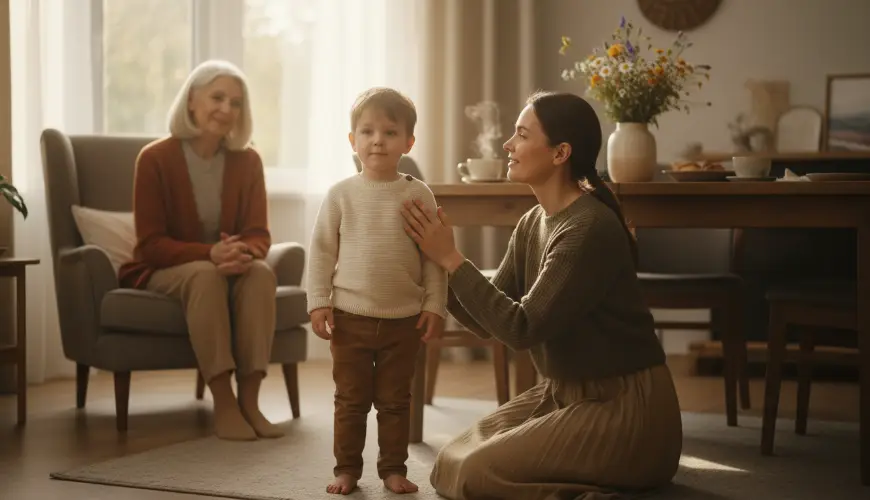
Anyone who has ever attended a family celebration knows the situation. Grandma leans in for a kiss, Grandpa waits for a hug, and a small child hides behind a parent’s leg or simply shakes their head. An awkward silence follows, along with a slightly offended look from the grandparent and swift pressure from the adults: “Come on, give Grandma a kiss. You know her!” This seemingly innocent situation, played out in millions of Czech families every weekend, actually conceals a much deeper issue – a child’s bodily autonomy.
The term bodily autonomy may sound a little technical, but its essence is simple. Every person, regardless of age, has the right to decide what happens to their body. Who can touch them, when, and how. We take this for granted with adults. With children, however, it remains a subject that often creates tension between modern parenting approaches and traditional family customs.
Try our natural products




Why respecting a child’s boundaries matters
Opponents of this approach often argue that it is oversensitive, or that children simply need to be taught manners. But research suggests otherwise. According to child psychology experts, including those associated with the American Psychological Association, children whose bodily boundaries are respected have greater self-confidence and a better understanding of consent in adulthood. So this is not just about a child’s immediate comfort – it is about laying a lasting foundation for healthy relationships.
A child who learns that they must give kisses and hugs even when they do not want to is learning something dangerous: that their feelings and objections do not matter when it comes to pleasing an adult. This lesson can carry over into other situations – at school, on the playground, and unfortunately even into adulthood. By contrast, a child who is given room to say “no” learns that their voice matters.
Parenting author Alfie Kohn put it aptly: “If we want to raise children who can say no in situations where it really matters, we have to teach them that no is a valid answer even in those seemingly small moments.”
But where did the pressure to force children into physical displays of affection come from in the first place? It is largely a cultural custom passed down for generations as a standard of politeness. Grandparents who feel hurt by rejection are usually not acting out of malice – they themselves were raised in a system where such behavior was expected without question. The problem, then, lies not in their intentions but in a learned pattern that now needs to be reconsidered.
Take a specific example: seven-year-old Anička arrives with her parents at her aunt’s birthday party. Her aunt, whom she sees twice a year, wants to hug and kiss her as soon as she walks through the door. Anička feels shy, instinctively steps back, and hides behind her mother. Embarrassed by her aunt’s reaction, her mother pressures Anička: “Come on, say hello to your aunt. Aren’t you ashamed?” In the end, Anička submits to the hug in tears. What did she learn in that moment? That her physical discomfort matters less than social convention. And her aunt? She got a hug, but she obtained it by force – which brought her no genuine closeness at all.
The situation could have unfolded very differently. Her mother could have said: “Anička is a little shy today, but I’m sure she’ll warm up in a while.” Then she could have let things unfold naturally. Anička might have approached her aunt on her own half an hour later because she felt she had a choice. Paradoxically, this could have created a more authentic connection than the forced one.
How to talk to grandparents and relatives
One of the biggest challenges is communicating with grandparents and other relatives who may see respect for a child’s bodily autonomy as a personal rejection or as poor parenting. “We didn’t make such a fuss about this in our day, and nobody came to any harm,” is a common response. And it is true that our parents’ and grandparents’ generations did not have these kinds of conversations. But that does not mean the approach was right – only that its effects were not widely discussed.
The key is to explain to relatives that it is not a rejection of them personally, but a matter of respecting the child. A child who is not forced into physical contact actually develops trust in adults more quickly – because they know no one will force them to do something they do not want to do. Grandparents who understand this often find that their relationship with their grandchildren is deeper and more natural.
In practice, parents might briefly tell relatives before a visit: “Little Tomáš is a bit shy about greetings at the moment. Please don’t take it personally; it’s a developmental phase.” This helps avoid awkward situations at the door and lets relatives know what to expect. Alternative forms of greeting can also be a great solution – a wave, a “high five,” or simply saying hello are all perfectly valid ways to connect without physical contact.
It is also important for the child to see that their parents are on their side. If a parent stands up for their child in front of relatives – calmly, without dramatics, but clearly – the child remembers. They know that adults believe them and that their feelings are taken seriously. This is the foundation of the secure attachment described by attachment theory, developed by John Bowlby and further expanded by Mary Ainsworth.
Sometimes, despite everyone’s best efforts, a grandparent may react with hurt or irritation. In such cases, it is better not to pursue the matter in front of the child and to save any deeper discussion for another time, when the child is not present. The aim is not to create family conflict, but to protect the child while maintaining healthy relationships.
It is worth noting that respecting bodily autonomy does not mean a child grows up without rules or without regard for others. Politeness and respect for others can be taught in many ways – by saying hello, smiling, or showing interest in others by asking, “How are you?” Physical contact is just one of many forms of communication, and certainly not the only one that builds relationships.
Parents who explore this subject often face the question of when and how to talk to their child about bodily autonomy. The answer is surprisingly simple: from the beginning and on an ongoing basis. Even a young toddler understands the words “no” and “stop” and recognizes that their response matters. Older children can be given more complex explanations – for example, that everyone has the right to make decisions about their own body and that this rule applies to them as well as to others.
The Czech organization Střep – Czech Center for Family Rehabilitation, along with many other child psychology experts in the Czech Republic, points out that preventing sexual abuse begins with these seemingly small everyday situations. A child who knows they can say “no” even to Grandma will be better equipped to handle situations in which an unfamiliar adult’s behavior makes them uncomfortable. This is not alarmism – it is prevention.
It is also important to take the child’s age and developmental stage into account. Infants and toddlers naturally depend on physical contact and care, so the rules work differently for them. But from around the age of two or three, when a child begins to express their own wishes and consciously reject or accept contact, it is appropriate to start respecting their signals. Developmental psychology describes this period as crucial for the formation of identity and autonomy – Erikson’s theory of psychosocial development, for example, emphasizes that it is in early childhood that a child develops a basic sense of autonomy versus shame and doubt.
In recent years, the subject of children’s bodily autonomy has become increasingly prominent in public awareness, not only in professional circles but also in everyday parenting discussions on social media and in parenting podcasts. That is good news. It means that society is slowly reconsidering old patterns and looking for approaches that better reflect what we know about child psychology and healthy development.
Of course, no approach to parenting is perfect, and every family will find its own way. But recognizing that a child has a right to their own body is a step that costs nothing – and can change a great deal. The next family celebration does not have to be a battle between politeness and respect. It can be an opportunity to show a child that their feelings matter, and to show relatives that healthy relationships are built on freely given, not forced, expressions of affection.