
Learn pandiculation and change your morning wake-up routine
Every morning, a small spectacle unfolds that most people overlook. A cat slowly wakes up, opens its eyes, and before taking a single step, its entire body goes through a long, slow, almost meditative stretch. Its back arches, its paws extend as far as possible, and its jaw opens in a silent yawn. The whole ritual lasts perhaps five seconds, but it looks like something absolutely essential. And you know what? That's exactly what it is. This movement even has its own scientific name – pandiculation – and modern neuroscience is beginning to reveal why it is far more important for the human body than we ever thought.
Most people get out of bed, drink their coffee, and launch into the day without devoting a single conscious moment to their body. Yet these first minutes after waking are absolutely crucial from the perspective of the movement system. The body has spent hours in relative stillness, muscles have "reset," the nervous system has shifted into rest mode, and the entire locomotor apparatus is waiting for a signal that it's time to function again. Pandiculation is precisely that signal.
Try our natural products





What pandiculation actually is and how it differs from ordinary stretching
The word pandiculation comes from the Latin pandiculari, meaning to stretch out, to open up. It is a natural, reflexive movement in which a muscle is first deliberately contracted and only then slowly released. This pattern – contraction followed by slow release – is fundamentally different from what most of us understand by the term stretching. Classic stretching works by passively elongating a muscle and holding it under tension. Pandiculation, by contrast, actively engages the nervous system: the brain consciously sends a signal to contract the muscle, monitors the body's response, and then guides its gradual release.
A pioneer in the field of pandiculation and somatics was the American philosopher and therapist Thomas Hanna, who described in his work how the nervous system gradually "forgets" how to properly release chronically tense muscles. He called this phenomenon sensory-motor amnesia – a state in which the brain loses the ability to consciously control certain muscle groups because they have been under tension for so long that the brain regards this as its normal baseline state. According to Hanna, pandiculation is one of the few ways to truly "rewrite" this amnesia and restore the natural connection between the brain and muscles.
This is where the key difference lies. When we try to stretch a chronically tense muscle by force alone – as we do with classic stretching – the brain may trigger a protective reflex and the muscle contracts even further. It is like pulling on a rope that someone is holding from the other side. Pandiculation bypasses this resistance because the movement begins with a deliberate contraction rather than passive elongation. The brain receives information that the movement is safe and intentional, and only then is it able to truly release the muscle.
Cats, dogs, birds, and newborns master this skill instinctively. A newborn who has just woken up stretches its entire body in one fluid movement – arms up, back arched, legs extended – and then relaxes. Nobody taught it to do this. It is an innate neurological programme that gradually fades during the course of growing up and a sedentary lifestyle, without us even noticing.
Interestingly, science also confirms what animals do instinctively. Research published in the journal Frontiers in Neuroscience shows that conscious movement sequences engaging proprioception – that is, the perception of one's own body position – have a demonstrable effect on the regulation of muscle tone and the overall state of the nervous system. Pandiculation is precisely such a movement.
What happens in the body when we stretch in the morning
After a night spent lying down, various processes take place in the body. Intervertebral discs re-hydrate and expand slightly during sleep, so people tend to be a few millimetres taller in the morning than in the evening. Muscles that have not been actively engaged throughout the night have reduced blood flow and lower temperature, which affects their elasticity. Fascia – the connective tissue enveloping muscles and organs – may lose some of its elasticity after prolonged immobility. And the nervous system, which has been virtually disconnected from motor functions during deep sleep, is only just waking up and calibrating.
Pandiculation at this moment serves as a kind of "reboot" of the entire system. The deliberate contraction and release of muscles sends intense proprioceptive signals to the brain, telling it: I am here, I am awake, I need to know where my body parts are and how tense they are. The brain responds to these signals by updating the so-called muscle map – the internal image of the body that it uses to plan and control movement. The more accurate this map is, the smoother, more coordinated, and less painful our movements become.
Consider a specific example: Jana, a forty-three-year-old teacher, had suffered for years from pain in her lumbar region. An orthopaedist found no structural damage, a physiotherapist taught her exercises that helped in the short term, but the pain always returned. Then she came across somatic exercise based on the principle of pandiculation. She began devoting five minutes each morning to conscious stretching – not by force, but slowly, with an emphasis on sensing what was happening in her body. After a few weeks, she noticed she was waking up without the usual stiffness. After three months, the pain had significantly subsided. Her story is not unique – similar experiences are described by people all over the world who have discovered pandiculation as part of their morning routine.
This of course does not mean that pandiculation will cure all back pain or replace medical care. But as a preventive and supportive tool for maintaining mobility and reducing chronic tension, it has extraordinary potential that is currently very little utilised in the general population.
Natural stretching also has an effect on the psyche. During pandiculation, the parasympathetic nervous system is activated – the branch of the autonomic nervous system responsible for calm, regeneration, and digestion. Slow, conscious movements with full exhalation lower cortisol levels and help the body transition from its nocturnal resting state into wakefulness without the stress response that is typical of abrupt morning rising and immediate rushing.
As Thomas Hanna said: "Movement is life. Without movement, life is merely stagnation." And pandiculation is perhaps the most natural movement the human body knows.

How to incorporate pandiculation into everyday life
The good news is that pandiculation requires no equipment, no special mat, and no hour of free time. All it takes is a few minutes and a willingness to listen to your own body. The basic principle is simple: slowly and consciously contract a group of muscles, hold the contraction for a moment, and then release even more slowly – while paying attention throughout to what you feel. The movement should never be painful or forced.
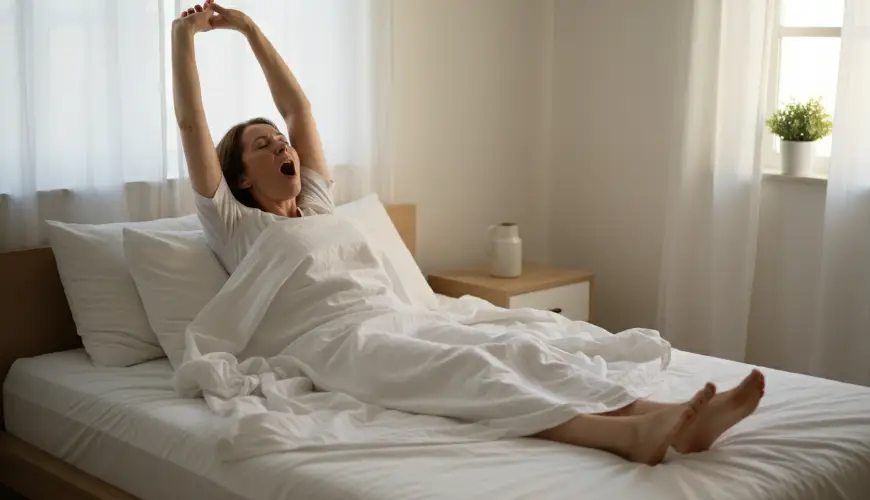
The most natural place to start is in the morning, while still in bed. Before you get up, take a moment. Stretch your arms above your head, arch your back, yawn – and let your body find the movement it needs on its own. You do not need to follow any prescribed pattern. The body itself knows where it needs to go, if you give it space and attention.
For those who want to go deeper, there are structured somatic exercises according to Thomas Hanna or his students, such as Hanna Somatics, where specific sequences for different parts of the body can be found. Likewise, many yoga traditions work with similar principles – conscious contraction before release is the basis of certain asanas and pranayama techniques.
Pandiculation can also be practised during the day, especially after prolonged sitting at a computer or after any static position. Stand up, slowly arch your back, deliberately contract the back muscles or glutes, and then release them – the whole thing takes thirty seconds and can significantly reduce the cumulative tension that builds up in the body during the working day.
- In the morning in bed: conscious full-body stretch before getting up, yawning, slow arching of the back
- After prolonged sitting: stand up, deliberately contract the back muscles or glutes, then slowly release
- Before sleep: a short sequence to release the tension accumulated throughout the day, focused on the areas where you feel the greatest stiffness
Interestingly, pandiculation naturally supports an overall approach to body care that is close to the philosophy of a sustainable healthy lifestyle – that is, care that requires no expensive equipment or complex protocols, but is rooted in naturalness and awareness. Much like choosing quality natural foods or eco-friendly household products, it is a decision to return to what is simple, natural, and functional.
The cat that stretches on the windowsill every morning is not thinking about neurology. It simply does what its instinct guides it to do. Humans have this instinct too – they just need to consciously rediscover it. And perhaps it takes so little: next time you wake up in the morning, don't reach for your phone straight away. Stretch. Yawn. Let your body do what it knows best. The results may surprise you.