
Prepare Rattan and Wooden Garden Furniture for Winter
Every year, the same scenario repeats itself. September arrives, the days grow shorter, temperatures drop, and the garden that was recently buzzing with summer activity begins to slowly fall asleep. Garden furniture stays outside – sometimes out of laziness, other times because owners simply don't know what to do with it. Then spring comes, bringing an unpleasant discovery: cracks in wooden slats, deformed rattan weaving, or rusty joints that have shortened the lifespan of a beloved set by several years. Proper preparation of garden furniture for winter is not a pointless ritual – it is an investment in its longevity.
Garden furniture today represents a significant financial investment. A quality wooden bench or rattan seating set can cost thousands of crowns, which is why it pays to give them a little attention at the end of the season. It is nothing complicated. All it takes is knowing the basic principles, understanding how different materials react to moisture, frost, and sunlight, and adjusting your approach accordingly.
Try our natural products


Why preparing furniture for winter is so important
Winter in Czech conditions is not kind to garden furniture. Alternating frosts and thaws, moisture, rain, snow, and ice – all of these affect materials in ways that are not immediately visible but gradually cause irreversible damage. Wood, for example, absorbs water that expands when frozen, causing microcracks. These gradually widen, the wood splits and loses its structural integrity. With rattan – whether natural or synthetic – the situation is similar. Natural rattan is particularly sensitive to moisture and frost, as it is an organic material that easily develops mould and can break or deform with repeated freezing.
Synthetic rattan, which is used in a large proportion of garden furniture today, is more durable, but it is not entirely immune to the long-term effects of extreme temperatures and UV radiation. Quality protection will therefore extend the lifespan of furniture regardless of the material it is made from. As the old gardening saying goes: "What you store well in autumn, you will welcome well in spring."
A practical example? A family from the South Moravian Region purchased a solid teak dining set for their terrace three years ago. The first winter, they left it outside without any protection, covered only with a cheap plastic tarpaulin. In spring, they found that the wood had darkened significantly, grey mould spots had appeared on the surface, and two table boards had begun to crack. The following year, they invested in quality teak oil, furniture protective covers, and moved part of the set into the garage. The result? After four years, the furniture still looks like new.
This story is not exceptional. It repeats itself in gardens across the country and shows that the difference between damaged and well-preserved furniture lies not in its price or quality, but in the owner's approach.
How to prepare wooden garden furniture
Wooden garden furniture requires care that differs depending on the type of wood used. Teak behaves differently from acacia, and differently again from pine or spruce. What they all have in common is this – before winter they need thorough cleaning, treatment, and ideally relocation to a sheltered space.
The first step is always thorough surface cleaning. The furniture should be freed from all dirt, leaf debris, moss, and any stains from food or drinks. A brush with medium-stiff bristles and a soapy solution will do the job. For more durable woods such as teak or acacia, a pressure washer can also be used, but with caution – too strong a jet of water can damage the wood surface or open its pores more than is desirable. After washing, it is essential to let the furniture dry thoroughly for at least 48 hours – damp wood must not come into contact with protective products, as these would not be absorbed correctly.
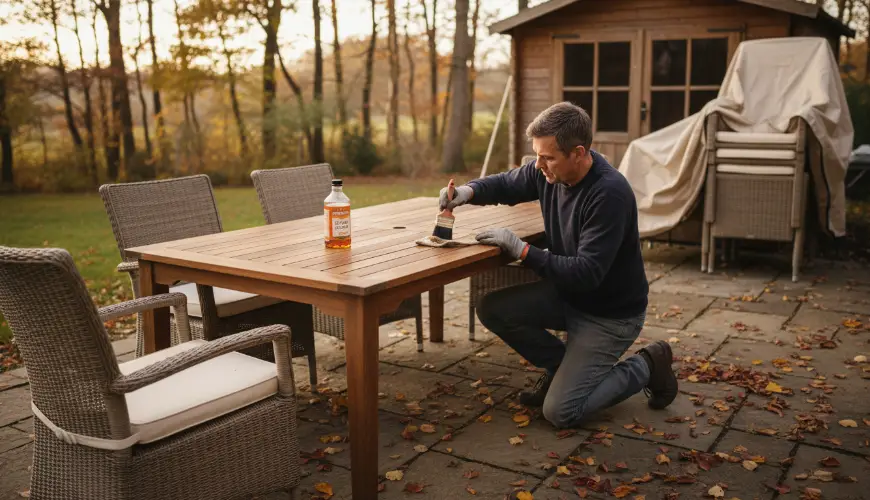
Once the wood is dry, it is time for treatment. For exotic woods such as teak or bangkirai, special oils are ideal, as they penetrate deep into the wood structure and protect it from within. These oils prevent drying out, cracking, and greying. For softwoods such as pine or spruce, impregnating agents or wood stains are recommended, which form a protective film on the surface. It is important to choose products intended for outdoor use with UV filters and fungicidal additives that prevent mould growth.
If wooden garden furniture has metal components – screws, hinges, or legs – it is advisable to check their condition and if necessary treat them with an anti-corrosion product. Metal parts are often the first place where problems begin, because metal and wood react to changes in temperature and moisture differently, which causes joints to loosen.
As for storage, the ideal solution is to move wooden furniture into a garage, shed, or other covered space. If this is not possible, it must be covered with quality protective tarpaulins or special furniture covers. These should be made from breathable material – impermeable plastic tarpaulins trap moisture and cause exactly the problems we are trying to prevent. Breathable covers allow air circulation while protecting against rain and snow.
One more thing that is often overlooked: furniture should not stand directly on the ground or paving. If it remains outside, it is advisable to place it on wooden blocks or feet to prevent direct contact with the ground, where moisture accumulates.
Caring for rattan garden furniture before winter
Rattan furniture – whether made from natural or synthetic rattan – has its own specific characteristics that must be taken into account when preparing for winter. Natural rattan is a material that under no circumstances tolerates moisture or frost, and should therefore always be moved indoors. It is an organic fibre that develops mould in damp conditions, deforms, and cracks in frost. If you own garden furniture made from natural rattan, winter storage in a dry place is an absolute necessity.
Before storage, the furniture must be cleaned. Natural rattan is cleaned with a soft brush or a cloth dampened with a mild soapy solution. It is important to avoid excessive soaking – rattan should be wiped rather than washed. After cleaning, leave it to dry thoroughly in the air and only then move it indoors. As a preventive measure against drying out and cracking, the surface of natural rattan can be treated with linseed oil or a special rattan care product.
Synthetic rattan, made from polyethylene or similar plastics, is considerably better off. It is resistant to moisture, UV radiation, and mould, and can therefore under certain conditions survive winter outdoors. Nevertheless, at least basic protection in the form of quality covers is recommended. Synthetic rattan can become brittle and crack at extremely low temperatures, especially if it is older or of lower quality. Furthermore, the metal frames on which the rattan is woven are susceptible to corrosion if not protected.
Cleaning synthetic rattan before winter is straightforward – simply rinse it with a pressure hose or a sponge with soapy solution, let it dry, and cover it with breathable covers. If possible, bring at least the cushions and textile parts inside. These are the most susceptible to moisture and mould, and replacing them tends to be more expensive than one might expect.
Useful information on proper care for different types of garden furniture is offered by, for example, the Czech Gardening Academy or specialist portals dedicated to garden design and exterior care.
A practical overview of what not to forget when preparing furniture might look like this:
- Thoroughly clean all furniture before storage or covering
- Let it dry completely – never store damp furniture
- Treat wood with oil, wood stain, or impregnation according to the type of wood
- Check and treat metal parts against corrosion
- Use breathable protective covers, not impermeable plastic tarpaulins
- Move natural rattan and textile accessories indoors
- Raise the furniture so it does not stand directly on damp ground
Properly preparing garden furniture for winter does not take a whole day. It is usually a matter of one afternoon, which pays back many times over in the form of well-preserved and functional furniture for the next season. Quality garden furniture, with good care, can last for decades – and autumn preparation is one of the key moments that determine whether this investment truly pays off.
It is also worth considering whether it is time to renew the surface finish or carry out minor repairs. Autumn is an ideal opportunity to check the condition of the furniture, replace damaged screws, sand rough edges, or replace missing sections of rattan weaving. Repairs carried out in autumn mean that in spring the furniture is immediately ready to use – without unnecessary delay or stress.
The garden is a place of rest, gathering, and joy. And that is precisely why it deserves to have the furniture that completes it in the best possible condition. A little care at the end of the season is the least that can be done for it – and the result will show itself with the very first rays of spring sunshine, when you can sit outside with a coffee and the knowledge that your garden has been properly looked after.