

Safe lifting of children and bags protects your back
Back pain is among the most common health problems of the modern era. According to the World Health Organization, up to 80% of people suffer from back pain at least once during their lifetime, with a large proportion of these problems arising not from athletic performance or heavy physical labor, but from completely ordinary everyday activities. Lifting shopping bags, hauling a pram up from the basement, or repeatedly picking a small child up off the floor – these are situations most of us deal with dozens of times a day without thinking about what is happening to our spine in the process. And it is precisely this unawareness that is the greatest enemy of a healthy back.
People most commonly damage their backs not through a single instance of overexertion, but through long-term poor movement habits. The spine is an extraordinary structure capable of bearing enormous loads, but only when it is loaded correctly and evenly. Once we repeatedly bend in ways that overburden the intervertebral discs or joint capsules, gradual wear and tear sets in, which can manifest as a dull ache, a herniated disc, or even chronic problems that diminish quality of life for many years.
Try our natural products





Why parents of young children are particularly at risk
Parents of infants and toddlers form one of the most at-risk groups when it comes to overloading the lumbar spine. A small child weighs on average between 6 and 12 kilograms, but that in itself is not the problem. The problem is frequency – experts estimate that a caregiver of a young child lifts them fifty or more times during the course of a day. Each of these lifts is a small load that accumulates. If a poor technique is added on top of that – rounded back, straight legs, trunk bent forward – then the pressure on the intervertebral discs in the lumbar region multiplies several times over the physiological value.
Consider a real-life example: a young mother named Petra, who after returning from maternity leave began experiencing chronic lower back pain. She had never engaged in any extreme sport and had no history of injury. Yet the pain restricted her to the point where she could not sit for more than half an hour. The physiotherapist who examined her immediately identified the cause – overloaded lumbar musculature and an early-stage herniation of the L4/L5 disc. The cause was not any dramatic event, but months of repeatedly lifting her child with a rounded back, carrying a full changing bag over one shoulder, and standing hunched over a low changing table. Petra is just one of thousands who have gone through the exact same experience.
Physiotherapists and orthopedic specialists agree that the most important preventive measure is mindful movement. This does not mean thinking about every step, but learning correct movement patterns so that they become automatic. It is a principle similar to learning to ride a bicycle – at first, every movement requires conscious thought, but gradually the correct habits become a natural part of one's movement repertoire.
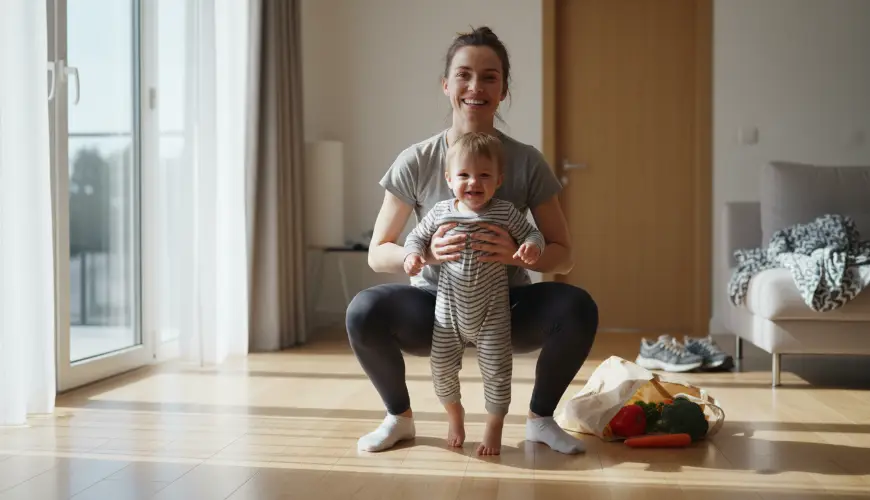
The fundamental rule when lifting anything heavy – whether a child, a shopping bag, or a box – is to bend the knees, not the back. It sounds simple, but in practice it requires conscious effort, because the natural reflex for most people is to bend forward at the hips. The correct approach involves getting as close as possible to the object or person being lifted, lowering one's center of gravity by performing a squat or partial squat, and only then lifting with a straight back and an engaged core. Experts in movement biomechanics, such as those at the American Council on Exercise, emphasize that activating the deep spinal stabilization system – the muscles that hold the spine in a neutral position – is the key step that most people skip entirely when lifting.
What does this mean in practice? Just before lifting, it is advisable to gently exhale and draw in the abdominal muscles, as if bracing for a blow to the stomach. This simple action activates the deep trunk muscles and creates a natural "muscular corset" that protects the spine. There is no requirement for this to be visible or performed in any dramatic way – it is a subtle but effective activation.
Correct lifting step by step and back care in everyday life
When lifting a child, it is also important to pay attention to where the child is lying or sitting at that moment. Lifting from a deep cot or from the floor with straight legs is among the riskiest movements of all. Where possible, it is advisable to first draw the child closer to the edge of the cot or sit them up, and only then lift them. For changing tables, there is a firm recommendation: the height of the table should be adjusted so that the caregiver can work with a straight back – approximately at elbow height. A changing table set too low forces the person to hunch over for the entire duration of the nappy change, which is extremely detrimental to the lumbar spine.
Shopping bags and the everyday carrying of heavy items is another chapter entirely. Modern society has conditioned us to carry bags over one shoulder or in one hand, which causes asymmetric loading of the spine. Distributing the load evenly is one of the simplest and most effective measures available. Where possible, it is always better to split the shopping into two equally heavy bags, one in each hand, rather than carrying everything in one. An even better option is to use a backpack or ergonomic shopping bag worn on the back, which loads the entire spine evenly and leaves the hands free.
As physiotherapist and proponent of healthy movement Pavel Kolář notes in his publications on dynamic neuromuscular stabilization, the spine is not a static structure – it is designed for movement, not for remaining in one position for extended periods. This applies to carrying bags as well: regularly switching the hand in which the bag is carried, or taking short breaks during longer walks, can significantly reduce one-sided overloading.
Strengthening the core – the area encompassing the abdominal, back, and gluteal muscles – also plays a crucial role. A strong core acts as a natural corset that keeps the spine in the correct position even under sudden loads. Nor is it necessary to spend hours in the gym – regular exercises such as the plank, glute bridge, or birddog, which can be performed at home without any equipment, are sufficient. The Czech Society for Orthopaedics and Traumatology and numerous physiotherapists recommend dedicating at least 15 minutes a day to these exercises, with results becoming apparent after just a few weeks of regular training.
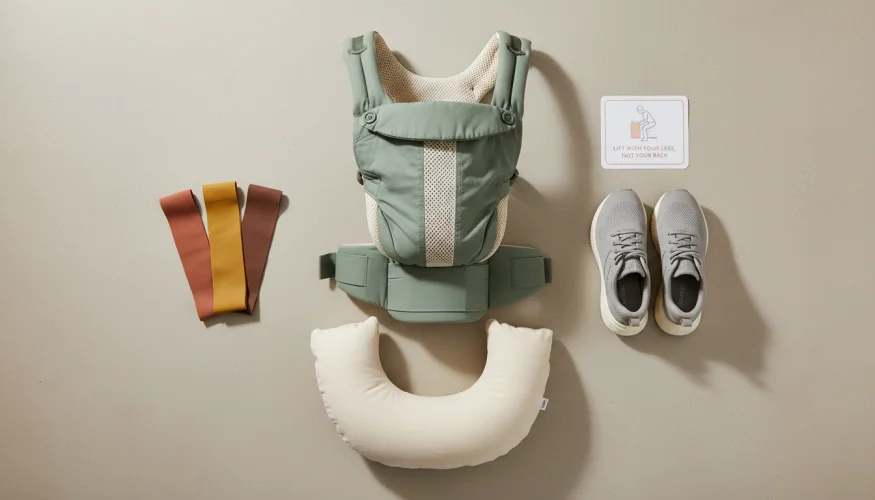
Footwear choice is also not to be overlooked. High heels or, conversely, completely flat shoes with no cushioning alter the biomechanics of the entire musculoskeletal system and transmit increased impact forces to the spine. When carrying a child or heavy bags, it is advisable to choose footwear with a moderate heel and a good cushioning layer that absorbs some of the impact with each step. The same applies to ergonomic insoles, which can significantly improve pressure distribution across the soles of the feet and thereby indirectly protect the entire spine.
An important but often overlooked aspect is correct posture and body position during breastfeeding or feeding a child. Young mothers spend an enormous amount of time in the first months after birth sitting with the baby in their arms, typically adopting a position with the head bent forward and the back rounded. This position overloads the cervical and thoracic spine and can cause so-called "text neck" – a syndrome of neck overload that has been spreading in recent years beyond the context of mobile phone use. The solution is conscious postural adjustment: resting the back against a firm support, using a nursing pillow that raises the baby to the correct height, and regularly stretching the neck and shoulders.
When it comes to ergonomic aids, the market today offers a wide range of products designed to minimize spinal load during everyday activities. Ergonomic baby carriers – whether in the form of slings or structured carriers – are designed to transfer the weight of the child to the parent's hips, thereby relieving the lumbar spine. The key is correct carrier adjustment: the child should sit in the "M" position with knees higher than the bottom, and the carrier should be tightened sufficiently so that the child sits high and close to the parent's body. A child hanging loosely in a carrier actually places more strain on the parent's back than carrying the child in one's arms.
For carrying shopping and everyday items, ergonomic bags and backpacks with anatomically shaped straps, lumbar padding, and adjustable strap length are growing in popularity. These products are not merely a fashion trend – their design is grounded in biomechanical principles and genuinely helps reduce one-sided spinal loading. When choosing a bag, it is worth looking for models with a chest strap and a hip belt, which secure the backpack to the body and prevent it from swaying during walking.
Back pain need not be an inevitable companion of parenthood or a busy everyday life. It is enough to pay attention to small details – how we bend, how we carry, how we sit, how we sleep. As the saying goes: "Prevention is better than cure." In the case of the back, this is doubly true, because treating chronic spinal problems is lengthy, costly, and never entirely certain. Correct movement habits, on the other hand, once learned and made automatic, serve a person for life and require no special equipment or extra time. The back is the foundation of movement – and movement is the foundation of a good quality of life.