
Batch cooking, or a week's worth of meals in 3 hours
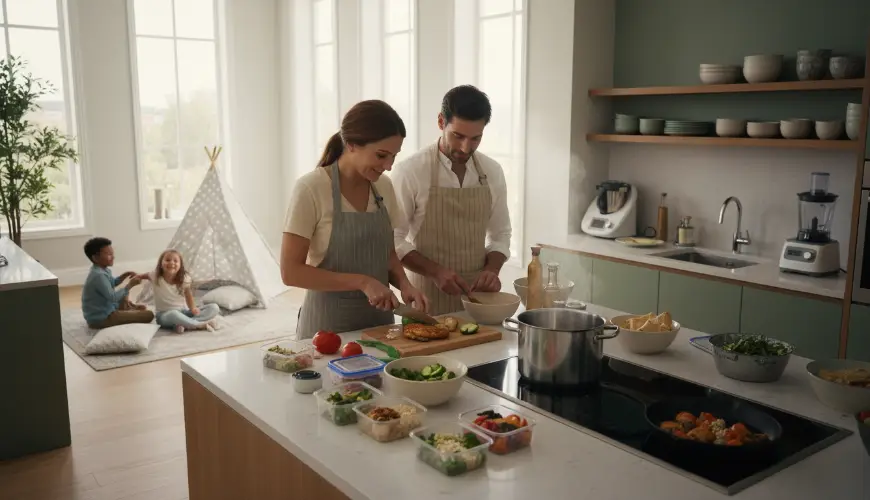
Imagine a Sunday afternoon. The kids are playing in the living room, the aroma of roasted vegetable medleys wafts from the kitchen, and four containers of ready-made lunch for Monday through Thursday are cooling on the counter. Friday? There's still soup in the freezer from last week for that. It sounds like a scenario from a lifestyle magazine, but in reality, it's the regular Sunday routine of thousands of families who have discovered batch cooking – that is, cooking in bulk ahead of time. For working parents who every evening balance overtime, kids' activities, and the desire to give their family something better than a reheated frozen pizza, this approach can be a real lifesaver.
The concept itself is nothing new. Our grandmothers routinely cooked large pots of goulash and soups that lasted several days. What has changed, however, is the way Sunday cooking can be planned so that in just three hours, a varied menu for the entire work week is created. And that's exactly what this whole approach is about – it's not about spending half of Sunday slaving over the stove, but about cooking smartly, efficiently, and with minimal unnecessary stress.
Try our natural products





Why batch cooking works especially for families with children
There are several reasons why batch cooking is gaining popularity particularly among working parents – and it's not just about saving time. Of course, time is the most precious commodity for most families, but batch cooking also addresses other pain points of everyday life. First and foremost, there's the question of money. When a person cooks without a plan, they shop impulsively, buy convenience foods, and often throw away groceries they don't manage to use in time. According to data from WRAP, an organization focused on food waste, the average household throws away food worth the equivalent of tens of thousands of Czech crowns each year. Planned cooking for the entire week dramatically reduces this number, because you buy exactly what you need and use up practically everything.
Then there's the question of health. When a person comes home from work at six in the evening, exhausted, and hungry kids demand food "right now," it's incredibly easy to reach for the quickest solution – and that typically means things with a long list of ingredients on the packaging. Batch cooking eliminates this pressure, because the food is already done or nearly done; you just need to reheat it or simply add a fresh side dish. The family thus eats more variety, more balanced meals, and without the guilt of "we had just hot dogs again."
And finally, there's the psychological aspect, which is often overlooked. The daily decision of "what are we going to cook today?" is a source of so-called decision fatigue. Psychologists describe this phenomenon as the gradual depletion of mental capacity through repeated decision-making throughout the day. When the daily dinner dilemma is eliminated, a surprising amount of mental energy is freed up for more important things – like actually sitting down with the kids after dinner and having a chat.
Let's take a concrete example. Markéta and Tomáš, parents of two school-age children from Brno, described their experience in one of the Czech parenting online groups. Before implementing batch cooking, they spent roughly an hour every evening thinking about and cooking dinner, often accompanied by arguments about whose "turn" it was. After switching to Sunday batch cooking, their weekly time spent in the kitchen dropped from approximately seven hours to just under four – three hours on Sunday and minor adjustments during the week. "The biggest change wasn't about time, though," Markéta wrote, "but the fact that we stopped being irritable every evening around six."
How to prepare food for the entire week in three hours on Sunday
Now for the practical side of things, because even the best theory is useless without a concrete guide. The key to successful batch cooking isn't just the cooking itself, but the preparation that precedes it. The entire process can be divided into three phases: planning, shopping, and the actual cooking. And it's precisely the first two phases that determine whether those three hours on Sunday will be enough or whether they'll turn into an all-day marathon.
Planning ideally takes place on Thursday or Friday, when you already know what the upcoming week looks like – whether there are any activities, visits, or late returns from work. The point isn't to plan five completely different gourmet menus. On the contrary, the foundation of batch cooking is the principle of shared ingredients. This means cooking several basic components that are then combined into different meals throughout the week. For example, a large batch of roasted vegetables serves as a side dish with chicken on Monday, becomes the base for a tortilla wrap on Tuesday, and gets added to a pasta salad on Wednesday.
Shopping should take place on Saturday or Sunday morning, ideally following a pre-made list divided into categories – vegetables, proteins, carbohydrates, extras. Experienced batch cookers recommend buying a maximum of three types of meat or other protein sources and four to five types of vegetables. Less is more – with a limited number of ingredients, you can paradoxically create greater variety if you work with different seasonings and preparation methods.
And then comes that Sunday three-hour session. How to structure it? A proven approach, also recommended by authors of popular cookbooks focused on meal prep, such as The Meal Prep King Plan by John Clark, looks roughly like this:
- First half hour – preparing all ingredients: washing, chopping, marinating. Everything is prepared at once to minimize the number of transitions between tasks.
- Next 90 minutes – the actual cooking, utilizing all available "stations" simultaneously. Vegetables and meat roast in the oven, grains (rice, bulgur, pasta) cook on one burner, a sauce or soup is prepared on another. A slow cooker or a multi-function cooker like an Instant Pot can meanwhile be preparing legumes or braised meat.
- Last hour – cooling, portioning into containers, labeling with date and contents, cleaning up the kitchen.
An important detail that beginners often overlook: not everything has to be a completely finished meal. Batch cooking also includes so-called homemade semi-prepared items – pre-cooked rice, a baked chicken thigh, washed and chopped salad, homemade dressing in a mason jar. These components are then assembled during the week in five to ten minutes, which is a time comparable to reheating a ready-made meal from the freezer, but with an incomparably better result.
As for storage, the general rule is that meals for Monday through Wednesday can go in the fridge, while portions for Thursday and Friday are better off frozen and moved to the fridge the day before for gradual thawing. Quality airtight containers are essential in this regard – investing in glass containers pays off many times over, not only in terms of durability but also because food can be reheated directly in the microwave without concerns about harmful substances leaching from plastic.
As British nutritional therapist Amelia Freer said in her book Nourish & Glow: "The healthiest meal is the one you actually prepare and eat – not the one you plan in your head but never cook." And that's precisely where the power of batch cooking lies. It doesn't demand perfection; it doesn't demand culinary artistry. It just demands a system.
One of the most common concerns parents express is monotony. "Won't we be eating the same thing all the time?" The answer is: no, if you work with the principle of variations. One and the same chicken breast, baked with rosemary, can end up sliced in a salad with avocado on Monday, in a whole-grain tortilla with hummus and vegetables on Tuesday, and as part of a warm bowl with rice and soy sauce on Wednesday. The same ingredient, three completely different flavor experiences. This approach is, incidentally, the foundation of the so-called "modular meal prep" philosophy, which is discussed in more detail by, for example, Budget Bytes, one of the most respected international resources on cooking on a reasonable budget.
Another practical tip is involving the kids. It doesn't have to be anything groundbreaking – even a five-year-old can wash tomatoes, sort peppers by color, or fill containers with rice. Sunday cooking together can thus become a family ritual that gently shows children where food comes from and how much work goes into preparing it. At a time when numerous studies point to children's disconnection from the food preparation process as one of the factors behind unhealthy eating habits, this is a side benefit worth mentioning.
For those who think three hours on Sunday still sounds like a lot, it's important to remember the context. Three hours per week versus one hour per day – that's a difference of four hours per week, sixteen hours per month, nearly two hundred hours per year. Those are hours that can be spent with family, exercising, resting, or doing whatever brings joy. And that's precisely why batch cooking isn't just about food – it's about lifestyle and a conscious decision about how to spend your time.
Getting started doesn't have to be complicated, either. There's no need to prepare a complete five-day menu on the very first Sunday. It's enough to start with two or three meals, find out what works, what the family appreciates, and what, on the other hand, remains uneaten in the containers. Gradually building a system is more sustainable than a revolutionary overhaul that fizzles out after two weeks. Many parents start simply by cooking a big pot of soup on Sunday and pre-preparing one batch of a main dish – and even that is a huge step forward compared to the daily chaos.
Batch cooking for working parents isn't a trendy fad that will disappear in a year. It's a pragmatic solution to a real problem – how to ensure, in a hectic life, that the family eats well, healthily, and together, without requiring superhuman effort. All it takes is a bit of planning, a few quality containers, and three hours on Sunday that will transform the rest of the week.