
# Why It Does Us Good to Rearrange Furniture Every Once in a While
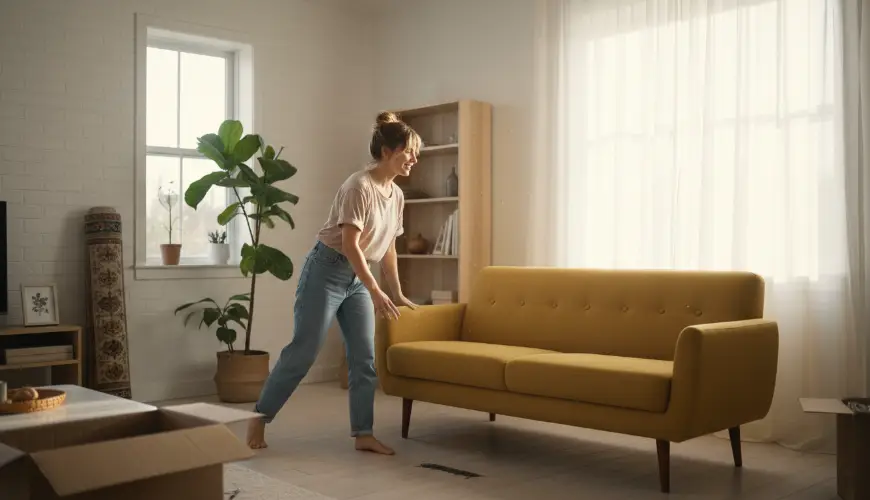
Have you ever woken up in the morning with a sudden urge to move your bed to the opposite wall, shift the sofa closer to the window, or completely reorganise your entire living room? You're not alone. This seemingly irrational impulse, which overtakes almost all of us from time to time, actually has deep psychological, physiological, and practical roots. Rearranging furniture is not merely a domestic whim – it is the way in which the brain and body respond to a need for change, control, and renewal.
Psychologists and interior designers agree that the environment in which we live has a fundamental impact on our mood, productivity, and overall wellbeing. And it's not just about aesthetics. The way furniture is arranged affects the flow of energy in a room, natural lighting conditions, and how we physically move through a given space. When a space begins to feel cramped, dull, or simply "somehow wrong", it is a signal that the time for change has come.
Try our natural products






The Brain Loves Novelty
The human brain is evolutionarily wired to seek out new stimuli. This phenomenon, which neuroscientists refer to as novelty-seeking behavior, is associated with the release of dopamine – the neurotransmitter of reward and motivation. When we find ourselves in an environment that does not change, the brain grows accustomed to it and stops actively perceiving it. It literally "switches it off" from conscious attention. This is why, after a while, we stop noticing the picture on the wall, the sofa in the corner, or the plant on the windowsill, even though they are still in their place.
Rearranging furniture immediately breaks through this automatic filter. Suddenly we begin to perceive our home differently – fresher, more attentively, with greater presence. It is a little like returning from holiday: the rooms we left feeling tired and overwhelmed welcome us back with unexpected warmth. Rearranging furniture can produce this effect without us having to go anywhere at all.
Interestingly, this mechanism works even when the result is not necessarily "better" than the original arrangement. The brain appreciates the very act of change, the process of thinking about the space, and the physical rearranging of things. British psychologist and author Adam Grant repeatedly emphasises in his research that the ability to actively change one's environment is one of the key manifestations of psychological flexibility – a quality that protects us from stagnation and depression.
Rearranging furniture is therefore not merely an aesthetic decision. It is a mental exercise that sets our thinking in motion, opens new perspectives, and reminds us that we have greater control over our lives than it sometimes appears. And the sense of control is one of the most powerful psychological tools against anxiety and helplessness.
It is no coincidence that many people rearrange furniture precisely during periods of transition – after a break-up, after returning from hospital, after losing a job, or conversely after a major positive life change. The physical reorganisation of space serves as a ritual that symbolically marks a new beginning. "I want my room to look different too, because I am a different person now," says, without words, the person who moves the wardrobe from the window to the door.
Research in environmental psychology – such as the work of Roger Ulrich and Colin Ellard – repeatedly demonstrates that the environment directly influences our emotional regulation. In his book Places of the Heart, Colin Ellard describes how the brain constantly "reads" the surrounding space and adjusts our moods, decision-making, and stress levels accordingly. If the environment does not suit us, both body and mind respond with increased tension – even when we are not consciously aware of the cause.
Physical Activity Hidden in a Domestic Ritual
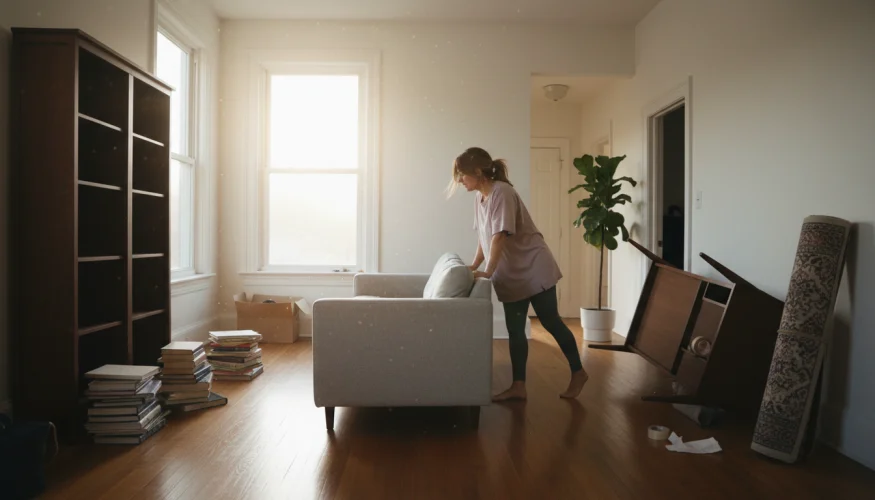
Rearranging furniture is also a physical matter, in the very best sense of the word. While moving a heavy wardrobe or sofa requires genuine physical effort, it is a type of movement that is functional, meaningful, and motivated by a clear goal. Unlike routine exercise, which many of us perceive as an obligation, moving furniture is connected to a concrete outcome – and this keeps us moving for longer and with greater commitment.
Take the example of Markéta, a thirty-year-old graphic designer from Brno, who during the pandemic was working from home and gradually began to feel that her flat was suffocating her. Every day she sat at her computer in the same spot, staring at the same walls and the same arrangement of things. One weekend she decided to rearrange the entire room – she moved her desk to the window, shifted the sofa to the centre of the room, and reorganised the bookcase. The result? Not only did she immediately like her flat more, but the whole process left her physically tired in the most pleasant way – she slept like a log that night and woke the next day with unexpected energy and enthusiasm for work.
Such an experience is not exceptional. The physical exertion involved in rearranging furniture stimulates the production of endorphins, lowers cortisol levels, and contributes to an overall sense of wellbeing. And yet it is a form of movement that requires no equipment, no gym membership, and no special clothing. All it takes is the courage to put your hands on the sofa and ask yourself: what if we tried it over there?
There is also an interesting aspect of spatial thinking that rearranging furniture activates. Before we begin the actual moving, we must visualise various arrangement options in our heads, estimate dimensions, think through passageways and functional zones. This type of thinking – mental rotation and spatial imagination – is associated with activation of the prefrontal cortex and is considered one of the best natural forms of brain training. Studies published in Psychological Science suggest that regular engagement of spatial thinking may slow cognitive decline associated with ageing.
Home as a Living Organism
There is yet another reason why rearranging furniture does us good, and it is perhaps the deepest of all. Home is not a static object – it is a living space that evolves alongside us. Our needs, habits, and priorities change, and the space in which we live should reflect these changes. A child's room naturally changes as the child grows. A work corner that functioned three years ago may no longer suit today's way of working. A dining table that always stood against the wall might now serve better in the middle of the room, where the family gathers more frequently.
Rearranging furniture is a way of keeping our home in harmony with who we are right now – not with who we were when we moved in. It is an act of self-care, expressed through space. And this is precisely why it tends to be so emotionally satisfying: it is not just about aesthetics, but about authenticity.
In the context of a sustainable lifestyle, rearranging furniture has yet another important dimension. Instead of succumbing to the impulse to buy new furniture, new decorations, or to completely redesign the interior, it suffices to work with what we already have. Moving the sofa, turning the rug, or changing the lighting can transform a room beyond recognition – without generating any waste, spending any money, or placing any burden on the environment. This form of creative recycling of one's own space is precisely the approach that resonates with the values of sustainable living.
Feng shui, the ancient Chinese art of spatial harmony, has been working with similar principles for millennia. Whether or not one believes in the energy flows of chi, the fundamental idea holds true: the arrangement of furniture affects how we feel in a space, how we move through it, and how we function within it. Modern research in environmental psychology confirms this intuition with empirical data. For example, a Harvard University study focused on the impact of the work environment on productivity showed that minor changes to the arrangement of a space can increase workers' performance and satisfaction by tens of percent.
Rearranging furniture is also an opportunity for cleaning and getting rid of things that no longer serve us. When we move a wardrobe, we encounter dusty corners, forgotten objects, and things we thought we had lost long ago. This "side effect" of rearranging tends to be surprisingly therapeutic. Getting rid of unnecessary things – whether by donating them, selling them, or disposing of them responsibly – contributes to a sense of lightness and clarity that is then reflected in one's mental wellbeing.
There is no need to wait for a major occasion, a move, or a renovation. Sometimes all it takes is one afternoon impulse, a little courage, and a willingness to accept that the result need not be perfect straight away. Rearranging furniture is a process, not a project with a fixed outcome. And it is precisely this openness, this playfulness towards one's own space, that is perhaps the most valuable thing it can bring us.