
Master your move without chaos and unnecessary stress
Moving ranks among the most stressful life events – and that's no exaggeration. Psychologists place it alongside divorce or job loss, and research repeatedly shows that it's an experience capable of exhausting a person both physically and emotionally. Yet there is a way to manage the entire process with a clear head and without being left with nothing but memories of crumpled boxes, lost keys, and needless arguments. The secret lies in preparation, attitude, and what you take with you – and what you leave behind.
Anyone who has ever moved knows that moment: you're standing in the middle of a flat surrounded by piles of things, you don't know where to begin, and the deadline is relentlessly approaching. That's exactly the situation Jana, a thirty-year-old graphic designer from Brno, found herself in when she moved an entire household from a four-room flat into a smaller but cosier space in a neighbouring district last year. "I thought I could manage it in a weekend," she says. "In the end, it took me three weeks to move, and for a month afterwards I couldn't find basic things." Jana's story is not the exception – it's the rule. And that's precisely why it's worth preparing properly for a move.
Try our natural products





Preparation is the foundation of everything
The key to managing a move without unnecessary chaos is to start earlier than seems necessary – ideally six to eight weeks before the planned move. That sounds like a lot, but time shrinks surprisingly quickly before a move. The first step that experienced movers recommend is a so-called household audit – a thorough walk through every room and every cupboard with a single question: do I really need this in my new life?
Sorting through belongings before a move is not merely a logistical necessity; it's an opportunity. An opportunity to rid yourself of years of accumulated items – things you hold onto out of habit or sentiment but which don't actually add any value to your life. The philosophy of minimalism and conscious consumption, which has been discussed more and more in recent years, takes on a very practical dimension here. What you don't need can be donated, sold, or – as a last resort – recycled. Charitable organisations such as Diakonie or local swaps and clothing exchanges are excellent places to pass things on with a good conscience.
Once you know what is being moved, it's time to plan the move itself. Whether you hire a removal company or manage with friends and a borrowed van depends on the volume of belongings, the distance, and the physical fitness of everyone involved. Both options have their advantages, but a professional removal company significantly reduces the risk of damaged items and strained backs. If you opt for a company, compare several quotes and don't forget to read reviews – references are very valuable in this industry.
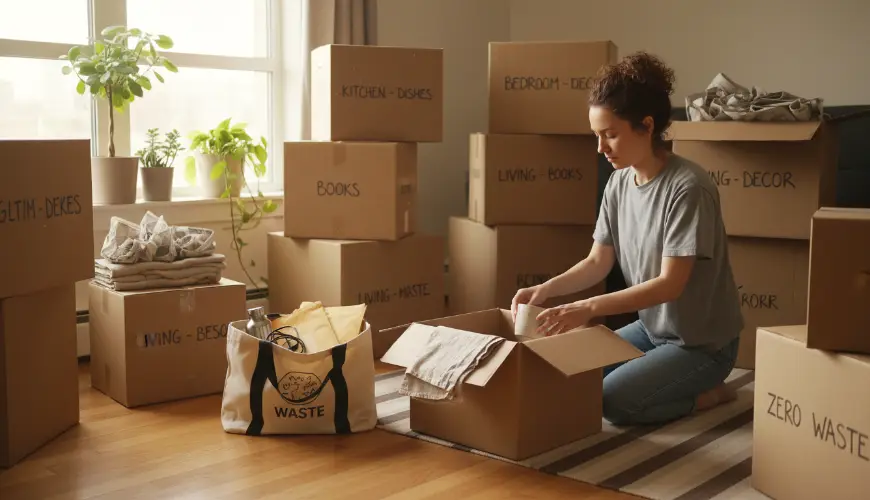
In parallel with this, it's a good idea to start gathering packing materials. And this is where the first great opportunity for an eco-friendly approach presents itself: instead of buying new cardboard boxes, try contacting local supermarkets, bookshops, or pharmacies – they have a steady supply of sturdy boxes that would otherwise end up in recycling. Instead of bubble wrap, towels, blankets, old newspapers, or fabrics that are moving with you anyway make excellent packing materials. Every box packed without new plastic is a small victory for the household and for the planet.
A box labelling system is another thing that seems unnecessary until you start using it. Simple colour coding by room, or a brief description of the contents written directly on the box, saves hours of searching after you arrive at your new place. There are apps such as Sortly that allow you to create a digital inventory of the contents of each box – it may sound excessive, but for a larger household it's an invaluable aid.
The administrative side of things must not be forgotten either. Changing your registered address, transferring contracts for electricity, gas, and internet, redirecting post, notifying your employer, bank, or insurance company – all of these tasks have their deadlines and are better handled gradually rather than in the final week before the move. Create a simple list of institutions that need to be informed and tick them off one by one. The Czech Social Security Administration, the tax office, your health insurance provider – each of these institutions has specific deadlines and procedures.
Moving day: how to survive the move itself
When moving day arrives, the biggest mistake is to underestimate its physical and time demands. A realistic time estimate is roughly double what seems reasonable. If you think you can manage in four hours, plan for eight. This buffer is not a sign of pessimism but of healthy realism that will protect you from unnecessary stress.
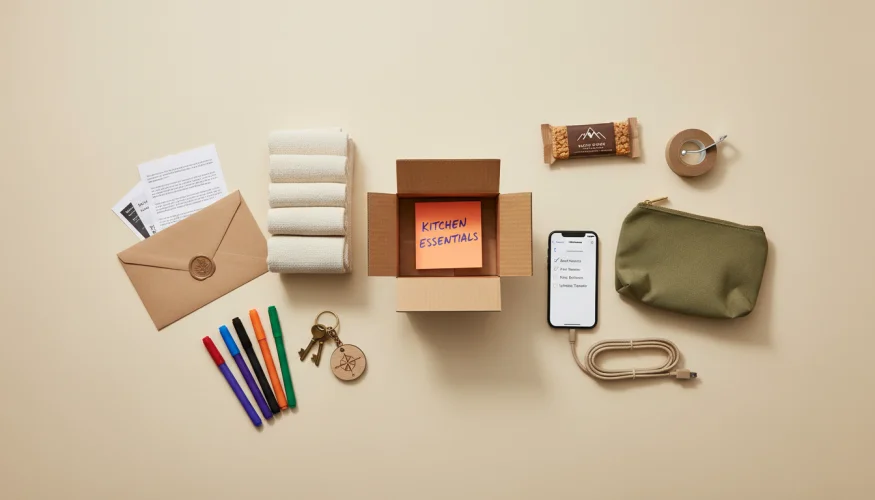
On the morning of moving day, it's good to start with a clear head and a full stomach – that sounds trivial, but in the rush of preparations breakfast is easily skipped, and then fatigue and irritability set in at precisely the moment when strength and patience are needed. Prepare a special "survival kit" – a bag or box that will travel in your personal vehicle and not in the removal lorry. It should contain things you'll need immediately upon arrival: chargers, essential medicines, toiletries, a change of clothes, important documents, a little food, and of course the keys to the new flat.
As the Danish proverb says: "Well begun is half done." In the context of moving, this is literally true – preparation during the final week and on the morning of the move itself determines how the whole day unfolds.
If you are moving with children or pets, it's a good idea to arrange alternative activities for them on moving day. Small children in an environment full of boxes, moving adults, and open doors are a source of stress for everyone – and for the children themselves, moving can be a disorienting experience. Grandparents, a friend, or a childminding service can be a genuine lifesaver on such a day. Cats and dogs enjoy moving just as little – a carrier or being looked after by friends is a far kinder option than a full day of chaos.
At the new place, it's wise to start unpacking with the most important things first: the bedroom and bathroom should be functional before anything else. The reason is simple – after an exhausting moving day, you need somewhere to rest and somewhere to wash. The kitchen, living room, and the rest of the home can wait until the next day or two. Settling in gradually is healthier than trying to sort everything out at once.
A mindful approach to the new space also pays dividends in the long term. Before you position furniture permanently and hammer in the first nail, take a moment to observe: how light moves through the rooms at different times of day, where the natural centre of each room is, what you feel is missing from the space and what you don't need. A new home is a chance to arrange things better than before – more thoughtfully, more sustainably, and better suited to your current needs.
Moving is also a natural moment for reflection on what home actually means. It's not about four walls or a specific address – it's about the atmosphere that develops within a space. And that is created by people, habits, objects with a story, and an approach to life. That's precisely why it makes sense to invest in things of genuine value for a new home: quality, sustainably produced textiles, natural fragrances and cleaning products free of unnecessary chemicals, or furniture from sustainable sources. Such an approach turns a new space into a place where you feel good – and that, after all, is the whole point of the endeavour.
Moving without chaos is neither a myth nor the preserve of organisational geniuses. It is the result of conscious planning, realistic expectations, and a willingness to approach the whole process with a degree of perspective. Yes, something will always go wrong – a box will tear, the lift will be occupied at exactly the moment you're carrying the sofa, or it will turn out that the new fridge fits into the kitchen with just one centimetre to spare. That's all part of moving, just like packing tape and markers. But if you have a plan, a system, and people around you who will help, you'll manage. And one morning you'll wake up in your new home, make yourself a coffee, and realise that it was all worth it.