
# How to Stop Hoarding Plastic Bags Once and For All
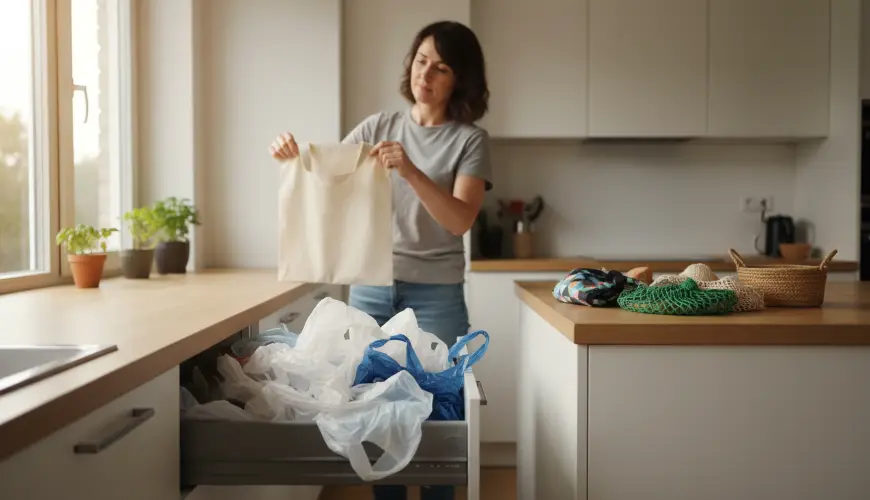
There is in every household one place that everyone knows about, but no one talks about out loud. A drawer, a cupboard under the sink, a bag hanging behind the kitchen door – a place where plastic bags live. Crumpled, stuffed into each other, overflowing over the edge. You shove them in there thinking you'll use them someday. And then another one arrives. And another. Until the whole system one day explodes – both literally and figuratively.
Hoarding plastic bags is not just an aesthetic problem or mere untidiness. It is a symptom of a deeper habit that most people are not even aware of. Every shopping trip brings a new bag, every bag ends up in that pile, and the pile grows faster than anyone can use them up. Yet a solution exists, it is accessible and requires no dramatic life change – just a slightly different way of thinking about everyday small things.
Try our natural products






Why we accumulate plastic bags so easily
Plastic bags are masters at being inconspicuous. They are light, compact and free – or almost free. After the introduction of charges for plastic bags in the Czech Republic, which was contributed to by the European directive on reducing the impact of plastic products on the environment, their consumption did decrease, but did not disappear. According to data from the European Commission, the goal was to reduce the consumption of lightweight plastic bags to 40 pieces per person per year by 2025 – which still represents a considerable amount of plastic.
The psychological mechanism of hoarding is simple: a bag arrives, you put it aside because "it might come in handy." This justification is perfectly rational – and that is precisely why it is so effective. The problem arises when "it might come in handy" is repeated a hundred times and actual use occurs only a few times a year. The rest of the bags just take up space and wait for an opportunity that never comes.
Interestingly, hoarding plastic bags is not the preserve of untidy people. On the contrary – people who otherwise maintain order tend to approach a bag as a potentially useful item that would be a shame to throw away. The result is a paradox: the more carefully a person stores bags, the more of them they have.
The situation is well known to families with children, for example, where plastic bags serve as improvised snack pouches, covers for wet swimwear or replacement liners for small rubbish bins. But even this level of consumption is not enough to empty the drawer. Supply always exceeds demand.
Concrete steps to stop the hoarding
The key is not dramatic action, but a change of system. It is not enough to throw the bags away once a year and start again – that is only a temporary solution. Real change lies in stopping new bags from entering the household, or at least significantly reducing their arrival.
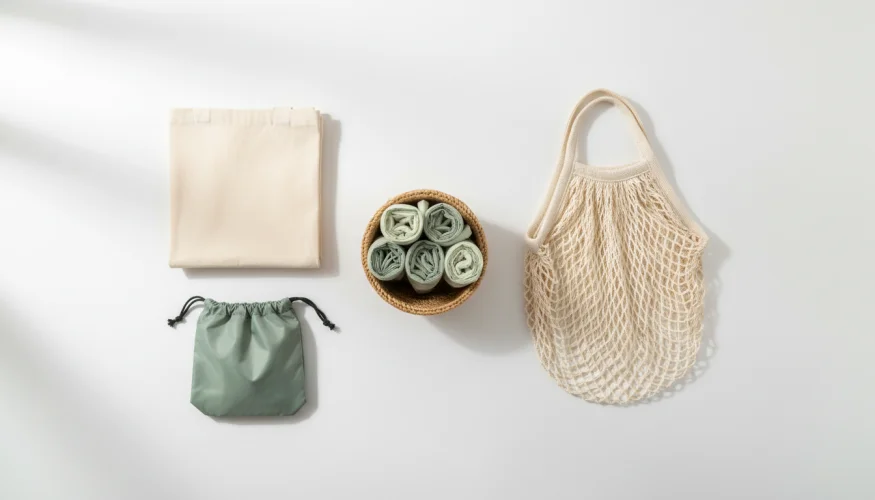
The first and most effective step is to always have your own bag to hand. It sounds banal, but it is precisely this apparent banality that makes the biggest difference. A fabric bag folded into a jacket pocket, a canvas pouch in a handbag or a foldable shopping bag in the car – these are small changes with a big impact. Many people acquire plenty of reusable bags but leave them at home while reaching for a plastic bag in the shop. The system must work so that the bag is where it is needed – not where it is convenient to store it.
The second step is conscious reduction of the existing supply. Before switching to a new system, it is worth going through the existing pile and realistically assessing how many bags you actually need. Practical use of plastic bags in the home makes sense – as bin liners for small bins, rubbish bags or packaging when moving house. But for these purposes, a fraction of what most households store is sufficient. The rest can be taken to a plastic bag collection point, which are usually located directly in supermarkets. This method of recycling is far more effective than throwing bags into general waste.
The third step is to reconsider what to replace plastic bags with at home. This is where the variety of alternatives available on the market today comes into play:
- Canvas bags are durable, washable and available in various sizes – suitable for shopping and as an everyday bag
- Net bags for fruit and vegetables replace plastic bags for loose goods and are washable and reusable
- Foldable bags made from recycled materials fit in a pocket and are always to hand
- Jute or rattan baskets add style to shopping and last for years
- Compostable bags for cases where a plastic bag truly cannot be replaced in any other way
The transition to these alternatives is not a matter of a single purchase, but of gradually building habits. As zero waste pioneer Anne-Marie Bonneau says: "We don't need a handful of people doing zero waste perfectly. We need millions of people doing it imperfectly." In other words – even a partial change makes sense.
Sustainable change that lasts
Changing habits is a science in itself. Research in behavioural psychology shows that new behaviour is best reinforced when it is linked to a specific trigger and reward. In the case of plastic bags, this can work as follows: the trigger is leaving home to go shopping, the new behaviour is taking your own bag, and the reward is the feeling of having done a small good – for yourself and for those around you. This mechanism is described, for example, in Charles Duhigg's book The Power of Habit, which explains how habit loops work and how they can be consciously reprogrammed.
Environment also plays an important role. If reusable bags are stored in a clearly visible place – for example, hung by the front door or folded directly in a handbag – the likelihood of their use is significantly higher than when they are hidden away in a storage room. This is the principle of so-called "choice architecture", meaning the design of an environment that makes it easier to make the right decisions without requiring willpower or conscious effort.
Sharing the habit within a family or household also plays a major role. If one member of the household stops hoarding bags but the others continue in the old way, the result will not materialise. Conversely, if the change becomes a shared project, it has a much greater chance of success. Families who introduce a simple system – for example, a basket by the door for bags ready for use and a clear rule about the maximum number of plastic bags to keep – report that the change came surprisingly easily.
Why is it so important to stick with it? Because plastic bags are among the most commonly found plastic waste in nature. According to a WWF report, they pollute oceans, rivers and soil, and their decomposition takes hundreds of years. Every bag saved is therefore a small but real contribution to less pollution of the planet. And it is precisely this awareness that can be the most powerful motivation to keep people committed to new habits even in moments when it would be more convenient to reach for an old plastic bag.
Practical change often happens at the moment when a person realises how many bags they actually use in a year. Try calculating it once: the average Czech person goes shopping several times a week, and if they take one plastic bag each time, we quickly arrive at hundreds of pieces per year. Yet one quality fabric bag can last up to a thousand uses – and despite higher initial environmental costs, its production has an incomparably better long-term balance.
A drawer full of plastic bags is not just clutter. It is visible evidence of a system that has stopped working – a system where things arrive automatically and leave only with difficulty. Changing it requires neither heroic resolve nor expensive investments. It requires only a little attention, one good habit and a bag in the right place. And perhaps also the willingness to admit that those two hundred plastic bags in the drawer were never something anyone truly needed.