
# Why Are Bees Important and How to Help Them on Your Balcony ## Why Are Bees Important? Bees are
If bees disappeared from the world, humanity would survive them by only a few years. This sentence, attributed to Albert Einstein – although historians question its authenticity – captures something fundamental: without bees, the ecosystem that feeds billions of people would collapse. Yet their numbers have been declining dramatically in recent decades. Pesticides, loss of natural habitat, diseases, monocultures in agriculture – all of these together have created conditions in which it is increasingly difficult for bees to survive. And while major political and agricultural solutions are in the hands of institutions and governments, each of us can take a concrete step. Even from a fifth-floor balcony.
Bees are not just producers of honey. They are key pollinators that ensure the reproduction of approximately one third of all food consumed by humans. According to the United Nations Food and Agriculture Organization (FAO), more than 75% of the world's food crops depend on insect pollination. Apples, cherries, blueberries, almonds, cucumbers, pumpkins – none of these would exist without bees, or their production would decline sharply. Bees do not only pollinate crops grown for people, but also plants that form the basis of food for wild animals. Their influence therefore permeates the entire food web.
Try our natural products



Why bees are losing space and food
The problem is not just one thing. It is an interplay of factors that reinforce one another. Intensive agriculture has transformed the landscape into vast expanses of a single crop – wheat, rapeseed or maize – where bees find food during the flowering period but go hungry for the rest of the year. The hedgerow vegetation has disappeared, the field margins overgrown with wild herbs, the old orchards with their diverse trees. Instead, chemically treated fields stretch out, where herbicides eliminate "weeds" – precisely those flowering plants that bees need.
Pesticides from the neonicotinoid group are particularly insidious. Unlike older insecticides, they do not kill bees immediately – they disrupt their orientation, memory and ability to communicate. A bee that cannot return to the hive will not bring food or pass on information about pollen sources. The colony gradually falls apart. This phenomenon, known as Colony Collapse Disorder, has caused the destruction of millions of bee colonies around the world over the past two decades.
Added to this is the Varroa destructor mite, a parasite that has spread from Asia throughout the world and attacks both adult bees and their larvae. European bees have no natural defence against it, and beekeepers are therefore forced to intervene chemically on a regular basis. Without the care of a keeper, wild colonies of the honey bee in Europe would probably not survive today.
It is easy to think that this is a problem for farmers and ecologists, not city dwellers. But this is where a surprising finding emerges: the urban environment can be surprisingly favourable for bees. Cities offer a diversity that is lacking in the countryside – parks, gardens, rooftop beds, balconies with flowers. Research shows that the diversity of plants in urban areas is often higher than in agricultural landscapes. And where there is a variety of plants, there is also a variety of pollinators.
How to help bees from a balcony or garden
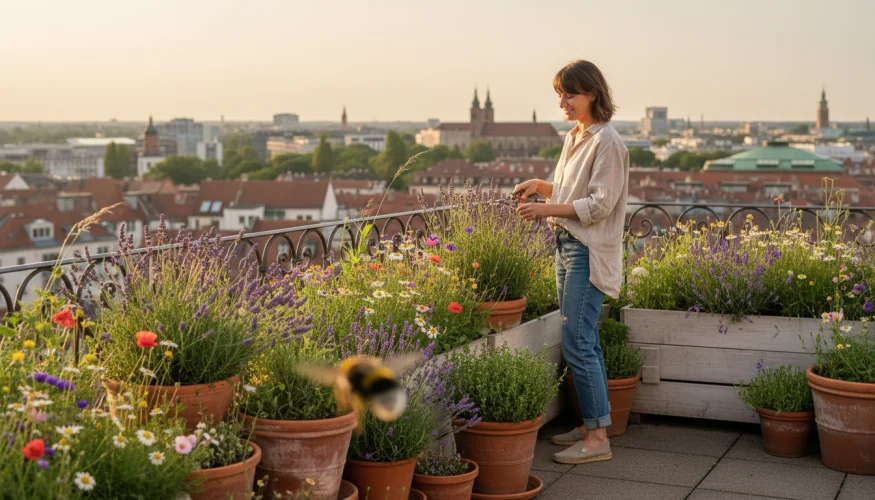
This is where we get to what absolutely anyone can do. You do not need a plot of land or a garden. All it takes is a balcony, a windowsill, or even just a single planter with the right choice of plants.
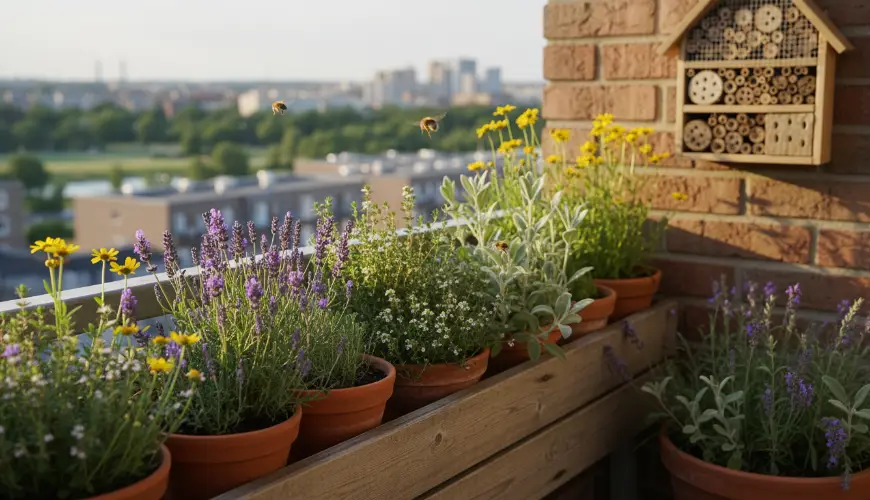
The most important rule is simple: plant what bees actually need. Not all ornamental plants are useful to them. Double-flowered varieties, bred for their appearance, often have so many petals that you simply cannot reach the nectar and pollen at all. A bee simply cannot physically get inside. Instead, choose simple, natural flower shapes. Excellent choices include lavender, lemon balm, thyme, marjoram, savory or sage – herbs that are also useful in the kitchen. Chamomile, sunflowers and chicory also do very well on a balcony. If you have room for larger containers, try verbena, agastache or echinacea.
It is also important to think about seasonal continuity. Bees need food from early spring through to late autumn. Start with crocuses or snowdrops in containers that overwinter outside, continue with fruit trees in pots (yes, even a dwarf apple or cherry tree can be grown in a container), and finish the season with heather or asters. This approach ensures that your balcony will be a food source throughout the entire active season for pollinators, not just for the period when one favourite plant is in bloom.
Take Markéta, for example, who lives in a fourth-floor flat in Brno. Just three years ago, she had only a few geraniums on her balcony, which she watered more or less out of habit. Then she learned about the decline of pollinators and decided to try something different. Today she has over twenty species of plants in four window boxes and two larger containers on her balcony. Every afternoon, bumblebees, solitary bees and butterflies come to visit them. "For the first time in my life, I realised that my window is part of the landscape," she says. Her example shows that change does not have to be large to be meaningful.
In addition to plants, there is another way to help bees – an insect hotel or bug house. The honey bee is just one of approximately 700 species of bees living in the Czech Republic. Most of them are solitary species that do not nest in hives, but in hollow stems, underground burrows or crevices in wood. These species are often even more important for pollinating natural vegetation than the honey bee, yet they receive far less attention. An insect hotel – even a simple, homemade one assembled from bamboo sticks and pine cones – will offer them a place to overwinter and nest. Place it in a sunny spot, sheltered from rain, at least a metre above the ground.
What you do not do is just as important as what you do. Stop spraying balcony plants with insecticides. Even products labelled as "natural" can be toxic to insects. If you are dealing with aphids, try mechanical methods first – washing with water, picking by hand – or natural predators such as ladybirds. Also avoid an overly clean and tidy balcony: a little "mess" in the form of dry stems or a pile of twigs is a valuable refuge for insects.
A good source of inspiration is the Zachraňte opylovače (Save the Pollinators) project, which maps locations suitable for pollinators in the Czech Republic and offers practical advice for gardeners and balcony owners. The European initiative Bee Life works in a similar way, monitoring legislation that affects bees and educating the public about their protection.
Someone might argue that one balcony will not make any difference. And mathematically speaking, they would be right – one planter of lavender will not save the bee population. But nature does not work as the sum of isolated actions. It works as a network. Every balcony, every rooftop garden, every unmown lawn becomes a node in that network. The British organisation Bumblebee Conservation Trust even speaks of the concept of "bee corridors" – corridors for pollinators that can be created by connecting private gardens and balconies across an entire city. Every contributor is part of something larger, even if they cannot see it at first glance.
Last but not least, it is worth mentioning that helping bees is not only an ecological act, but also an aesthetic and psychological one. Gardens and balconies full of flowering plants are more beautiful, more fragrant and more alive. Watching a bumblebee skilfully explore a lavender flower is, in its own way, a meditative experience. Research in environmental psychology shows that contact with nature – even in its smallest, balcony form – reduces stress and improves mood. Helping nature and taking care of your own wellbeing are not contradictory goals. They are two sides of the same decision.
If you are interested enough in the topic to be considering a next step, consider supporting local beekeepers – by buying honey directly from a keeper in your region, you are contributing to the preservation of a tradition that has a centuries-long history in the Czech lands and is today under economic pressure from cheap imported honey. Local honey also contains pollen from the local landscape, giving it a specific flavour and potential health benefits that industrially processed honey from the other side of the world cannot offer.
Bees are a mirror of the health of the landscape. Where they thrive, so do others – plants, birds, insects, people. And if they are not thriving, it is a signal that something in the ecosystem is not working as it should. Listening to this signal and responding to it – even just by adding a planter of thyme to the balcony – is a small but real way of standing on the right side.