

Darkness as a lost value costs us more than sleep
We live in an age when the light never fully goes out. Street lamps shine through the night, phone screens flicker even at three in the morning, and neon advertisements reflect their glow off low clouds above every major city. It seems as though modern civilisation has declared a quiet yet thorough victory over darkness – and yet few people realise what they are actually losing in the process. Darkness is not an enemy that has been defeated. It is a natural part of existence, without which the human body, nature, and the psyche simply cannot manage.
The data speaks for itself. According to research by the International Dark-Sky Association, more than 80% of the world's population suffers from light pollution, and in Europe and North America the figure is even higher – over 99% of people never experience a truly dark night free from artificial light. Generations that grew up without ever seeing the Milky Way do not even realise they are missing something. And yet they are – on many levels at once.
Try our natural products






What happens in the body when night ceases to be night
The human organism evolved over hundreds of thousands of years in the rhythm of alternating light and darkness. This circadian rhythm – the biological clock governing almost every cell in the body – is extraordinarily sensitive to light stimuli. A key role is played by the hormone melatonin, which the brain's pineal gland begins to produce precisely when the eyes detect a drop in light. Melatonin does not merely make a person feel sleepy – it regulates the immune system, has antioxidant effects, and contributes to protection against certain lifestyle diseases.
The problem arises when darkness does not come. The blue light emitted by the screens of phones, tablets, and computers suppresses melatonin production more significantly than any other type of radiation, as demonstrated by a study published in the journal PNAS. The body simply does not know that it is night. The biological clock shifts, sleep is delayed, and its quality declines. And chronic lack of quality sleep is not merely a question of fatigue – it is associated with a higher risk of obesity, type 2 diabetes, cardiovascular disease, and depression.
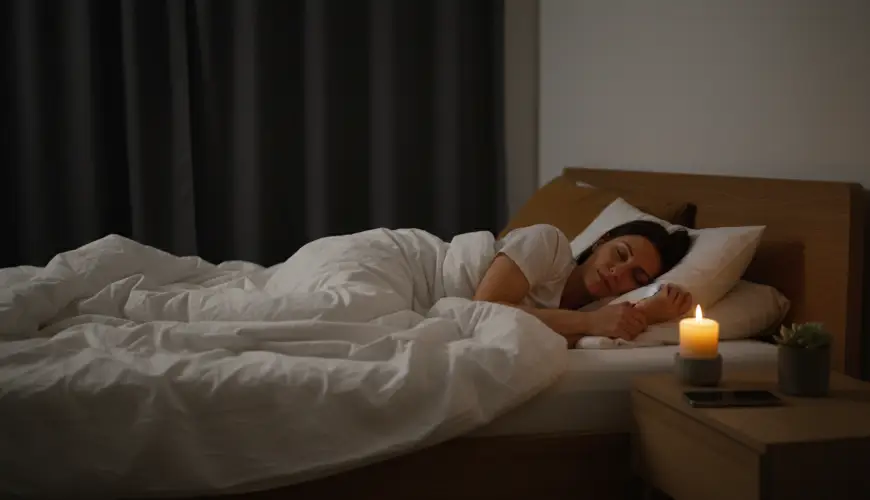
This is not just theory. Consider Martina, a thirty-year-old graphic designer from Brno who for years worked late into the night with her monitor and room at full brightness. She would fall asleep around two in the morning, wake up exhausted, and suffered from repeated infections. Now she is trying a different approach: after dark she dims the lights, switches her phone to night mode, and sleeps in a room with heavy curtains. The result? After a few weeks, both the length and quality of her sleep improved noticeably. Martina's story is not exceptional – thousands of people who have decided to take darkness seriously describe a similar experience.
Natural darkness does not mean giving up comfort or returning to a cave. It means consciously working with the rhythm of day and night, respecting the body's natural signals, and creating conditions that allow it to function as evolution intended. This is precisely why products such as quality blackout curtains, soy wax candles, and lamps with warm, low-intensity light have become so popular in recent years – they help restore the natural evening transition into calm.
Darkness, nature, and what light pollution destroys
The effects of losing darkness are not merely personal – they extend far beyond the boundaries of the human body. The ecosystems of the entire planet are built upon the rhythm of day and night, and once this rhythm is disrupted, problems begin to cascade in ways that do not appear connected at first glance.
Insects that navigate by the light of stars and the moon circle around street lamps until they exhaust all their energy and die. Migratory birds that navigate by the starry sky become disoriented above illuminated cities and fly into buildings. Sea turtles, whose hatchlings are guided by the light above the ocean surface, head towards illuminated hotel complexes instead of the sea. Coral reefs regulate their reproductive cycle according to moonlight – and artificial coastal lighting disrupts this rhythm with fatal consequences for entire underwater ecosystems.
Scientists from the German Helmholtz Centre for Environmental Research warn that light pollution is one of the most underestimated factors contributing to the global decline of insects. Yet insects form the foundation of the food chain for a vast number of other species. Darkness, then, is not merely a romantic concern for poets and astronomers – it is an ecological necessity, the loss of which threatens the planet's biodiversity in ways we are only beginning to fully understand.
It is natural to ask: can an individual actually make any difference in this regard? The answer is surprisingly yes. Choosing bulbs with warm-coloured, low-intensity light, switching off outdoor lights when they are not needed, installing motion sensors instead of permanently lit lamps – all of these are steps that, taken together, have a measurable impact. And once a person begins to recognise the value of darkness, they will naturally start to protect it on other levels as well.
The writer and naturalist Robert Macfarlane wrote: "Darkness is not the absence of light. It is the presence of night." This seemingly simple thought carries a profound truth – darkness has its own quality, its own content, its own gifts. Ceasing to perceive it as merely a lack of light is the first step towards learning to respect it once again.
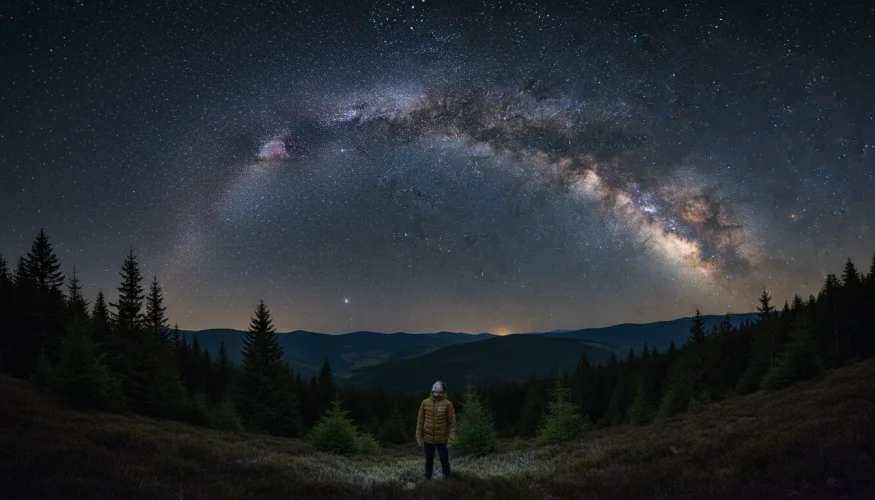
A night sky free from light pollution is one of the most extraordinary experiences that nature offers for free. The view of the Milky Way, which for millennia was a self-evident part of human experience, has become a rarity accessible only to those who venture far from cities. Astronomers and conservationists are therefore establishing so-called dark sky areas – regions with strict lighting regulations where the night sky is protected in the same way as rare plant species or historical monuments. In the Czech Republic, for example, the Beskydy Protected Landscape Area is a place where conditions for observing the starry sky have remained relatively well preserved.
The psychology of darkness: what is lost when night disappears
There is yet another dimension to the loss of darkness that receives less attention – the psychological and spiritual one. Throughout the entirety of human history, night was a time of rest, dreaming, contemplation, and encounter with one's inner self. Darkness naturally slows things down, compels stillness, and creates space for thoughts and emotions that have no chance of surfacing in the light of day. Many cultures built entire rituals and celebrations around this rhythm – the winter solstice, vigils, nocturnal meditation.
Modern people have learned to avoid darkness, and in doing so deprive themselves of a natural time for processing impressions, resting the nervous system, and creative thinking. Research in sleep psychology shows that the deep sleep phase, which occurs in complete darkness, is crucial not only for physical recovery but also for memory consolidation, emotional regulation, and the creative processing of problems. The brain literally "rewrites" the day's experiences into long-term memory during the night – and this process requires genuine darkness and quiet.
An interesting perspective is also offered by traditional medical systems such as Ayurveda or Traditional Chinese Medicine, which have always worked with the rhythm of day and night as a fundamental axis of health. Evening calming, the reduction of stimuli after dark, and a natural transition into sleep are not optional extras in these systems but basic prerequisites for balance. Modern science has been vindicating them over recent decades.
Practical steps that help restore a healthy relationship with darkness are not particularly complicated. The following things are helpful:
- An evening calming ritual – reducing screen use at least an hour before bed, switching to warm, dimmed lighting
- Quality bedroom blackout – darkness in the sleeping space should be as complete as possible
- Time in nature at dusk – consciously observing the transition from day to night as a meditative experience
- Reducing outdoor lighting – choosing fixtures with warm-coloured light and shades that direct light downwards rather than into the sky
It is no coincidence that interest in ecological products supporting a natural sleep rhythm – from soy candles and natural aromatherapy to quality cotton bedding and blackout curtains – has grown significantly in recent years. People instinctively sense that something is missing and seek a path back to a more natural way of being.
Darkness is not backwardness or deprivation. It is the natural right of every living creature – the right to rhythm, rest, and night. A civilisation that denies itself this right pays for its perpetual brightness with a price that manifests in hospitals, in therapists' offices, in disappearing insect species, and in the empty night sky above cities. Restoring value to darkness does not mean rejecting progress – it means understanding that true progress respects the natural limits and rhythms upon which life is built. And sometimes the wisest thing one can do is simply turn off the light.