

# What Does Blue Light Do to Your Eyes and Sleep ## What Is Blue Light? Blue light is part of the
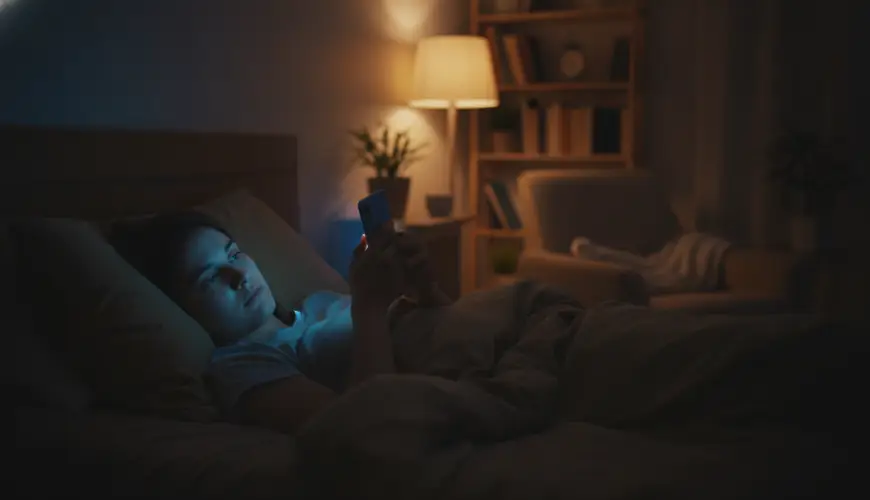
Modern humans spend an average of more than seven hours a day in front of screens. A phone first thing in the morning after waking up, a computer at work, a tablet in the evening before bed – and in between, television, smartwatches and countless other glowing displays. Few people stop to think about what this light specifically does to their eyes and how significantly it affects sleep quality. Yet the answer to this question can change everyday habits in ways that genuinely make a difference to health.
Blue light is part of the visible light spectrum, with a wavelength of approximately 380 to 500 nanometres. It is naturally emitted by the sun, and for this reason the human body uses it as a signal for wakefulness – the brain interprets it as "it's daytime, time to be active". The problem arises when a person is exposed to this light after dark, because the body then receives conflicting information. Smartphone screens, computer monitors, LED lighting and televisions all emit blue light at high intensity, even during hours when the body should naturally be slowing down and preparing for rest.
Try our natural products
How blue light affects sleep
The key to understanding the whole mechanism is melatonin – the hormone that governs the circadian rhythm, that is, the body's internal biological clock. Under normal circumstances, the pineal gland, a small gland in the brain, begins producing melatonin approximately two hours before a person goes to sleep. The body calms down, temperature drops, drowsiness increases. But blue light significantly suppresses this production. Research from Harvard Medical School confirms that exposure to blue light suppresses melatonin secretion approximately twice as powerfully as other types of light and shifts the circadian rhythm by more than three hours.
In practice, this means that an hour of scrolling on your phone just before bed can cause a person to fall asleep significantly later than planned – and even if they then spend the same number of hours in bed as usual, their sleep will be less deep and less restorative. The brain simply does not have time to pass through all phases of the sleep cycle, particularly the most important one – the REM phase, during which memories are processed, emotions are regulated and cognitive functions are restored.
The result is well known: morning fatigue despite having slept for a sufficient length of time, irritability, poorer concentration, cravings for sweets and stimulants such as coffee. Long-term disruption of the sleep rhythm can then contribute to more serious health problems – ranging from metabolic disorders and a weakened immune system to an increased risk of cardiovascular disease. The World Health Organisation has even classified night-shift work, which causes chronic disruption of the circadian rhythm, as a probable carcinogen.
Take the example of Markéta, a thirty-year-old graphic designer who worked on her computer every evening until midnight and then spent another hour browsing Instagram on her phone. Although she went to bed at one in the morning and got up at eight, she felt constantly exhausted. It was only after she began observing a "digital curfew" – putting away screens at least an hour before bed – that her energy levels improved significantly within a few weeks. It is a simple example, but one that illustrates how powerful an influence light hygiene has on everyday wellbeing.
What blue light does to the eyes
Sleep is not the only area where blue light leaves its mark. The eyes are exposed to it directly and for hours at a time, and this has consequences. The most common symptom of excessive exposure is what is known as Computer Vision Syndrome, which describes a cluster of symptoms including burning and dry eyes, blurred vision, headaches and fatigue. According to estimates from the American Optometric Association, these problems affect approximately 50 to 90 percent of people who regularly work in front of screens.
Blue light penetrates deep into the eye, reaching the retina, and there is scientific evidence suggesting that long-term exposure may contribute to damage to photoreceptors. Some studies point to a possible link with the development of age-related macular degeneration, one of the most common diseases leading to vision loss in later life. It is important to add that research in this area is ongoing and experts disagree on the degree of risk, but cautious prevention is certainly no bad thing.
Another factor is the frequency of blinking. When looking at a screen, a person blinks approximately three times less than usual, which leads to the tear film drying out more quickly and to a feeling of dryness or grittiness in the eyes. This effect is entirely independent of blue light itself – it is a consequence of the focused gaze that screens naturally induce. The combination of both factors means that eyes are genuinely strained after a long working day in front of a monitor in a way that has no precedent in the history of the human species.
How can one protect against this influence? There are several practical approaches that do not require a radical lifestyle change but can have a noticeable effect. The 20-20-20 rule is one of the simplest: every 20 minutes, look at a distant object approximately 6 metres away for 20 seconds. This brief rest helps relieve tension in the eye muscles and encourages natural blinking.
Another tool is blue light filters, which are now available in various forms:
- Blue light filtering glasses – worn when working with screens or in the evening while watching television
- Screen protector films – reduce the amount of blue light emitted directly at the source
- Apps and system settings – for example, Night Shift on Apple devices or Night Light in Windows, which change the colour temperature of the display after dark
- Specialist lighting – warm bulbs with a lower proportion of blue light for evening hours
Night mode on screens does not eliminate blue light entirely, but it does significantly reduce its intensity, which is beneficial for the circadian rhythm. However, it is ideal to combine these technical solutions with behavioural changes – that is, genuinely putting the phone away before bed rather than simply relying on a filter.
An interesting perspective is also offered by the Japanese concept of "ma", which emphasises the value of empty space and pauses. Applying it to digital hygiene means consciously incorporating screen-free moments into the daily rhythm – in the morning before checking messages for the first time, at lunchtime instead of scrolling, and in the evening as a transition to calm. Such an approach requires no technology, only a deliberate decision.
Sleep science has advanced considerably over the past twenty years, and today we know that sleep quality is not a luxury but a fundamental biological need comparable to nutrition and physical activity. As leading global sleep expert Matthew Walker puts it: "Sleep is the most effective medicine we have for restoring brain and body health." And one of the most easily influenced variables that sabotages sleep is precisely evening exposure to blue light.
Light hygiene is a concept that has come to the fore in recent years among both doctors and productivity experts. It encompasses not only limiting blue light, but also maintaining regular wake and sleep times, getting sufficient exposure to natural daylight in the morning – which, paradoxically, helps the body respond better to darkness in the evening – and adapting home lighting to the time of day. Warm, yellowish light in the evening versus bright, cool light in the morning and late morning. Such a rhythm corresponds to what the human body, after hundreds of thousands of years of evolution, has come to expect.
A practical change need not be radical. It is enough to start with a single adjustment: turn on night mode on all devices so that it activates automatically after dark. Add to this the habit of putting the phone away half an hour before bed and reaching for a book instead, or putting on some calm music. Such small steps, repeated every day, can bring noticeable improvements in sleep quality, morning energy levels and overall wellbeing within a few weeks.
Eyes and sleep are just two of the areas that blue light affects. Research suggests possible impacts on mood, the immune system and long-term cognitive health as well. The more hours a day the average person spends in front of screens, the more relevant these topics become – and the more important it is to be aware of them and to make conscious decisions about how to use technology. The point is not to reject technology, but to learn to live with it in a way that does not harm the body.