

# The Power of Small Rituals Lies in Conscious Presence

Every day brings its share of the unexpected. A delayed train, an overflowing inbox, a conflict at work, or simply that feeling that everything is demanding a piece of your attention at once – and you are just one person in the middle of it all, with a limited amount of energy. It's no wonder that many people are looking for ways to keep their heads above water in this chaos. The answer doesn't have to come in the form of a weekend retreat, an expensive wellness stay, or a radical lifestyle change. All it takes is small, recurring rituals that anchor the day to a fixed point and help the brain and body orient themselves in time.
A ritual is not the same as a routine, even though these two words are often used interchangeably. A routine is mechanical – you brush your teeth because that's what you do. A ritual is intentional – you prepare your coffee slowly because that is your time, your moment of calm before the world starts making demands. It is precisely this intentionality, this presence in the moment, that is the key to why small rituals work where big decisions fail.
Try our natural products




Why the brain loves predictability
Neuroscientists have known for some time that the human brain is a prediction machine – it constantly tries to anticipate what is coming in order to conserve energy. When a day is full of uncertainty and unexpected situations, the brain works overtime, consuming resources that are then unavailable for concentration, creativity, or emotional regulation. Small rituals outsmart this mechanism by inserting fixed points into the day – moments that the brain recognises, anticipates, and that require no decision-making effort.
Research published in the journal Psychological Science showed that repetitive ritual behaviour reduces anxiety and improves performance even in situations where a person is under stress. There is no mystical explanation involved – the mechanism is purely psychological. A ritual signals to the brain: I know this, I can handle this, this is safe. And therein lies its power.
Consider Martina, a project manager from a mid-sized city, who two years ago was going through a period of chronic exhaustion. She enjoyed her work, but was struggling to manage the transitions between different roles – a mother in the morning, a team leader mid-morning, a colleague in afternoon meetings, a partner in the evening. Each transition was abrupt and unplanned. On the advice of her psychologist, she began introducing small breaks: five minutes of tea before the first call, a short walk between work and picking up the children, an evening note of three things that had gone well that day. After three months, she described feeling no less busy, but coping better. The days are just as full – but she is no longer drowning in them; she is swimming.
Rituals in the morning, afternoon, and evening
The most effective rituals are those that structure transitions – the moments when you move from one context to another. Morning is a natural place to begin the day with conscious intention. It doesn't have to involve an hour of yoga or candlelit meditation – ten minutes without your phone, a glass of water, a window thrown open. These seemingly trivial acts have a profound influence on how your nervous system is set up for the rest of the day.
Afternoon rituals tend to be the least explored territory, even though the afternoon is the most critical time of day for most people. Energy drops, concentration falters, frustration builds. A short walk – even just around the block – can reset attention in a way that no amount of coffee can guarantee. A Stanford University study found that walking increases creative thinking by 81 percent compared to sitting. That's not a small thing – it's an argument for anyone who thinks they can't afford the time for a walk.
Evening rituals serve an entirely different function: they signal to the body that it's time to slow down. The transition from an active day to sleep is not automatic – especially in an age when screens constantly stimulate the nervous system. A small pre-sleep ritual – whether reading a physical book, taking a warm shower, making a brief diary entry, or simply sitting quietly in an armchair for five minutes – helps the body recognise that rest is approaching.
As the writer and philosopher Alain de Botton said: "Rituals are a way of giving shape to the things that matter to us." And that is precisely the point – to give shape to a day that would otherwise slip through your fingers like water.
How to truly establish a ritual
The biggest trap when building rituals is that people start out too ambitiously. They decide to meditate for thirty minutes every morning, exercise for an hour every day, and keep a detailed journal every evening. After two weeks, the system collapses at the first complication – an illness, an exceptional work situation, or simply a bad day. And with it falls the motivation too.
A more sensible approach draws on the concept that behavioural scientists call "tiny habits." Their pioneer, B. J. Fogg of Stanford University, describes in his book Tiny Habits how the brain accepts new behaviour far more readily when it is small, specific, and attached to an existing routine. Instead of "I will meditate every morning," try "after my first sip of coffee, I will close my eyes for two minutes." Instead of "I will write in my journal every evening," try "before I turn off the light, I will write one sentence about today."
The key is also that the ritual should bring an immediate, if modest, sense of satisfaction. The brain learns through rewards – and if after your morning ritual you notice that you feel a little better, a little calmer, that information is stored and the path to the ritual will be easier next time. Over time, a conscious decision becomes automatic – but not empty; rather, meaningful.
Another practical tool is what is known as "stacking" – layering rituals. This is the principle of adding a new ritual directly onto an existing activity. If you make tea every morning, add three deep breaths to it. If you have lunch at the same time every day, add a no-screens rule to your lunch break. Stacking works because existing behaviour serves as a trigger for the new one – the brain doesn't need to expend any effort to remember.
It's worth noting that rituals don't have to be a solitary affair. Shared rituals – a family dinner without phones, a morning hug, coffee with colleagues before the working day begins – have a strong social dimension and deepen a sense of belonging. Social bonds are, after all, one of the best-documented factors in mental resilience, as repeatedly confirmed by, for example, the Harvard Study of Adult Development, one of the longest studies of human happiness ever conducted.
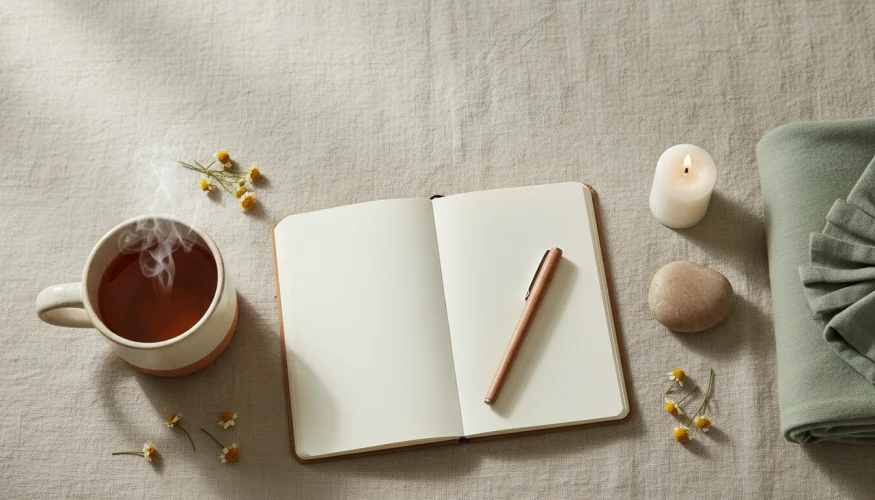
Some people approach rituals through objects – and this is not superstition, but psychology. A particular mug, a favourite blanket, a candle with a certain scent – these objects function as anchors that activate a state of mind associated with the ritual. If you always read by the same lamp with a warm drink in hand, those two cues alone are enough for the brain to begin switching into relaxation mode before you even open the book. It's not magic – it's conditioned learning, which science described over a hundred years ago.
It is also important not to underestimate rituals connected to the body. Movement, breath, touch – these physical inputs have a direct effect on the nervous system and are often faster than any cognitive technique. Three slow exhales activate the parasympathetic nervous system and literally slow the heart rate. Stretching your shoulders releases tension you may not even realise you are carrying. The touch of warm water while washing your hands can be – if you pay attention to it – a small reset in the middle of a hectic morning.
What may be most surprising about all of this is how little a ritual needs in order to be effective. It doesn't need an hour-long block in the calendar. It doesn't need special equipment or perfect conditions. It only needs intentionality – the intention to be present in that moment, in that particular act. And that is something anyone can afford, regardless of what their day looks like.
Difficult days will not cease to exist. Stress, unexpected complications, and an overwhelming weight of obligations are part of modern life, and no ritual will change that. What can change, however, is how a person moves through it all – whether like a ship without a rudder, or like someone who knows at least a few fixed points to return to. And that is where the true value of small rituals lies: not in simplifying the world, but in anchoring us within it.