
# School Readiness for First Grade and Signs of School Maturity
Every year in spring, thousands of Czech families experience the same dilemma. Their child is celebrating their fifth or sixth birthday, school enrollment time is approaching, and parents find themselves asking a question that has no clear-cut answer: is our child truly ready? School readiness is not something that can be measured with a ruler or read off a calendar. It is a complex set of abilities, skills, and inner preparedness that develops at a different pace in every child.
Czech experts in child psychology and education agree that age alone is just one of many indicators. According to recommendations from the Czech School Inspectorate and research focused on early child development, a whole range of factors come into play – from physical maturity and emotional stability to the ability to concentrate on a given task for at least twenty minutes. It is precisely this complexity that makes assessing school readiness a topic deserving far more attention than most parents give it.
Imagine a situation that is entirely common in Czech families. The mother of six-year-old Tomáš is certain her son is ready for school – he can read syllables, knows numbers up to twenty, and loves dinosaur encyclopedias. Yet at enrollment, it becomes clear that Tomáš cannot sit at a table for more than five minutes, cries when he has to complete a task without his mother present, and responds to the teacher's questions in single words or not at all. His cognitive abilities are above average, but his emotional and social maturity lags significantly behind. This imbalance is surprisingly common, and parents often overlook it precisely because they focus on what the child "can do" rather than on how the child copes with the demands of the world around them.
Try our natural products



What school readiness actually means
Experts traditionally divide school readiness into three core areas: physical, cognitive, and social-emotional preparedness. These three components are closely interconnected and none of them can be assessed in isolation.
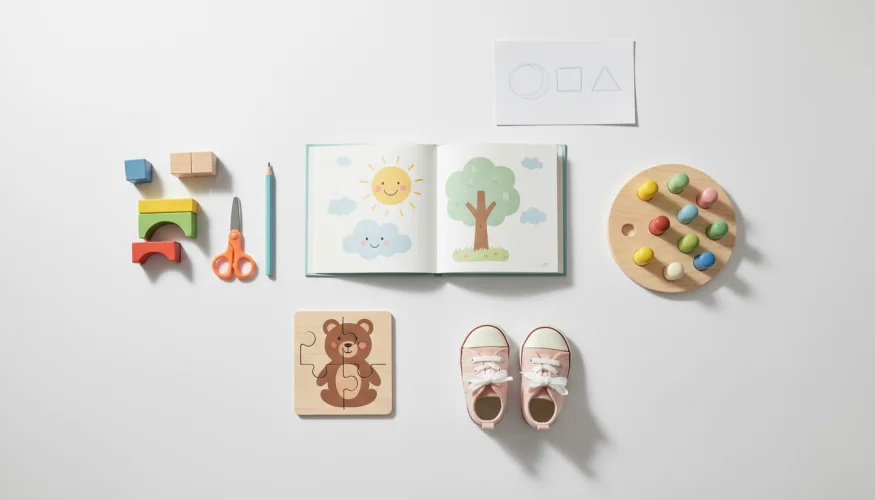
Physical maturity encompasses not only the child's overall health, but also their gross and fine motor skills. A child ready for school should be able to hold a pencil correctly, cut a simple shape out of paper, fasten buttons on a coat, or tie their shoelaces. Equally important is laterality – that is, an established preference for one hand, which is essential for learning to write. If a child still switches hands or holds a pencil in a cramped and clumsy way, writing may be significantly more demanding than it needs to be. A physically mature child is also able to sustain focused sitting without notable fatigue and can manage basic self-care without adult assistance.
Cognitive preparedness is the area parents most commonly focus on. It includes the ability to concentrate on a given task, to work deliberately and purposefully, to distinguish similar shapes and sounds, to understand basic mathematical concepts such as more and less, to orient themselves in time and space, and to have an adequate vocabulary. A child should be able to recount a simple story, answer questions in complete sentences, and follow instructions that involve multiple steps at once. Also important is so-called phonemic awareness – the ability to hear and distinguish individual sounds within words, which is the foundation for successful reading and writing.
The third and in many respects most important area is social-emotional maturity. A child entering school finds themselves in a new environment where they must respect the authority of the teacher, cooperate with peers, handle the frustration of failure, and cope with separation from their parents. Psychologist and early childhood development specialist Jana Nováková put it aptly: "School is not just a place where children learn to read and count. It is above all the first major social experience, one that shapes their relationship with learning for the rest of their lives." A child who cannot accept losing, cannot wait their turn, or bursts into tears at every minor obstacle will have a considerably harder start in a group setting regardless of how well they know the alphabet.
How to assess school readiness at home and with a specialist
Parents have a wide range of ways to get at least a rough picture of their child's readiness before enrollment. The simplest is observation in the natural situations of everyday life. How does the child manage playing games with rules? Can they accept losing without it ending in an outburst of anger? How do they behave in a group of other children – are they able to negotiate, step back, lend a helping hand? Can they manage being alone in a different environment, such as at their grandparents' or at an after-school activity, without significant anxiety?
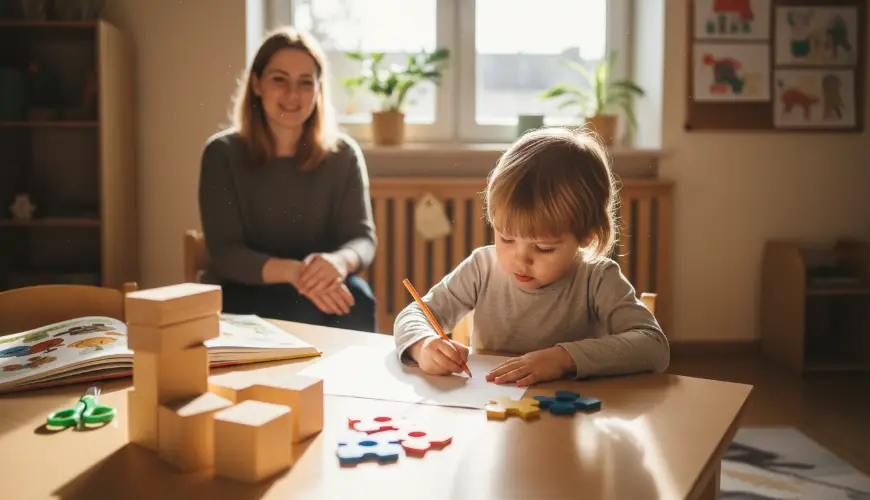
Another good indicator is the child's ability to work independently on a simple task. Try giving them the task of drawing a picture or completing a puzzle and observe how long they can stay with it without your presence and encouragement. A mature child should be able to sustain focused work for at least twenty minutes without needing constant guidance.
If parents are unsure, they can turn to an educational-psychological counseling center, where specialists will carry out a comprehensive assessment of school readiness. This assessment is free of charge and includes standardized tests covering all the areas mentioned above. The outcome is not simply a verdict of "ready – not ready," but a detailed picture of the child's strengths as well as the areas it would be beneficial to develop further before starting school. The network of educational-psychological counseling centers in the Czech Republic operates throughout the country, and an appointment can be arranged without a doctor's referral.
The enrollment for first grade itself is also a diagnostic tool. Experienced teachers can, during a relatively brief interaction with a child, reveal a great deal – not only what the child knows, but also how they respond to an unfamiliar environment, how they communicate with an unknown adult, and how they handle mild stress. There is therefore no reason to dread enrollment as an exam that can be "failed." It is rather an opportunity to receive feedback from people who have daily experience assessing school readiness.
One of the most frequently asked questions parents raise at enrollment concerns the deferral of school attendance. Czech legislation allows entry to school to be postponed by one year if a child is not yet sufficiently mature. However, a deferral should not be seen as a failure, nor as an automatic solution to every uncertainty. A deferral makes sense when there is a specific area that can be purposefully worked on over the course of the year – whether that involves speech therapy, developing fine motor skills, or building emotional resilience. If the child is simply "not big enough" or the parents are just hesitant but no specific area requires significant development, a deferral may be unnecessary and in extreme cases even counterproductive.
The environment in which the child grows up also plays a very important role. Research repeatedly shows that children who regularly attended kindergarten are on average better prepared for the transition to primary school than children raised exclusively at home – not only in social terms, but cognitively as well. Kindergarten naturally trains the abilities that are key to school success: respecting rules, working in a group, coping with separation from parents, and completing structured tasks. This does not, of course, mean that home upbringing cannot be equally valuable – it depends on what stimuli and opportunities the child receives.
Parents can actively support school readiness through a wide range of everyday activities. Reading fairy tales at bedtime develops vocabulary and the ability to listen. Cooking or baking together trains patience, precision, and the ability to follow instructions. Board games with rules teach children to handle both losing and winning and to wait their turn. Arts and crafts, modeling, or working with paper strengthen fine motor skills. And simple time outdoors, moving around and playing freely with peers, develops social skills in a way that no structured activity can fully replace.
It is worth noting that a child's gender plays a non-negligible role in the question of school readiness. Statistics consistently show that boys are on average school-ready several months later than girls of the same age – particularly in the area of social-emotional maturity and the ability to concentrate. This does not mean that every boy automatically needs a deferral, but parents should be open to this fact and not allow themselves to be swayed by pressure from those around them or by comparisons with older siblings or friends.
Finally, it is important to emphasize that assessing school readiness should never be a one-sided process in which parents simply await the verdict of specialists. Parents know their child best and their observations are of irreplaceable value. At the same time, it is natural that closeness and emotional attachment can distort one's perspective – for better or for worse. Some parents see their child as more mature than they are; others unnecessarily underestimate their child's abilities out of excessive caution. An open dialogue with kindergarten teachers, the child's pediatrician, and if appropriate a psychologist, is therefore the best path to an informed decision.
Starting first grade is a big step for every child – perhaps one of the biggest in their life so far. Timing this step correctly, supported by a realistic view of both strengths and areas for development, can significantly influence whether the child experiences school as an adventure full of discovery, or as a source of stress and failure. And that is precisely why the question of school readiness deserves all the attention it truly merits.