

# What Lies Behind the Feeling of Loneliness Even Among People
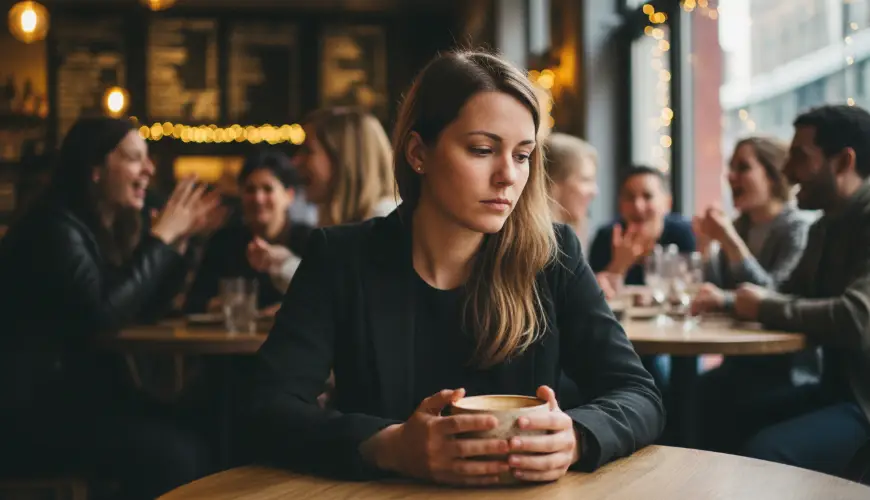
The modern world offers more opportunities for social contact than ever before. Social networks, open-plan offices, shared apartments, endless work meetings – and yet more and more people describe a feeling of deep loneliness that doesn't come in the silence of an empty flat, but in the middle of a crowd. This very paradox is one of the most puzzling and yet most widespread experiences of our time: the feeling of loneliness even among people.
It is neither a weakness nor a fabrication. It is a real, psychologically well-documented condition that affects people of all age groups, professions and lifestyles. And although it is being talked about more and more, many of those who experience it think they are alone in this – which is, as will soon become clear, one of its cruellest characteristics.
Try our natural products






What exactly is loneliness when you are not alone?
In order to understand why a person feels lonely even in the presence of others, it is first necessary to distinguish between physical solitude and emotional loneliness. Physical solitude is simply the state of having no one around you. Emotional loneliness is something different – it is the absence of meaningful connection, the feeling that no one truly knows you, understands you, or cares about you in the way you would wish.
Psychologists refer to this type of loneliness as so-called social isolation within a collective. A person can sit at a party, laugh at jokes, toast with friends – and at the same time experience complete emptiness inside. As if they were behind a glass wall that separates them from others without anyone noticing. Research repeatedly shows that the quality of interpersonal relationships is more important than their quantity – and this is precisely where the core of the problem lies.
For example, a study published in the journal Personality and Social Psychology Bulletin found that people who feel they were not understood by others even after direct conversation show significantly higher levels of loneliness than those who live alone but feel fulfilled in their relationships. In other words – being misunderstood in the presence of others hurts more than being physically alone.
Consider a specific example: Jana works in a busy advertising studio, surrounded by colleagues every day. She goes to shared lunches, takes part in team-building events, shares professional successes. On the surface, she is part of the group. But at home in the evening she feels a heaviness she cannot name. No one at work knows what she experiences outside the office. None of her colleagues ask how she is really doing. Contact exists, but depth is missing. Jana is not experiencing solitude – she is experiencing loneliness.
Why is this so widespread today?
The answer is not simple, but several factors of modern life contribute to this phenomenon more than others. One of the most fundamental is the way we communicate. Digital communication – texts, likes, quick messages – creates an illusion of closeness without truly fulfilling it. We share content, but we don't share ourselves. We react to posts, but we don't listen to real stories.
American physician and former US Surgeon General Vivek Murthy writes in his book Together: "Loneliness is not just a feeling – it is a warning signal, like hunger or thirst. It tells us that we are missing something essential for our survival." Murthy, who has described loneliness as a public health epidemic, points out that chronic loneliness is comparable in health terms to smoking fifteen cigarettes a day. This is therefore not a sentimental complaint, but a serious health issue.
The pace of life also contributes to the feeling of loneliness even in company. People are overwhelmed by obligations, performance pressures and constant availability – and yet, or perhaps precisely because of this, they have no time for truly deep conversations. Friendships are maintained rather formally, meetings are planned and efficient, but rarely spontaneous and genuine. Superficial contacts accumulate, while deep bonds grow thinner.
Another factor is the culture of individualism, which, while supporting personal freedom and self-development, simultaneously weakens the sense of belonging and community. Where people once lived within stronger communal structures – extended families, neighbourhood ties, religious communities – many today function as isolated units who meet only when they explicitly plan to do so.
Interestingly, loneliness even among people affects different age groups unevenly. Intuitively, we might expect older people to be the loneliest. However, research from the Cigna Global Loneliness Index repeatedly shows that the loneliest generation is young adults aged 18–22 – precisely the age group that spends the most time on social networks. The paradox is complete.
Nor can we ignore the impact of the Covid-19 pandemic, which, while physically separating people from one another, paradoxically helped many to realise how shallow their previous relationships had actually been. When superficial social opportunities disappeared, it became clear how many truly deep bonds each of us has – and for many, that number was surprisingly low.

How can one work with this feeling?
Recognising the feeling of loneliness even in the company of others is the first and most difficult step. Many people mask this state with excessive activity, constantly seeking company, or conversely withdrawing completely. Both extreme mechanisms lead to the same result – a deepening of the divide.
Psychologists recommend starting with quality, not quantity. Rather than expanding one's social circle, the focus should be on deepening relationships that already exist. This means sharing something personal, asking about another person's genuine experiences, being present in conversation rather than merely sharing physical space. It sounds simple, but in practice it requires courage and deliberate effort.
The environment in which we live and spend our time also plays an important role. Research shows that contact with nature and a slower pace of life reduce the feeling of inner emptiness and improve the ability to form authentic relationships. It is no coincidence that people who consciously slow down, limit their screen time and engage in community activities – gardening, cooking, shared creative pursuits – report a greater sense of belonging. Such an approach to life, often associated with the principles of a slow and mindful lifestyle, acts not only on the body but also on the ability to be truly present with other people.
This is not about romanticising simplicity. It is about the conscious decision to pay attention to what truly nourishes interpersonal relationships. Shared meals without phones. A walk without headphones. A conversation with no agenda and no time limit. It is precisely in such moments that what psychologists call "social capital" is formed – and its absence is one of the main causes of loneliness even in a crowd.
It is also worth noting that seeking professional help is not a sign of weakness, but of sound judgement. Chronic loneliness can be a symptom of deeper psychological difficulties, such as social anxiety, depression or low self-esteem. A therapist or psychologist can help identify patterns of behaviour that prevent genuine connection with others – and offer concrete tools for changing them. The Czech Association for Psychotherapy or platforms such as Nevypusť duši offer good starting points for those seeking support.
It is also important to stop stigmatising the admission of loneliness. Society still tends to view a lonely person as someone who has failed at building relationships – as if it were a personal shortcoming. In reality, loneliness is part of the human experience, and admitting it requires more courage than hiding it behind a false smile at yet another party.
The feeling of loneliness even among people is one of the loudest silent signals of our time. It tells us that being physically present is not enough – that genuine connection requires intention, time and the willingness to show up as we truly are. And perhaps this is precisely the most important challenge we face as a society: learning not merely to be together, but truly – one for another.