

# Make Your Own Sugar-Free Thyme Cough Syrup Thyme (*Thymus vulgaris*) has been used for centuries
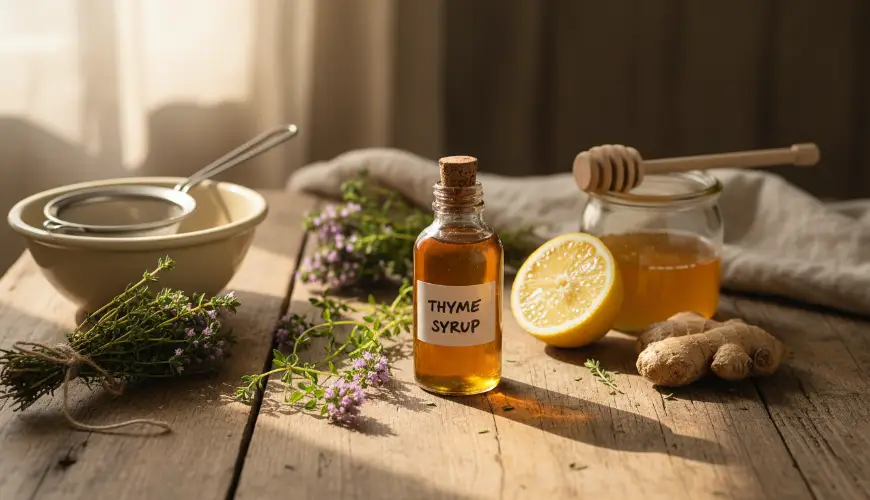
When autumn arrives along with the first colds, most of us reach for tried-and-tested remedies from the pharmacy. But what if instead we opened the pantry and prepared something that heals just as well – or perhaps even better – while containing not a single gram of refined sugar? Thyme syrup for coughs is one of those recipes passed down from generation to generation, and modern science is only now beginning to confirm their validity.
Common thyme (Thymus vulgaris) is not just a fragrant kitchen herb. It is a plant with a rich history of medicinal use dating back to ancient Egypt and Greece. Hippocrates recommended it for respiratory ailments, medieval monks cultivated it in monastery gardens as an indispensable medicinal herb, and today's phytotherapy ranks it among the most thoroughly studied plants of all. It is therefore no surprise that interest in homemade sugar-free thyme syrup has grown significantly in recent years – people are looking for natural alternatives that are effective, safe, and gentle on the body.
Try our natural products

Why thyme works so well for coughs
The key to thyme's healing properties lies in its chemical composition. The main active compound is thymol – a natural phenol with proven antimicrobial, antifungal, and antioxidant properties. In addition to thymol, thyme also contains carvacrol, flavonoids, and tannins, which together create a synergistic effect. In other words, these substances do not act in isolation but mutually reinforce each other, making them more effective together than each one individually.
From a scientific perspective, particularly noteworthy is a study published in the specialist journal Arzneimittelforschung, which compared the effects of thyme extract with commonly available cough medicines. The results showed that thyme-based preparations were comparably effective in treating acute bronchitis, without the side effects typical of synthetic drugs. Similar conclusions were reached by the European Medicines Agency (EMA) review, which officially classified thyme among plants with well-documented medicinal use in upper respiratory tract catarrh and coughs.
Thyme acts on coughs through several mechanisms. It loosens mucous secretions in the bronchi, making them easier to cough up – this effect is professionally referred to as mucolytic and expectorant action. It also mildly relaxes the smooth muscle of the bronchi, providing relief from spasmodic, dry coughs. And last but not least, it reduces inflammation of the mucous membrane, which is very often the cause of persistent throat irritation. Add to this the powerful antibacterial properties of thymol, and we have before us a herb that truly addresses the causes of the problem rather than merely masking the symptoms.
But why sugar-free syrup? Refined sugar paradoxically suppresses the body's immune response – research suggests that high sugar intake can temporarily reduce the activity of white blood cells. Moreover, sugar is unsuitable for diabetics, children prone to tooth decay, and anyone trying to limit their intake. A sugar-free syrup does not mean a flavourless syrup at all – honey can serve as a substitute, having powerful antibacterial properties of its own, as can glycerin or other natural alternatives.
Step-by-step recipe for sugar-free thyme syrup
Preparing homemade thyme syrup is surprisingly simple and truly anyone can manage it. The most common sweetener used instead of sugar is natural honey, which not only gives the syrup the right consistency but also multiplies its healing effects. Honey contains hydrogen peroxide, defensin-1, and other substances with proven antimicrobial effects – making it an ideal ally for thyme.
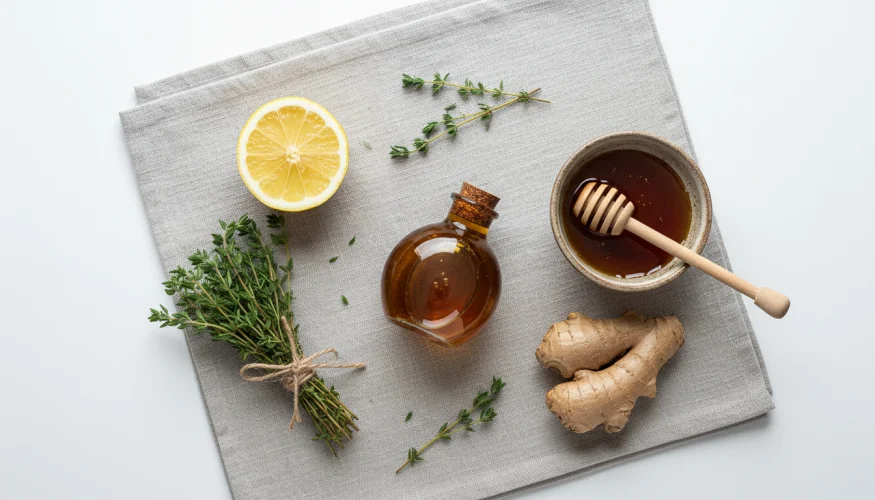
The basic ingredients are straightforward: fresh or dried thyme, water, honey, and optionally lemon or ginger to enhance the effect. Lemon juice adds vitamin C and strengthens the antioxidant action of the whole preparation, while ginger contributes anti-inflammatory gingerols and shogaols. The result is a syrup that tastes pleasant, smells of herbs, and genuinely helps.
The preparation process is as follows:
- Pour 300 ml of cold water over fresh or dried thyme (approximately 30–40 g of fresh or 15 g of dried) and slowly bring to the boil.
- Reduce the heat and leave to steep on a low heat for approximately 15–20 minutes with the lid on, so that the essential oils do not escape into the air.
- Strain the decoction through a fine sieve or cheesecloth and allow to cool slightly – the liquid should be at around 40 °C so that the honey does not overheat and lose its healing compounds.
- Add 2–3 tablespoons of quality honey (ideally manuka or buckwheat honey for their higher antibacterial activity) and stir well.
- Add the juice of half a lemon to taste, and optionally a few slices of fresh ginger that were part of the decoction.
- Pour into a glass bottle with a lid and store in the refrigerator.
A syrup prepared this way will keep in the cold for approximately two to three weeks. Adults take one teaspoon three to four times a day; children over one year of age (honey is not suitable for infants!) may receive half the dose. The syrup is most effective when you do not rush to swallow it – it is best to let it act in the throat for a while.
A practical example comes from the experience of Markéta, a teacher from Brno, who began preparing sugar-free thyme syrup for her family three years ago. "We used to buy pharmacy syrups at every cold, but they either contained a lot of sugar or chemical substances I didn't want to give to the children," she says. "Since we started making homemade thyme syrup, we get through autumn considerably better. The cough clears up faster and I know exactly what's inside." Her experience is not unique – thousands of families who have decided to take their health into their own hands share similar stories.
When to reach for thyme syrup and when to see a doctor instead
Thyme syrup is an excellent aid for common colds, seasonal coughs, bronchitis, or throat irritation caused by dry air. It is also suitable as a preventive measure during periods of increased respiratory illness – regular small doses can strengthen the natural immunity of the mucous membranes. The World Health Organization, in its overview of traditional herbal medicines, recognises thyme as a safe and effective herb for respiratory ailments.
However, it is important to be realistic. As Paracelsus once wrote: "Everything is poison and nothing is poison – it is only the dose that matters." The same applies to every natural remedy: it has its place and its limits. Thyme syrup is not a substitute for medical care in serious illness. If a cough lasts longer than two weeks, is accompanied by high fever, chest pain, shortness of breath, or coughing up blood, it is essential to seek medical attention without delay. Pregnant women should also exercise caution – thyme in large quantities can stimulate uterine contractions – as should people with allergies to plants of the Lamiaceae family.
For most healthy adults and children over one year of age, however, sugar-free thyme syrup is an entirely safe choice with minimal risk of side effects. Unlike many synthetic cough medicines, it does not cause drowsiness, does not create dependency, and contains no substances whose pronunciation would take half a minute.
It is interesting to observe how people's approach to the home medicine cabinet has changed in recent years. Interest in herbal preparations, fermented foods, and natural cosmetics is growing across generations – it is no longer just alternative communities, but ordinary families looking for a more meaningful approach to healthcare. Thyme syrup is in this context a perfect example of what traditional herbalism offers: a simple recipe, accessible ingredients, scientifically supported effects, and no unnecessary additives.
If you want to always have quality dried thyme or other herbs on hand for home preparation, it is worth investing in organic products free from pesticides, which guarantee the maximum content of active compounds. Essential oils and flavonoids are naturally present in higher concentrations in herbs grown without chemical treatment, which is directly reflected in the potency of the resulting syrup. The quality of the honey also matters – industrially processed honey is typically pasteurised and loses a large proportion of its healing properties, whereas raw, unpasteurised honey retains the full spectrum of enzymes and antimicrobial substances.
Sugar-free thyme syrup is therefore not merely a fashionable healthy lifestyle trend. It is a remedy proven over thousands of years, confirmed by modern science, and one that can easily be prepared at home from a handful of accessible ingredients. In an age when we are bombarded with advertisements for preparations with impenetrable ingredient lists, this is a refreshing simplicity – a spoonful of greenery, a little honey, and a little patience.