

# How to Live with a Decision That Had No Right Answer

There are situations where a person stands at a crossroads and none of the paths lead where they want to be. It's not a question of right choice versus wrong choice – both options carry loss, compromise, or pain. And yet a decision must be made. How does one then live with such a decision? How does one bear the awareness that "doing it right" simply wasn't possible?
This is one of the most challenging situations the human mind can find itself in. Psychologists have a term for it: "dilemmas with no good answer," or they speak of so-called moral injuries – states in which acting in accordance with one value inevitably violates another. This is not an academic concept. It's about a mother who must choose between her career and caring for a sick parent. A doctor deciding on priorities in an overcrowded hospital. A person who ends a relationship because they know both people are withering within it, and yet also knows how deeply it will hurt the other.
Try our natural products






Why These Decisions Haunt Us
The human brain is naturally wired to search for mistakes. Evolutionarily, this makes sense – learning from past decisions helped survival. But this mechanism becomes a trap when a person repeatedly revisits a situation that had no good solution. Instead of a lesson, there comes only the recurring question: "What if I had decided differently?" And the answer never brings relief, because a different path would have brought different losses, not their absence.
Psychologist Kristin Neff, a pioneer in self-compassion research, describes this phenomenon as "rumination traps" – a state in which the mind becomes stuck in a loop of self-blame with no constructive function. Research by her group at the University of Texas at Austin repeatedly shows that self-compassion – the ability to relate to one's own pain with kindness rather than criticism – leads to better psychological health than self-flagellation, and paradoxically also to greater accountability for one's own actions.
This is important to understand: accepting that a decision was difficult and had no right answer does not mean avoiding responsibility. It means seeing the situation for what it truly was.
Let's take a concrete example: Jana worked as a freelancer while also caring for her mother with Alzheimer's disease. At a certain point, she faced a choice – accept a long-term contract that would greatly help the family financially but would require temporarily placing her mother in respite care, or decline the contract, stay home, and face mounting debt. She decided to accept the contract. Her mother managed the stay in the facility, but Jana still – three years later – goes through moments of asking herself whether it was the right thing to do. Yet declining the contract would likely have left her today with the feeling that she had failed in a different way.
Jana's story is not exceptional. It is the story of millions of people who had to choose between two things they cared about.
How to Come to Terms with Such a Decision
One of the most effective things a person can do is stop looking for proof that they decided correctly. This sounds paradoxical, but the attempt to retroactively justify a choice – searching for signals that "it turned out well" – keeps a person in a constant state of evaluation and uncertainty. Instead, it is healthier to accept that the decision was made at a specific time, with specific information and specific circumstances. And that such a decision is valid in itself, regardless of how the situation ultimately unfolded.
Philosopher and ethicist Ruth Chang, in her celebrated TED talk, describes difficult decisions as an opportunity for self-definition. She argues that when we face a choice where neither option is objectively better, the decision itself shapes us – it gives us the opportunity to establish who we are and what we stand for. In other words: a hard choice is not a failure of the system, but a space for authenticity.
This perspective can be liberating. If there was no right answer, then the decision could not have been "wrong" in an absolute sense. It was human. It was situated. It was yours.
Another important step is learning to distinguish between regret and guilt. Regret is a natural emotion that says: "I wish things were different." It is a sadness over loss – over the path not taken, over the value that had to give way. Guilt, on the other hand, says: "I did something wrong." In situations where no right choice existed, regret is justified and healthy. Guilt, by contrast, is misleading, because it presupposes that a better solution existed and was consciously ignored.
Therapist and author Harriet Lerner, in her book Why Won't You Apologize?, points out that many people confuse these two emotions and punish themselves with guilt for situations that deserve only regret and compassion. Accepting regret – without transforming it into self-blame – is one of the key steps toward allowing a difficult decision to stop paralyzing a person.
It also helps to talk about it with someone who can listen without judgment. This doesn't necessarily mean a psychotherapist, though one can be a very valuable resource. It might be a close friend, a partner, or a family member who understands the complexity of the situation. Sharing a difficult decision – without expecting the other person to confirm its correctness – brings relief, because it pulls a person out of the isolation of rumination. And isolation is one of the greatest enemies in these situations.
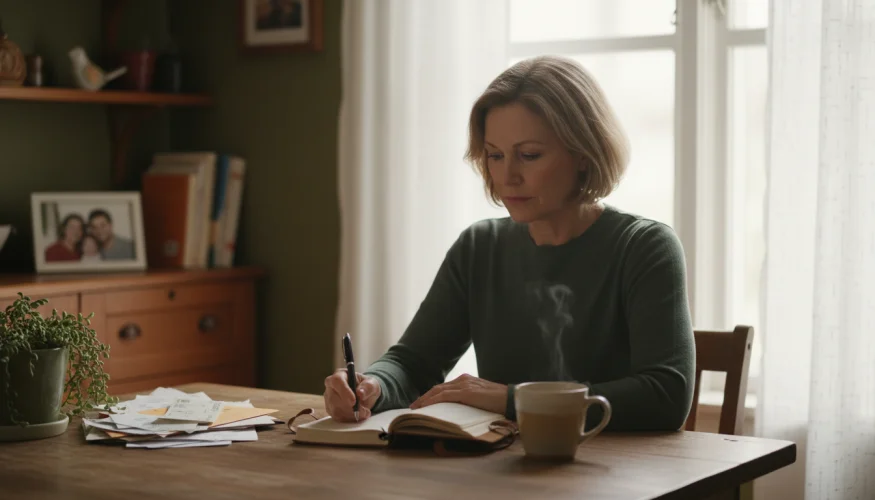
There is also a less obvious but very practical tool: writing. Research by psychologist James Pennebaker at the University of Texas has demonstrated that expressive writing – that is, freely recording thoughts and emotions connected to a difficult experience for 15 to 20 minutes a day over several days – measurably reduces psychological tension and helps people process traumatic or ambivalent experiences. Writing demands formulation, and formulation brings structure where there was chaos.
A natural part of coming to terms with a difficult decision is also embracing a time perspective. Immediately after a difficult choice, the emotional charge is strongest – a person sees only what was lost, and rarely what was gained or what was preserved. With time, the picture transforms. This does not mean the pain disappears, but it changes in character. It becomes part of the story, not its central point.
It is important, however, not to confuse acceptance with resignation. Accepting a difficult decision as part of one's own life story does not mean saying it didn't matter. It means acknowledging its weight – and moving forward nonetheless.
When It's Time to Seek Help
There are situations where one's own strength is not enough, and where coming to terms with a difficult decision turns into a chronic state of anxiety, depression, or an inability to function in everyday life. Moral injury – a term that originally arose in the context of war veterans but is now used much more broadly – describes the profound psychological impact of situations in which a person was forced to act against their values, or witnessed such actions. If feelings of guilt, shame, or hopelessness do not ease even after a considerable period of time, seeking professional help is not only reasonable, but necessary.
The Czech Psychological Association or platforms such as Nevypusť duši offer an overview of available resources, whether individual therapy, crisis lines, or self-help groups. Seeking help in such a situation is not weakness – it is precisely the kind of responsible decision that speaks to self-respect.
Returning to Jana – after three years, she has learned to accept moments of doubt as part of who she is. She stopped seeing them as evidence that she had failed, and began to understand them as a reminder of how much her mother meant to her. "Regret and love are made of the same stuff," she once told her therapist. And that sentence became an anchor for her.
Difficult decisions do not turn us into victims of our own mistakes. They turn us into people who carried something truly heavy – and continued nonetheless. And that is, perhaps, one of the most important things a person can know about themselves.