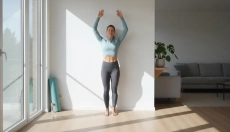

Try stepping up onto a stool instead of the gym
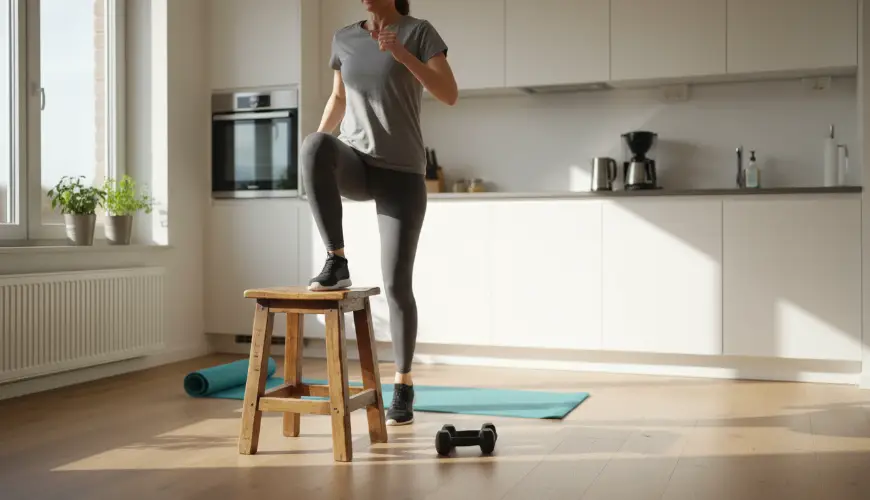
Imagine waking up in the morning, brewing a coffee, and getting a workout in before you even make it to your computer. No commuting, no waiting for machines, no membership fees. Sounds like a dream? For a growing number of people, it's an everyday reality made possible by one of the simplest yet most effective movements in the entire history of fitness – the step up. And that elevated surface doesn't have to be an expensive plyometric box from a sports shop. It can be an ordinary kitchen chair.
The step up movement is nothing new. People have been performing it in various forms since time immemorial – whether climbing stairs, stepping onto a bus, or navigating uneven terrain while hiking. But the modern fitness world has elevated it into a fully-fledged exercise that can surprise you with its effectiveness in its simplicity. And it is precisely this accessibility that makes the step up an ideal candidate for home workouts, with no need to invest in expensive equipment or pay for a gym membership.
Try our natural products




Why the step up is such an effective movement
From a physiological standpoint, it is what's known as a unilateral movement – that is, a movement in which one side of the body works independently. This is a significant advantage over classic squats or lunges performed with both legs simultaneously. During a step up, each leg must bear the full weight of the body on its own, which reveals any muscular imbalances between the left and right sides while naturally correcting them. This is precisely why sports physiotherapists recommend it not only as a training tool, but also as a rehabilitative exercise following knee or hip injuries.
The primary muscles engaged by the step up are the quadriceps – the front thigh muscles – but in reality, the entire lower body chain is involved. The gluteal muscles, hamstrings, calves, and not least the deep core stabilisers, which are constantly working to maintain balance. If you supplement the exercise with weights – say, simple dumbbells or shopping bags filled with books – you increase the demands on the entire body and approach the intensity that a gym has to offer.
Interestingly, research repeatedly confirms that unilateral training can be just as effective for building strength and muscle mass as bilateral alternatives. A study published in the Journal of Human Kinetics showed that unilateral movements activate stabilising muscles significantly more than their bilateral counterparts, contributing to better functional movement in everyday life.
Add a cardiovascular component – if you perform step ups at a faster pace or incorporate them into a circuit workout – and you have an exercise that combines strength training with aerobic exertion. This is precisely the type of movement that experts refer to as functional fitness: movement that mimics natural activities and prepares the body for real-life situations, not just performance in the gym.
Also key is how highly adaptable the step up is. A beginner can start with a low stool about twenty centimetres high and a slow pace. An advanced athlete can raise the platform, add weight, or increase the pace of repetitions to the point where their heart is pounding just as hard as during interval running. This scalability makes the step up suitable for virtually everyone – from seniors working on fall prevention to athletes looking for a supplement to their strength training.
How to properly do step ups at home
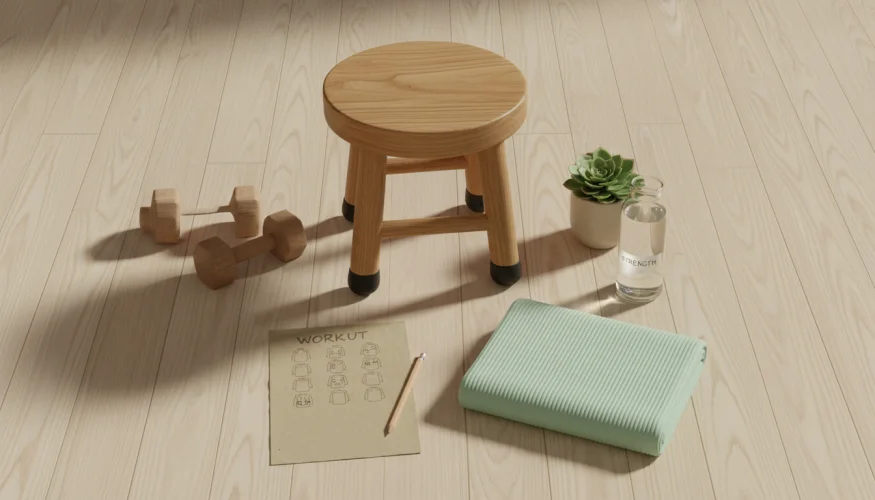
Before you begin exercising, you need to choose the right platform. Stability is absolutely crucial – the stool you step onto must not slide or wobble. Ideally, use a sturdy wooden or metal stool with non-slip feet, or a step on a staircase, which is of course firmly fixed. The height of the platform should be such that when you step up, the knee of the leading leg forms approximately a ninety-degree angle. A stool that is too low will simplify the exercise to the point where it offers little benefit; one that is too high can put excessive strain on the knee and lead to injury.
The technique is straightforward, but requires attention. Stand facing the stool and place the entire foot of your leading leg flat on its surface – the heel must be firmly planted, not hanging in the air. Then push through the heel and step up onto the stool, with the other leg either joining or remaining in the air, depending on which variation you are performing. Your back should remain straight and your gaze directed forward, not downward. Descend in a controlled and slow manner – this eccentric phase of the movement is enormously important for building muscular strength.
Petra, a thirty-four-year-old mother from Zlín, began doing step ups on her kitchen stool after her second child was born, when she had neither the time nor the energy to travel to a gym. "At first it seemed absurd to me that I'd be exercising on a dining room chair," she says. "But after three weeks I started to feel it toning my glutes and thighs. After two months I added weights, and today I do step ups with a kettlebell in each hand. I don't miss the gym at all."
Petra's story is not exceptional. Home workouts have experienced an enormous boom in recent years, and the step up on a stool has become one of its symbols – an accessible, effective, and democratic way to move regardless of financial situation or geographical location. People in small flats, in villages without a fitness centre, or with packed work schedules are discovering that movement requires nothing more than a few square metres and a sturdy stool.
As fitness trainer and bestselling author Mark Lauren put it: "Your body is the best gym you'll ever have." And while the step up does require at least a minimal piece of equipment in the form of a raised surface, the principle remains the same – effective exercise requires far less than the fitness industry would have you believe.
If you want to get the most out of your home training, it's worth incorporating step ups into a structured programme. A basic scheme for beginners might look something like this:
- Warm-up – 5 minutes of marching in place or light jumping
- Step ups – 3 sets of 12 repetitions per leg with a one-minute rest between sets
- Supplementary exercises – press-ups, planks, or squats to engage the upper body and core
- Cool-down stretching – 5 to 10 minutes focused on the thigh muscles, glutes, and calves
Such a workout can be completed in thirty to forty minutes while targeting the majority of the major muscle groups. You can gradually increase the number of repetitions, add weight, or shorten the rest periods between sets to intensify the training.
One thing that is often overlooked when doing step ups at home is consistency and progression. The body adapts fairly quickly, and if you don't increase the difficulty after a few weeks, the exercise will stop delivering results. This doesn't mean you need to keep buying heavier weights – simply adding repetitions, slowing down the descent phase, or trying a variation with a higher stool is enough.
For those who want to go even further, there are numerous advanced variations of the step up. The Bulgarian split squat, in which the rear leg rests on the stool while the front leg performs a squat, is one of the most demanding unilateral exercises there is. The plyometric version of the step up, where you jump off the platform and alternate legs in the air, adds explosiveness and significantly raises the heart rate. These variations are proof that the potential of a simple stool is virtually limitless.
It is also important to mention safety considerations. People with knee or hip problems should consult a physiotherapist or doctor before beginning this exercise. The step up is generally considered a safe exercise, but like any movement, it can cause problems if performed incorrectly or with inappropriate loading. Pain in the knee during exercise is always a signal to stop and reassess your technique or the height of the platform.
A sustainable approach to exercise is, after all, the key to long-term results. The gym has its undeniable advantages – professional guidance, a variety of equipment, the social aspect – but for many people it is not sustainable in the long term in terms of time, finances, or motivation. Home training built around functional exercises such as the step up, by contrast, requires almost nothing and can easily be incorporated into everyday life. All you need to do is set aside time after breakfast, during a break while working from home, or in the evening before the television.
The world of fitness has changed dramatically over recent decades. Information is freely available, equipment can be replaced with household items, and scientific evidence clearly shows that you don't need sophisticated machines or expensive memberships to build a healthy, strong, and functional body. The step up on a stool is perhaps the best proof of this shift – a movement that was part of human life long before the first gym ever existed, and which even in the 21st century holds its place as one of the most effective and accessible exercises for the lower body. So why not give it a try today?