

Try balancing on one leg as ankle injury prevention
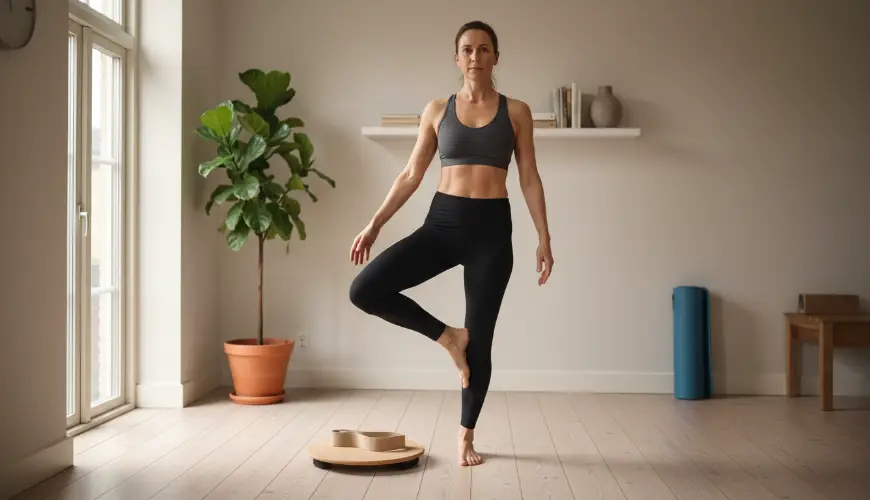
The ankle is one of the most vulnerable joints in the human body. All it takes is stepping on an uneven surface, making a quick sidestep during sport, or simply walking down stairs carelessly – and the result can be a painful sprain that puts you out of action for several weeks. Yet most people pay minimal attention to ankle care until something goes wrong. And that is precisely the problem. Ankle injury prevention is surprisingly simple and requires neither expensive equipment nor hours at the gym. One of the most effective tools is balance training – specifically balancing on one leg.
It may sound too simple. How can standing on one leg protect against injury? The answer lies deep in how our body works – in the interconnection of muscles, tendons, nerves and the brain, which together ensure stability during every movement.
Try our natural products



What happens in the ankle when you lose your balance
To understand why balancing works as prevention, it is first necessary to understand what happens in the ankle during normal movement. The ankle is not just a simple joint – it is a complex system of bones, ligaments, tendons and muscles that must handle enormous demands. When walking, it bears the weight of the entire body; when running, this load multiplies several times over. A key role is played by something experts call proprioception – the body's ability to sense the position of its parts in space without having to look at them.
Proprioceptors are tiny sensory receptors located in muscles, tendons and joint capsules. They continuously send information to the brain about how the joint is oriented, how tense it is, and how it responds to external stimuli. The brain processes these signals and immediately coordinates the muscular response. When you step on a stone and the ankle begins to roll, it is precisely proprioception and the speed of muscular reaction that determine whether you stabilise yourself or end up with a sprained ankle.
The problem arises when this system is weakened or slow. After an ankle injury – especially after a sprain – these sensory receptors are damaged. Studies published in the Journal of Athletic Training repeatedly show that people who have sprained their ankle once have a significantly higher risk of repeated injury, precisely because their proprioceptive system is not fully functional. Balance training specifically trains and strengthens this system, thereby reducing the risk of future injuries.
This is not just theory. Research published in the specialist journal British Journal of Sports Medicine demonstrated that regular proprioceptive training reduces the incidence of ankle sprains in athletes by as much as 35 to 40 percent. These are figures worth paying attention to.
Balancing on one leg: a simple exercise with a profound effect
Imagine a situation that many people will find familiar. Jana is a recreational runner who used to head out on forest trails once a week. Two years ago, she sprained her ankle on a tree root while running. Rehabilitation took six weeks, but even after returning to running she felt that her ankle was "not one hundred percent." Her physiotherapist recommended daily balance exercises – standing on one leg while brushing her teeth, cooking or waiting for the bus. After three months of regular training, her confidence while running improved significantly and she had not suffered any new injury in the past year.
Jana's story is not exceptional. Physiotherapists and sports physicians around the world recommend single-leg balancing as a cornerstone of both prevention and rehabilitation of ankle injuries. And the reasons are clear.
When you stand on one leg, your body must work continuously to maintain balance. The muscles around the ankle, the calf muscles, the muscles of the foot and the deep stabilising muscles of the entire lower limb are constantly active, making small corrections. At the same time, the proprioceptive system is trained to respond quickly and accurately. The more regularly you perform this training, the faster and more reliable these responses become. And it is precisely the speed of response that is absolutely crucial in the moment when the ankle begins to slip or roll.
Balancing on one leg is not just a matter for athletes. Older people who regularly train their balance demonstrably have a lower risk of falls – one of the most common causes of serious injury in later life. The World Health Organization WHO states that falls are the second leading cause of accidental injury death worldwide, with older adults being most at risk. Prevention through balance training is accessible to anyone, at any time and anywhere.

How to train balance correctly for healthy ankles
The good news is that starting balance training is genuinely easy. No special equipment or gym membership is needed. The foundation is consistency and gradually increasing the level of difficulty.
To begin, simply stand on one leg for 20 to 30 seconds, with the other leg slightly raised off the ground. It is an apparently trivial exercise, yet one that surprises many people – those who consider themselves physically fit often discover that maintaining balance for more than half a minute is not as easy as it looks. The ideal is to incorporate this exercise into your daily routine – while brushing your teeth, waiting for your coffee or watching television.
Once you have mastered the basic version, it is time to increase the difficulty. There are several ways to progressively make the training more challenging:
- Closed eyes – without visual input, the body must rely exclusively on proprioception, which significantly intensifies the training
- An unstable surface – a pillow, a folded blanket or a specialised balance board forces the muscles to work more intensively
- Movements of the upper limbs – adding arm movements or throwing a ball disrupts balance and requires greater concentration
- Single-leg squats – a more demanding variation that strengthens not only proprioception but also the strength of the muscles around the ankle and knee
- Walking on an unstable surface – stones, sand or grass naturally train the ankle's adaptability
Physiotherapists often recommend the so-called "stork test" – standing on one leg for 60 seconds – as a simple indicator of the functional state of the proprioceptive system. If you can manage this time without difficulty, your ankle is probably in good shape. If you are wobbling after just 10 seconds, this is a clear signal that balance training should be part of your daily routine.
As leading American physiotherapist and sports medicine expert Gary Gray said: "The ankle is the foundation of the entire movement system. If it is unstable, the instability transfers upward through the entire body." This thought aptly captures why caring for the ankle is not merely a matter of a local problem, but affects overall movement quality and health.
It is also important to mention that balance training is beneficial not only for those who have already suffered an injury. Preventive training is more effective than treatment – both in terms of health and in terms of the time and costs associated with rehabilitation. A sprained ankle may sound like a trivial injury, but when it recurs repeatedly it can lead to chronic instability, ankle osteoarthritis or long-term pain that significantly reduces quality of life.
An interesting perspective is also offered by research from Harvard Medical School, which emphasises that balance is one of the fundamental components of physical fitness – alongside strength, endurance and flexibility – and yet it is most frequently overlooked in standard training plans. People invest hours in cardio training or strength training, but pay minimal attention to balance. Yet it is precisely balance that determines whether you can handle a sudden change in terrain, a quick sidestep or an unexpected loss of stability.
Balance training also has implications for overall physical performance. Athletes who systematically work on proprioception and ankle stability are not only less vulnerable to injury, but also faster, more agile and better coordinated. Footballers, tennis players, basketball players or skiers – all benefit from an improved ability to respond to dynamic changes in body position. But the same principle applies to non-athletes. Everyday movement – walking on an uneven pavement, climbing stairs with shopping bags, playing with children in the park – requires functional balance and stable ankles.
Regular single-leg balancing is therefore one of the simplest, most accessible and most effective things anyone can do for the health of their ankles. It requires no investment, no special conditions and no great amount of time. It requires only a conscious decision to incorporate this seemingly unremarkable exercise into everyday life – and then to actually do it. Healthy ankles are not a given, but they are largely the result of how well we care for them before something goes wrong.