

# Organize a Clothing Swap and Have Fun Doing It --- Swap oblečení – neboli výměna oblečení – je s
Every one of us knows the feeling. You open your wardrobe, stare at dozens of items of clothing, and still feel like you have nothing to wear. Part of your wardrobe consists of things you bought in the euphoria of a sale but never really wore. Other pieces no longer fit, have gone out of fashion, or have simply been overshadowed by a new favourite combination. And yet it would take so little — swapping them for something someone else has stopped wearing but that would fit you perfectly. That's exactly what clothing swap is all about, a phenomenon that in recent years has been conquering not only environmentally conscious communities, but also ordinary groups of friends who want to refresh their style without unnecessary spending.
A swap, or clothing exchange, is nothing new. This practice has its roots deep in human history — people have always exchanged things they didn't need for things others did. In its modern form, however, clothing swap has taken on a new dimension. It's not just about saving money, but above all about a conscious approach to fashion that helps reduce the enormous amount of textile waste. According to data from the European Environment Agency, the fashion industry in Europe produces approximately 12.6 kilograms of textile waste per person per year — a figure that speaks for itself.
Why clothing swaps make sense
The fashion industry is globally one of the planet's biggest polluters. Producing a single cotton T-shirt consumes approximately 2,700 litres of water — as much as the average person drinks in two and a half years. Clothing exchange disrupts this cycle in the most natural way: it extends the lifespan of already manufactured items and slows demand for new production. But alongside the ecological dimension, a swap has another equally important aspect — a social one.
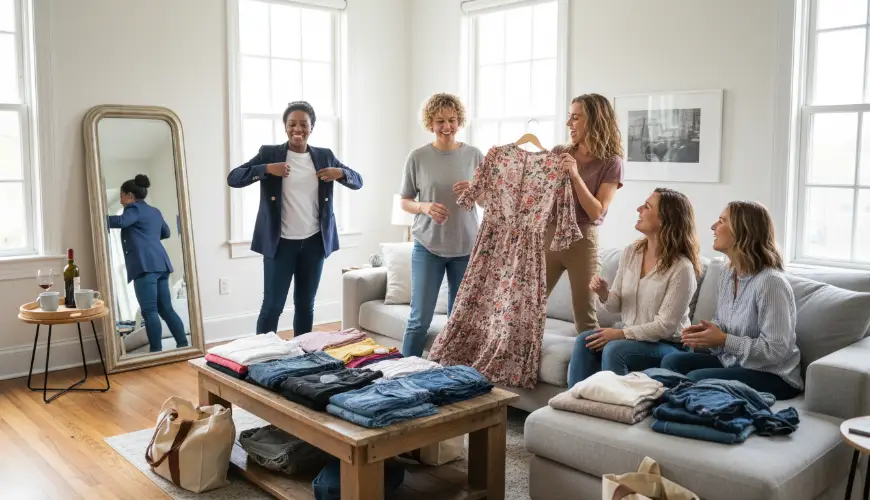
Imagine a Saturday afternoon at a friend's place. Piles of T-shirts, dresses, and jumpers are stacked on the sofa. Coffee sits on the table and a bottle of wine is being opened. Everyone has brought a bag of things that are just taking up space at home, and now they're enthusiastically rummaging through what the others have brought. Someone finds the jeans they've been looking for all year. Another leaves with an elegant blouse that would have cost a thousand crowns in a shop, yet paid nothing for it. This is exactly how clothing exchange with friends works in practice — and precisely why a one-off event becomes a regular ritual that everyone looks forward to.
A swap isn't just about things. It's an opportunity to spend time with people you care about, share the stories behind individual pieces of clothing, and discover new combinations you would never have thought of on your own. Fashion stylist and author of books on sustainable fashion Orsola de Castro put it aptly: "The most sustainable garment is the one that already exists." And what is a swap if not a celebration of exactly that?
Clothing exchange also has one practical effect that many people only realise in hindsight: it forces you to think about what you actually wear and what you're simply hoarding. The process of sorting through your wardrobe before a swap is therapeutic in itself. It makes you ask questions you would never otherwise ask yourself — why you bought that item in the first place, what doesn't work for you about it, and whether someone else might make better use of it than you.
How to organise a clothing swap step by step
Organising a clothing exchange isn't complicated, but a few basic rules will help ensure that everyone leaves with a good feeling — and ideally a few new additions to their wardrobe.
Start by choosing a host and a venue. A spacious living room or larger room where items can be laid out clearly is ideal. If you're planning a bigger event, a community centre or a café that rents out its space can work well. The number of participants should ideally be between six and fifteen — with fewer people the selection is limited, while with more the organisation can become chaotic.
The next step is setting the rules. Experienced organisers agree on this: clear rules from the outset prevent misunderstandings and disappointment. Each participant should bring at least five items of clothing that are clean, free from significant defects, and in wearable condition. There's no need to insist on branded items — quality matters, not origin. Torn T-shirts or items with stains, on the other hand, have no place at a swap.
When it comes to how the event itself runs, there are several tried-and-tested formats. The simplest is a free exchange, where everyone brings their items, lays them out, and others browse freely. This system works well among close friends where there is mutual trust. Another approach is a token or points system — each participant receives as many points as the number of items they bring, and hands over one point for each item they select. This system is fairer with a larger number of participants or if you're unsure whether contributions will be balanced.
Don't forget to think about practical details. A mirror — ideally several — is an absolute must. So too is a space for trying on clothes, whether an improvised changing area behind a curtain or a bathroom. We recommend sorting items by category: T-shirts separately, trousers separately, dresses and skirts together, accessories on a separate table. This simple organisation saves a lot of confusion and makes it easier for everyone to find their way around.
At the end of the event, there's usually a pile of items nobody chose. It's worth being prepared for this too. Agree in advance what will happen to them — whether everyone takes back what they brought, or whether the unclaimed pieces will go to a second-hand shop, a charity shop, or a textile collection point. There are several options and none is wrong — it's just good to be clear about it beforehand.
If you want to take your swap to the next level, you could add a mini fashion show where everyone models their new find. Or prepare a small style consultation — one of the participants can play the role of stylist and help others combine their new pieces with what they already have at home. This added value transforms a swap from a mere exchange of items into a genuine experience.
It's worth mentioning that clothing swaps don't have to be limited to friends. Increasingly popular are public swaps organised by community organisations, environmental groups, or even companies as part of their sustainability initiatives. In the Czech Republic and Slovakia, there are a number of platforms and social media groups where similar events are regularly organised and where you can find inspiration or simply join in. One active community is Slow Fashion Czech, which regularly shares tips on sustainable fashion, including information about swaps.
What to do with items that don't make it to the swap
Not every item of clothing is suitable for exchange. Older pieces with minor flaws that could be repaired deserve a second chance before you take them anywhere. Basic repairs such as sewing on a button, hemming trousers, or patching an inconspicuous spot can extend the life of clothing by years. Many cities now offer repair shops and tailors focused specifically on sustainable textile repair — and the cost of a repair is usually a fraction of the price of a new item.
If clothing is truly worn out and can neither be repaired nor donated, that doesn't mean it has to end up in the bin. Textile collection points, which are now available in most Czech towns and cities, ensure that the material is further processed or recycled. Organisations such as Diakonie ČCE and Charita ČR operate networks of collection points, where clothing either goes directly to people in need or to second-hand shops whose proceeds fund social programmes.
It's natural that not every swap will end with everyone taking home a full bag. Sometimes you simply won't find anything that fits or appeals to you. And that's fine. Even an empty bag on the way home has its value — it made you go through your wardrobe, let go of things you don't need, and contribute to the possibility of someone else wearing them. That's the true essence of a swap: it's not about having more, but about having better. Having things you actually wear, that suit you, and that have a story — perhaps the story that your best friend wore them before you.
And perhaps that's the greatest magic of clothing exchange. At a time when shopping has been reduced to a click and a parcel at the door, clothing swaps restore fashion's original social dimension. They serve as a reminder that behind every item stands a person — the one who made it, the one who wore it, and the one who is now passing it on. And that's a value no online shop can offer.