

Linden blossom and its effects on colds
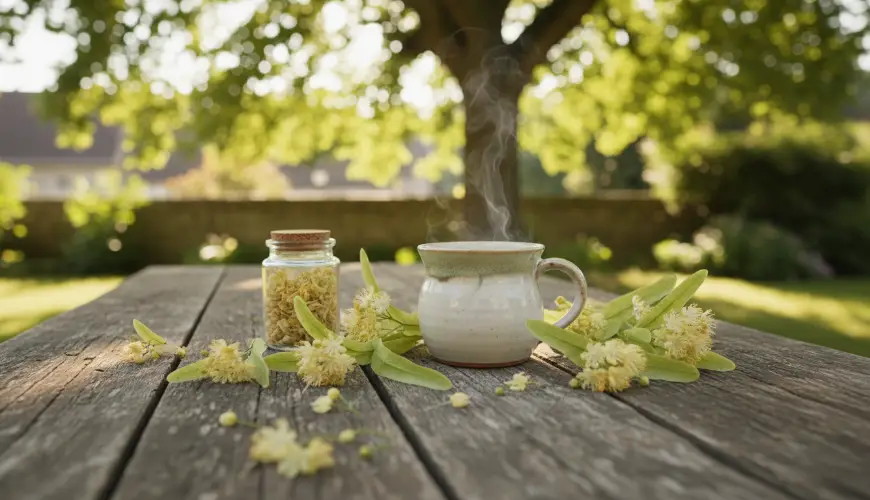
There is something calming about the idea of stopping beneath a sprawling linden tree in full bloom, closing your eyes, and breathing in that unmistakable fragrance which, for a brief time each summer, permeates entire streets, parks, and country roads. The linden is not only a symbol of Central European landscape and Czech national identity — it is also one of the most precious natural pharmacies that nature offers us completely free of charge. And yet most of us let it bloom and fade every year without notice, without extracting even a fraction of what it has to offer.
Linden blossom is among the oldest and most widespread herbs in traditional European medicine. As far back as the Middle Ages, it was considered a universal remedy for fever, restlessness, and various colds. Today its effects are confirmed by modern science as well — according to data from the German Commission E, which evaluates medicinal plants, linden flowers (Tilia spp.) are recognised as a herbal medicinal product that promotes perspiration during colds and soothes irritation of the mucous membranes of the upper respiratory tract. That is quite a strong statement for something that grows around the corner from almost every Czech home.
Try our natural products





When and How to Harvest Linden Blossom
Harvesting linden blossom is a science in itself, and those who master it have a supply of quality raw material every year that will last until the following summer. Timing is above all crucial. Linden typically blooms in June and July, with different species — small-leaved linden (Tilia cordata) and large-leaved linden (Tilia platyphyllos) — having their harvesting periods offset by one to two weeks. The large-leaved linden blooms earlier, approximately in the first half of June, while the small-leaved linden comes into its own at the end of June or the beginning of July.
The cardinal rule is: harvest when the flowers are just beginning to open or at the very moment of full bloom, never after they have started to fall or turn brown. It is precisely within this brief window that the concentrations of active compounds — flavonoids, mucilages, essential oils, and tannins — are at their highest. If harvesting is delayed by even a week, the quality of the raw material drops dramatically.
In practical terms: harvest the entire inflorescence together with the leafy bract, as it is the bract that contains valuable mucilaginous substances. Harvest in dry weather, ideally in the morning after the dew has dried but before the greatest midday heat. Avoid linden trees growing alongside busy roads or in industrial areas — their blossom may be contaminated with heavy metals and exhaust fumes. Trees on the edges of meadows, in parks far from traffic, or in gardens are ideal.
The quantity you harvest depends on your needs. A family supply for an entire winter is usually covered by around 200 to 300 grams of dried blossom, which corresponds to approximately one to two kilograms of freshly picked material. Fresh blossom is very airy and light, but once dried its volume decreases significantly.
Proper Drying as the Foundation of Quality
Drying linden blossom is the step on which the entire effort stands or falls. Poorly dried raw material loses not only its fragrance and colour, but above all the active compounds that make the whole endeavour worthwhile. The basic rule is simple: dry quickly, at a low temperature, and in the shade.
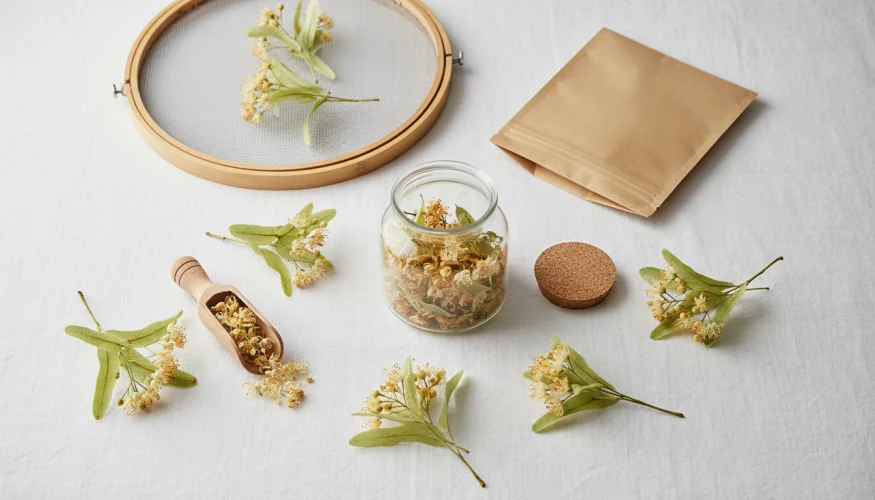
Spread freshly harvested blossoms in a thin layer on a clean linen or paper surface. The ideal location is a well-ventilated room without direct sunlight — an attic, a veranda, or even the shade beneath a pergola all work excellently. Direct sunlight breaks down the essential oils and causes browning, which is a visual signal of quality loss. The drying temperature should not exceed 35 to 40 degrees Celsius; if you are using an herb dryer, set it to the lowest setting.
During drying, gently turn the blossoms once a day so that air circulates evenly from all sides. The entire process usually takes three to five days, depending on air humidity and ambient temperature. Properly dried linden blossom is easy to recognise: it is brittle, crumbles at the touch, retains a pale yellow to cream colour, and smells intensely of honey with a faint spicy note.
Store the dried blossom properly in sealed glass jars or paper bags in a dark, dry place. Plastic containers and transparent vessels exposed to light are not suitable, as light and air accelerate the degradation of active compounds. Properly stored linden blossom retains its full quality for approximately one year — precisely until the following summer, when it is time for a new harvest.
Linden Blossom Tea at the First Signs of a Cold
And now to what most people harvest or buy linden blossom for: preparing it as a tea at the first signs of a cold. It is worth saying upfront — linden tea is not a miracle cure, but it is one of the most effective and pleasant ways to help the body at the moment you sense that something is brewing. A scratchy throat, mild fatigue, a slight runny nose — these are the moments when linden tea truly shines.
The active compounds in linden blossom work on several fronts simultaneously. Flavonoids, particularly tiliroside and quercetin, have anti-inflammatory properties. Mucilaginous polysaccharides form a protective film on the mucous membrane of the throat and upper respiratory tract, thereby soothing irritation and coughing. The essential oils then promote perspiration, which is the natural mechanism by which the body reduces fever. This is precisely why linden tea is traditionally drunk hot and under a blanket — not to make the person suffer, but to support the natural course of the body's defences.
Preparing the tea is very straightforward. Pour approximately 200 millilitres of hot water — not boiling, but hot, ideally around 80 to 90 degrees Celsius — over one to two teaspoons of dried linden blossom. Leave to steep covered for 10 to 15 minutes. Covering is important so that the essential oils do not escape with the steam. Then strain and drink slowly while the tea is still hot. Adults can drink two to three cups a day; one cup is sufficient for children over three years of age.
To enhance the effect, combine linden blossom with other herbal allies. The classic combination with chamomile strengthens the anti-inflammatory effect, adding ginger or cinnamon warms the body and promotes perspiration. A teaspoon of honey in each cup is not merely a matter of taste — honey has its own antimicrobial properties and at the same time soothes the throat. Lemon juice adds vitamin C and a pleasant freshness.
Consider a specific example: Jana from Brno travels with her family to the countryside at the end of June every year, where they harvest linden blossom from old trees on the edge of a village. She divides the dried blossom into small jars, which she then gives to relatives as gifts. She says that since she started using linden tea at the first sign of a scratchy throat each autumn, she has noticeably shortened the time her children spend ill. Of course, this is not scientific evidence — but such experience speaks for itself.
It is also important to mention safety. Linden tea is generally considered safe for most people when used in moderation. However, with long-term and excessive intake — on the order of many cups a day over an extended period — heart damage may occur in isolated cases, as some expert sources suggest. This concerns exclusively extreme overuse, not sensible seasonal consumption within the range of two to three cups a day. Pregnant women should consult a doctor before regular use.
As German physician and pioneer of phytotherapy Rudolf Fritz Weiss said: "Herbal medicine is not an alternative to modern medicine — it is its complement, rooted in millennia of human experience." Linden blossom is precisely such an example: an herb that has stood the test of time and whose effects are today confirmed by science.
It is fascinating how something so accessible and unassuming can simultaneously be so useful. In an era when the market is bursting with dietary supplements in glossy packaging and exotic superfoods from the other side of the world, it is worth pausing and looking at what the linden tree around the corner has to offer. Harvesting, drying, and preparing tea from linden blossom are not merely a practical skill — they are also a form of slow, mindful relationship with nature and the seasons. And that is a value no capsule can replace.