
Spiders in the House in Autumn and How to Repel Them Naturally
Every year it repeats itself like a precisely planned ritual. As soon as the days start getting shorter and outdoor temperatures drop, spiders begin appearing in the corners of living rooms, behind curtains, and under furniture. For some, it's an unpleasant surprise; for others, a nightmare. Yet few people know why this actually happens and what can be done about it without resorting to chemical sprays full of toxic substances.
The autumn invasion of spiders into homes is neither a coincidence nor the result of some coordinated action by eight-legged creatures. It is a natural biological phenomenon that has its own logic and its own causes. Understanding these causes is the first step towards managing the situation effectively while also being gentle – on yourself, your family, and the environment.
Try our natural products




Why do spiders come indoors in autumn?
Spiders are creatures that follow the rhythm of nature far more than most people realise. Contrary to the widespread myth, spiders do not move into homes because of winter – most domestic species do not live outdoors at all and spend the entire year inside buildings, we simply don't notice them. Those that come in from outside do so primarily for reproductive reasons. Autumn is the peak mating season for many spider species, and males set out on exploratory journeys in search of partners. This is precisely why in September and October we suddenly see spiders moving across floors and walls – they are mostly males on their way to find females.
There is another factor at play as well: the insects that make up spiders' food also retreat to warmer environments in autumn. Where there is food, predators follow. Houses and flats are therefore attractive to spiders not only as shelter but also as a food source. Flies, mosquitoes, moths, and other small insects are drawn to the warmth and light inside buildings, and spiders simply follow them.
It is also important to mention that spiders are not our enemies. Quite the opposite – they are natural regulators of insect populations, and their presence in the home has its advantages. Nevertheless, it is understandable that not everyone wants to share their living room with a garden spider or a house spider whose body can reach a surprisingly large size. And this is precisely where the question arises: how can we get rid of spiders or reduce their presence without resorting to chemicals?
Chemical insecticides and pesticides are effective, but their use in enclosed living spaces carries risks. They can be harmful to children, pets, and adults who are exposed to them over a long period. Moreover, their effect tends to be temporary and does not address the root cause of the problem. Natural alternatives are therefore an increasingly popular choice – and they have proven to be surprisingly effective.
Natural spider repellents that actually work
Nature itself offers a whole range of substances that spiders cannot stand. Their olfactory receptors are located on their legs and are extraordinarily sensitive, making them creatures that are very responsive to strong scents. This characteristic can be used to the home's advantage.
Peppermint essential oil is among the most frequently recommended natural repellents. Spiders cannot stand its intense scent and avoid places where it is present. Simply dilute a few drops of the oil in water, pour into a spray bottle, and spray onto window frames, door thresholds, corners, and other places where spiders like to linger. The effect is short-lived – the application needs to be repeated approximately once a week – but the results are noticeable. As a bonus, peppermint leaves a fresh scent in the room that is pleasant for people.
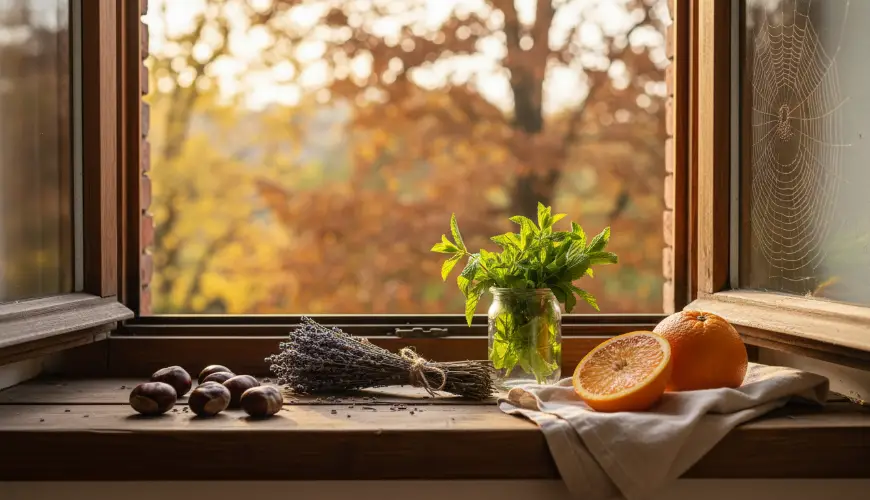
Eucalyptus or lavender essential oil is similarly effective. Lavender has the added advantage of repelling moths, making it an ideal choice for wardrobes and cupboards. Fresh sprigs of lavender or small fabric sachets filled with dried lavender placed in the corners of rooms can significantly reduce the presence of spiders and other insects.
Another tried-and-tested remedy is vinegar. White distilled vinegar mixed with water in a 1:1 ratio makes an effective spray that spiders dislike. Bear in mind that its scent is not particularly pleasant for people, but it dissipates quickly. Vinegar is completely safe, readily available, and very affordable.
A lesser-known but highly effective option is the chestnut trick. The fruits of the horse chestnut tree, which fall from the trees in autumn, contain substances that spiders reportedly cannot stand. Placing chestnuts along window sills and door thresholds is a traditional folk remedy whose effectiveness has not been conclusively confirmed by science, but many households have used it successfully for generations. And even if it were merely a placebo effect, chestnuts are certainly a lovely autumn decoration.
Citrus peel is another natural repellent worth mentioning. Fresh peel from lemons, oranges, or grapefruits placed in areas where spiders most commonly appear can reduce their presence. The essential oils contained in citrus peel are repellent to spiders, while their scent is, on the contrary, very pleasant for people. The peel needs to be replaced every two to three days to maintain its effectiveness.
Alongside these aromatic remedies, prevention also plays a key role. As the British organisation Buglife, which is dedicated to the protection of invertebrates, points out, spiders most commonly enter homes through ill-fitting windows, cracks in walls, and gaps under doors. Sealing these entry points is therefore one of the most effective measures of all – and entirely chemical-free.
Regular cleaning is another pillar of prevention. Spiders love clutter, dust, and dark corners where they can wait undisturbed. Regularly vacuuming corners, the space behind furniture and under beds, as well as removing cobwebs, signals to spiders that a given spot is not suitable for permanent settlement. Cobwebs are best removed as soon as possible – once a spider has built one, it begins to consider it home and will keep returning to it.
An interesting and entirely natural option is also getting a pet. Cats are natural hunters of spiders, and their presence in the home significantly reduces the number of eight-legged visitors. This is of course not a solution for everyone, but for cat lovers it is a pleasant side effect of their company.
As entomologist and science populariser David George Gordon once remarked: "Spiders are among the most useful creatures that share our homes with us – the problem is simply that we never agreed on it." This statement aptly describes the whole situation: it is more a question of coexistence than of war.
A practical example of how the natural approach works in everyday life can be found in the experience of a family from Prague who struggled every autumn with spiders in their ground-floor flat with access to a garden. After years of using chemical sprays, they switched to a combination of peppermint, regular sealing of windows, and chestnuts on the window sills. The result? According to them, the number of spiders dropped to a fraction of what it had been – without a single drop of chemicals.

When is the presence of spiders truly a problem?
In Central Europe, the presence of spiders in the home poses no health risk. None of the commonly occurring species, such as the house spider (Tegenaria domestica) or the garden spider (Araneus diadematus), represents a serious risk to a healthy person. Their bite is theoretically possible, but in practice it occurs only rarely, and its consequences are comparable to a mosquito sting. Detailed information about individual species and their behaviour is provided by, for example, the Czech Arachnological Society, which is dedicated to the research of spiders and other arachnids in the Czech Republic.
Nevertheless, there are situations where it is advisable to address the matter more thoroughly. If the presence of spiders is truly massive, it may signal a larger problem – for example, an overpopulation of insects in the home that is attracting spiders as prey. In such a case, it is useful to focus first on eliminating the insects, and the spiders will move on elsewhere in search of food.
It is also important to note that an excessive effort to completely eradicate spiders from the home is neither desirable nor realistic. Spiders are part of the natural ecosystem and their presence in small numbers is normal and beneficial. One average house spider can eliminate hundreds of insects over the course of a year – from flies and mosquitoes to moths. The goal should therefore not be the complete disappearance of spiders, but rather maintaining their numbers at an acceptable level and preventing them from settling in places where they are unwelcome.
Autumn serves as an annual reminder that we live in an environment shared with many other creatures – whether we like it or not. Instead of fighting nature, it pays to find ways to get along with it. And if a little peppermint, a handful of chestnuts, and regular cleaning are enough to achieve this, it is a path that makes sense not only for us, but also for the planet we live on.