

Grease the Groove: A Method for Your First Pull-Up

There is a method that few people talk about, yet it ranks among the most effective ways to master an exercise that troubles beginners and advanced athletes alike all over the world. The pull-up – or chin-up if you prefer – is for many people an almost unattainable goal. And this is precisely where an approach called grease the groove comes into play, a phrase that translates roughly as "lubricating the groove," whose principles are surprisingly simple, even though they rest on solid scientific foundations.
Imagine someone who exercises every day but never gets out of breath, never feels a burning sensation in their muscles, and yet after a few weeks suddenly manages to pull themselves up on a bar where before they couldn't even reach the halfway point of the movement. This is exactly the scenario described by thousands of people who have tried this method. It is no miracle or marketing trick – it is pure neurology applied to everyday movement.
Try our natural products



What does "greasing the groove" actually mean?
The entire philosophy of the grease the groove method comes from the legendary Russian trainer Pavel Tsatsouline, who popularised it especially in the world of kettlebell training and military preparation. The core idea is simple: the brain learns movement through repetition, not exhaustion. The more times a nerve impulse travels the same path, the stronger and more efficient that path becomes over time. This is precisely how myelination of nerve fibres works – a process in which nerve fibres become coated with a myelin sheath, which speeds up the transmission of signals between the brain and muscles.
In other words, when someone wants to master the pull-up, they don't need to spend an hour every day in the gym with bands and weights. Instead, it is enough to perform the given exercise or a variation of it several times a day, but always with something in reserve – never to failure, never to pain, never to fatigue. The movement should always look clean, controlled and without unnecessary effort. This condition is key, and it is also what distinguishes grease the groove from classic strength training.
Let us take a specific real-life example. Jana works from home and has a pull-up bar installed in the doorframe leading to the kitchen. Every morning when she goes to get coffee, she does two negative pull-ups – that is, a slow descent from the top position downward. After lunch she adds three pull-ups with a resistance band that compensates for part of her body weight. In the evening, before going to bed, she tries one pull-up with her own bodyweight. The entire training takes her no more than three minutes a day, she never gets tired, and her back and shoulders never hurt. After six weeks she manages her first clean pull-up without assistance. This scenario is not exceptional – it is a precise description of how the method works in practice.
It is important to understand why the classic "give it everything" approach fails so often. When someone trains pull-ups to absolute failure, the muscles are exhausted, form breaks down, and the brain memorises the movement in its worst form. The neural pathway is activated, but at the same time the pattern of poor technique and compensation is also reinforced. The result is that despite all the effort, progress stalls or injury even occurs. Grease the groove elegantly bypasses this problem because every repetition is quality, clean and technically correct.
How to practically incorporate the method into daily life
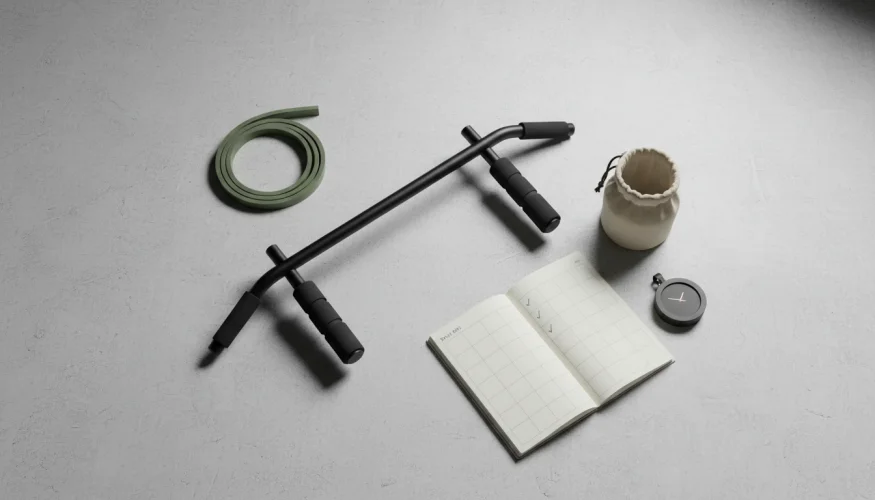
The most common question people ask is exactly how to fit grease the groove into their day. The answer depends on each person's starting point, but the general principle remains the same: choose an exercise or a suitable variation, set the number of repetitions at 40–60% of your maximum, and repeat it as frequently as possible throughout the day.
For someone who cannot yet do a single pull-up, this might mean negative pull-ups – jumping to the top position and lowering themselves down as slowly as possible. Someone else might work with a resistance band that compensates for part of their body weight. Another person might start with Australian pull-ups on a low bar, where the feet remain on the ground and the movement is significantly easier. Each of these variations meets the basic requirement: the movement should be achievable without excessive effort and with perfect technique.
A key aspect that people often underestimate is frequency. The grease the groove method works best when practised truly every day, or at least five to six times a week. The ideal solution is to place the bar somewhere you naturally pass through – in a doorframe, in a hallway or in the living room. Every time you walk past, you do a pre-determined number of repetitions. This approach, which some call "greasing the groove throughout the day," requires no special preparation, warm-up or equipment. All you need is a bar and determination.
Many sports scientists and coaches agree that this type of so-called submaximal training is extraordinarily effective for developing motor skills. Research published in the Journal of Strength and Conditioning Research repeatedly shows that neuromuscular adaptation – the brain's ability to recruit muscle fibres more efficiently – occurs most effectively with repeated, technically clean execution of a movement, not with training at the edge of failure.
Pavel Tsatsouline himself summarised this philosophy with the words: "Stop training to fatigue. Train to skill." This sentence perfectly captures why grease the groove works where traditional approaches fail.
In practical terms, a typical day using the grease the groove method for a beginner might look like this: three negative pull-ups after waking up in the morning, two pull-ups with a band at noon, three more negatives in the afternoon, and two more with a band in the evening. That is ten repetitions in a day, but none of them require maximum effort. Over a week, that amounts to seventy repetitions – and that is a number that gives the brain and nervous system sufficient stimulus to truly learn the movement.
The key question that remains is how long the method takes. It depends on your starting point, frequency and consistency, but most people report the first visible results after four to eight weeks. Those starting from zero – meaning with no strength in the upper body whatsoever – may need three to four months before managing their first clean pull-up. It is not a fast route, but it is a reliable one – and that is precisely what matters when it comes to movement skills.
One of the less frequently mentioned benefits of the method is also its impact on joint health. Because the movement is never performed to failure and the muscles are never overloaded, tendons, ligaments and joints have sufficient time to adapt without the risk of inflammation or overuse. The pull-up places particular demands on the elbow joints and shoulders, which is precisely why it is so common in classic training for people to end up with tendinitis or rotator cuff pain. Grease the groove significantly reduces this risk, because it loads the body gradually and proportionately.
Interestingly, the method can be applied not only to pull-ups but to virtually any exercise that requires a specific motor skill – from push-ups and squats to handstands. The principles remain the same: submaximal load, high frequency, perfect technique. Renowned physiotherapist and populariser of movement science Dr. Stuart McGill similarly emphasises in his work that movement patterns are consolidated through the repetition of quality movement, not through its quantity at the cost of technical degradation.
For women attempting pull-ups, grease the groove is a particularly suitable method. Statistically, women have on average less absolute strength in the upper body than men, which makes pull-ups more challenging for them. Classic strength training focused on hypertrophy can be demotivating, because results come slowly and the effort is high. Grease the groove offers a different approach: rather than building muscle mass, it focuses primarily on neuromuscular coordination – in other words, on teaching the brain to efficiently recruit the muscle fibres a person already has. The result is that many women manage their first pull-up sooner than they would have expected – and without a single day of classic strength training.
Consistency is absolutely crucial with the grease the groove method. Missing one day does not matter much, but regularly interrupting the process means the neural pathway does not have a chance to consolidate sufficiently. The brain needs repetitions close together in time for myelination to proceed effectively. A week-long break can mean having to start almost from scratch. It is therefore better to do fewer repetitions every day than many repetitions once every three days.
It is worth noting that grease the groove is not a substitute for a comprehensive training plan for those who want to build overall physical fitness. It is a tool focused on a specific goal – mastering a movement skill. Anyone who also wants to improve cardiovascular fitness, reduce body fat or build muscle mass will need other components of physical activity as well. But for that one specific goal – mastering the first pull-up – grease the groove is probably the most effective method in existence.
A pull-up bar in a doorframe, a few minutes a day, and the willingness to trust the process even when results are not immediately visible. That is the entire secret of a method that has helped thousands of people achieve what they considered impossible. The pull-up ceases to be an unattainable goal and becomes simply a matter of time – and a properly greased groove.