
Loofah and plant-based alternatives to plastic dish sponges
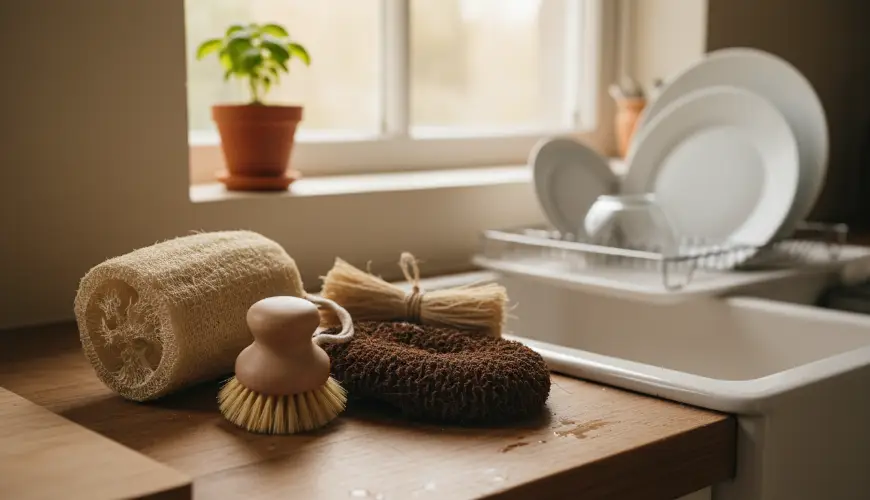
Each of us knows it – that classic synthetic dish sponge that starts to smell after a few weeks, begins to fall apart, and eventually ends up in the bin. Then a new one comes. And another. Few people realise that in the Czech Republic alone, millions of such sponges are thrown away every year, each one made from plastic that can take decades or even centuries to break down in nature. Yet alternatives exist that people have been using for centuries, long before the petrochemical industry invented synthetic materials. Plant-based dish scrubbers – and loofah in particular – are one of the simplest ways to make a small but meaningful change in the household.
Interest in natural alternatives to common kitchen tools has been growing significantly in recent years. This is not merely a fashionable trend or a marketing trick – behind it lies a genuine effort by people to reduce the amount of plastic waste they produce every day. And the kitchen is a place where it is surprisingly easy to start.
Try our natural products


What loofah actually is and where it comes from
Many people think loofah is a sea creature similar to sponges. In reality, it is the fruit of a tropical plant from the gourd family, specifically the species Luffa aegyptiaca or Luffa acutangula, grown mainly in Asia, Africa, and Latin America. When the fruit fully ripens and dries out, its flesh transforms into a dense fibrous network – and it is this network that serves as a natural scrubber. The resulting product is lightweight, durable, and surprisingly effective at washing dishes.
Loofah has thousands of years of history behind it. In ancient Egypt, India, and China, it was used for personal hygiene as well as a kitchen tool. Today it is experiencing a renaissance, this time in the context of a sustainable lifestyle. And no wonder – it is one hundred percent biodegradable, compostable, and with proper care it lasts surprisingly long.
How does loofah work in practice? Take the example of Klára, a thirty-year-old Praguean who decided a year ago to gradually replace plastic products in her household with natural alternatives. She started with loofah. "At first I was sceptical about whether it would actually clean anything," she says. "But after the first use I was surprised – the dishes were clean, the scrubber lathered well with any detergent, and most importantly – after a month it still didn't smell like those plastic ones." Klára's experience is not exceptional. Thanks to its open fibrous structure, loofah dries faster than synthetic sponges, which significantly reduces the risk of bacterial growth.
It is important to know how to care for loofah properly. After each use it should be wrung out well and left to air dry – ideally in a place with good airflow. Occasionally it can be soaked in a solution of water with a little vinegar or baking soda, which helps keep it clean and fresh. When the loofah has run its course – which you can tell when it becomes too soft or starts to fall apart – you simply toss it in the compost. No plastic, no microplastic waste.
Other plant-based scrubbers worth considering
Loofah is undoubtedly the star among plant-based scrubbers, but it is far from the only option. The world of natural kitchen tools is richer than it might seem, and each alternative has its own specific properties and advantages.
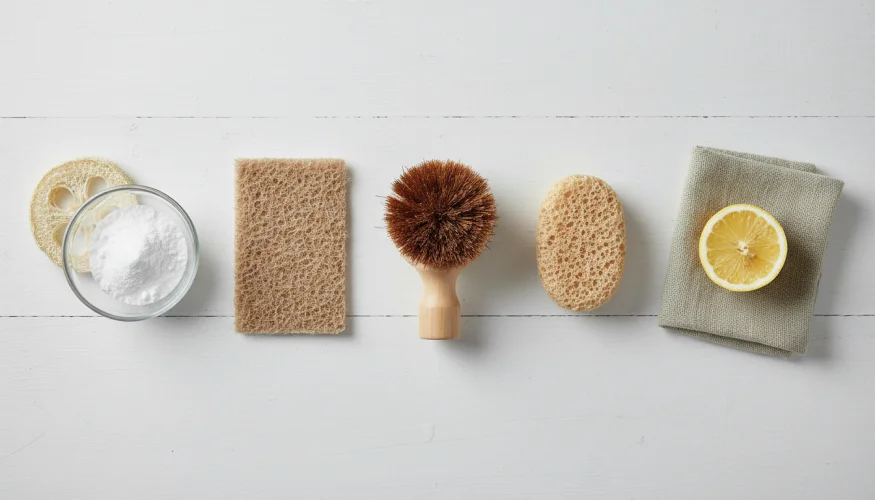
One of the oldest and most widespread options is the agave fibre scrubber. Agave, that impressive plant typical of Mexico and Central America, provides tough natural fibres that are ideal for more abrasive cleaning. Agave scrubbers and brushes are harder than loofah, making them particularly suitable for burnt pots, cast iron pans, or tougher grime. They are also fully compostable and their production has a long tradition in Mexican culture.
Another interesting alternative is coconut fibre scrubbers, known as coir. Coconut shell is a by-product of coconut processing, so its use is an example of circular economy in practice. Coconut scrubbers and scourers are very durable, have naturally antibacterial properties, and are excellent at removing dried-on food residue. They are somewhat harder than loofah, so they are not suitable for non-stick surfaces, but they work brilliantly on stainless steel cookware or ceramics.
For gentler washing, such as porcelain or glass, you can reach for sisal fibre scrubbers. Sisal comes from Agave sisalana and its fibres are softer than coconut, yet sturdy enough for everyday use. Sisal scrubbers are also popular because they are available in combination with cotton or hemp, which gives them a pleasant texture.
Hemp scrubbers and cloths also deserve a mention. Hemp is one of the most sustainable crops of all – it grows quickly, requires no pesticides, and almost every part of it has a use. Hemp kitchen tools are durable, quick-drying, and have a natural antimicrobial ability. They are also excellently compostable. According to a report by the European Environment Agency, hemp is among the crops with the lowest ecological footprint within the entire agricultural sector.
A special category is formed by cellulose and natural latex sponges – the so-called "natural cellulose sponge". Unlike classic synthetic cellulose sponges, which contain additives and dyes, natural ones are made from plant cellulose without chemical additives. They are soft, absorbent, and suitable for delicate surfaces. Their biodegradability depends on the specific composition, so it is important to read labels and choose certified products.
So how do you make sense of all these options and decide what to choose? It depends primarily on what you need the scrubber for. For everyday dishwashing, loofah is the ideal choice – it is versatile, readily available, and reasonably priced. For more abrasive cleaning, reach for agave or coconut fibre. For delicate surfaces, sisal or cellulose variants are more suitable. Many households end up combining several types, with each having its place.
Why the choice of scrubber matters more than we think
It might sound exaggerated – after all, we are talking about a dish sponge. But it is precisely in small things that a large part of our everyday plastic waste is hidden. According to estimates by the Plastic Soup Foundation, small plastic kitchen tools are among the most significant sources of microplastics in the home environment. Synthetic sponges gradually break down during use and release microplastic fibres that enter wastewater and subsequently the natural environment.
Microplastics are now detected practically everywhere – in drinking water, in marine animals, in soil, and in the human body. The World Health Organisation (WHO), in its report on microplastics in drinking water, warns that while sufficient data for definitive health conclusions are not yet available, a precautionary approach is warranted. In other words – minimising sources of microplastics in the home is a sensible preventive measure.
Switching to plant-based scrubbers is not merely a gesture. It is a concrete, measurable step towards reducing plastic waste. The average household uses approximately one synthetic sponge every three to four weeks, meaning ten to twelve sponges per year. If just one million Czech households switched to plant-based alternatives, ten to twelve million plastic sponges would be saved every year – and that is a number that sounds rather different.
Plant-based scrubbers have another advantage that receives less attention: they support traditional craft production and local agriculture in developing countries. Most loofah, agave, and coconut products come from small farmers in Asia, Africa, or Latin America, who thanks to growing demand for natural alternatives are gaining a sustainable income. When shopping, it is of course advisable to look for products with fair trade certification or at least from transparent producers who disclose the origin of their raw materials.
As the philosopher and environmental activist Aldo Leopold wrote: "A thing is right when it tends to preserve the integrity, stability, and beauty of the biotic community. It is wrong when it tends otherwise." This thought from his work A Sand County Almanac perfectly captures why even seemingly small decisions – such as the choice of a dish scrubber – have their deeper meaning.
The switch to plant-based scrubbers does not need to happen overnight. It is enough that next time the old synthetic one runs out, you reach for a natural alternative. Try it out, see how it behaves, how long it lasts, what works best with it. Most people who make this change do not voluntarily go back to plastic sponges – and that is probably the best recommendation there can be. Natural scrubbers are not about deprivation or compromise. They are about the fact that the same job can be done by something that leaves no trace where it should not.