

# Menstrual Cycle as a Key Indicator of Women's Health

Blood pressure, pulse, breathing, body temperature – these are the four vital signs that doctors measure first when they want to assess a patient's condition. They are the fundamental indicators of life, barometers of health that no one questions. And yet there is a fifth signal that has escaped medicine's attention for centuries, being overlooked, dismissed, or outright suppressed. For women, it is the menstrual cycle – and a growing number of experts now agree that it should be considered just as fundamental an indicator of health as the other four.
The American gynecological society ACOG (American College of Obstetricians and Gynecologists) formally endorsed this view as early as 2015, when it issued a statement recommending that the menstrual cycle be treated as a vital sign of health in girls and women. This is therefore not merely a metaphor or feminist rhetoric – it is a medical consensus that is gradually making its way into doctors' offices and into women's own everyday awareness.
Try our natural products


What does the menstrual cycle actually reveal?
The average cycle lasts 21 to 35 days, with bleeding typically lasting two to seven days. But these numerical ranges are only a rough framework. What truly matters is what happens inside – the hormonal choreography that governs not only reproduction, but also influences mood, energy, immunity, sleep quality, metabolism, and even cognitive performance. To say that the menstrual cycle is "just a women's thing" is as mistaken as claiming that the heart exists only to pump blood.
Each phase of the cycle brings a different hormonal environment. In the first, follicular phase, estrogen dominates, effectively "charging" a woman – improving mood, increasing sociability, and facilitating concentration. Around ovulation, energy reaches its peak and the body is primed for both physical and mental performance. In the second half of the cycle, the luteal phase, progesterone takes over, bringing calm but also greater sensitivity and a need for recovery. If the hormonal balance is disrupted, this entire rhythm breaks down – and the body signals this disruption through changes in the cycle.
An irregular cycle, very heavy or conversely very light bleeding, a missed period, or extreme pain – all of these are signals that deserve attention, not suppression through hormonal contraception without deeper investigation into the cause. Contraception can be a legitimate choice, but it should not serve as a bandage over symptoms whose underlying causes remain unaddressed.
Consider a specific example: a thirty-year-old woman who competes in running and has been maintaining a caloric deficit for an extended period notices that her period is coming less and less regularly and eventually disappears entirely. Many women in similar situations view this as a success – fewer worries, less discomfort. In reality, it is an alarming signal. The condition known as functional hypothalamic amenorrhea (FHA) means that the body is under such stress that it has "switched off" the reproductive system as non-essential. But estrogen, whose production declines in this state, is not important only for fertility – it also protects bones, the heart, and the brain. Research shows that women with long-term amenorrhea have a significantly higher risk of osteoporosis and cardiovascular disease later in life.
Why medicine overlooked the cycle for so long
The answer to this question is complex and reaches deep into the history of science. For centuries, research was focused primarily on male bodies – and quite literally so. Until recently, women were systematically excluded from clinical studies, partly because the hormonal cycle was considered a "confounding variable." The result is that a large portion of medical knowledge was generated from data that did not include women, even though their bodies function differently.
As Dr. Jen Gunter, author of The Menopause Manifesto and one of the most prominent voices in women's health, has noted: "Menstruation is not a weakness. It is an indicator that the body is functioning as it should." This seemingly simple idea represents a genuinely revolutionary shift in how we approach women's health – moving away from the pathologization of natural processes toward their understanding and respect.
Fortunately, the situation is changing. The scientific community is devoting increasing attention to what is known as cyclical living – an approach that respects the natural rhythms of the female body and adapts diet, exercise, work, and rest accordingly. This is not alternative medicine, but rather the application of physiological knowledge to everyday life. Research published in the journal npj Digital Medicine, for example, shows that tracking the cycle using apps and wearable technology can help detect health deviations before they manifest as more serious conditions.
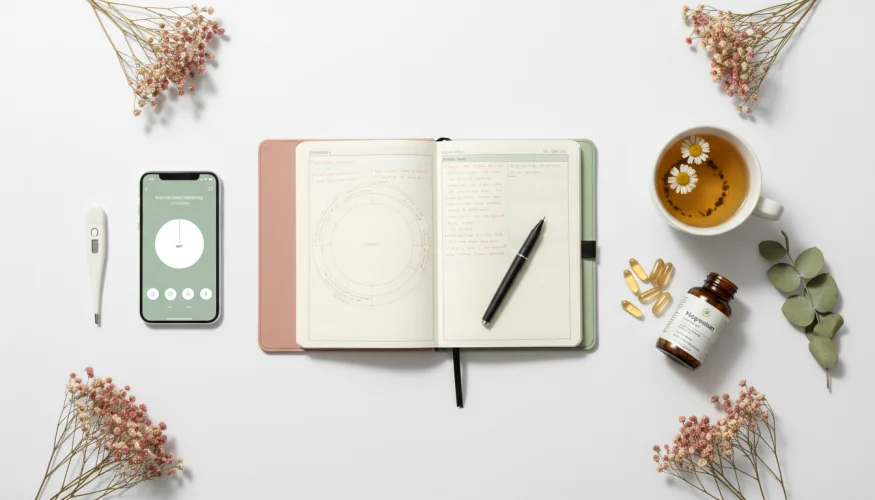
Cycle tracking – whether through an app, a paper diary, or by measuring basal body temperature – is thus becoming a tool for prevention, not merely for family planning. A woman who knows her cycle knows herself better. She knows when she naturally has more energy and when she needs to slow down. She knows when her emotions are influenced by hormonal fluctuations and when they signal something deeper. And she knows when it is time to see a doctor.
How to listen to your cycle in everyday life
Putting this approach into practice does not mean reorganizing your entire life around a menstrual calendar. It is more about gradual awareness and subtle adjustments that can have a surprisingly significant impact on overall wellbeing.
In the follicular phase, as estrogen levels rise, the body naturally handles greater physical and mental demands. This is an ideal time for more intensive training, important business meetings, or launching new projects. Around ovulation, energy is at its peak – social interactions come more easily and communication feels more natural. In the luteal phase, particularly during its second week, the body calls for recovery, deeper work in a calmer environment, and more nourishing food rich in magnesium, iron, and complex carbohydrates. And during menstruation itself, the need for rest and introspection reaches its peak.
Nutrition plays a crucial role throughout this entire process. Iron deficiency following heavier bleeding can cause fatigue and brain fog that many women mistakenly attribute to other causes. Magnesium helps alleviate cramps and premenstrual tension. Omega-3 fatty acids have anti-inflammatory effects that can reduce menstrual pain. There is nothing mystical about this – it is biochemistry that is well documented.
Movement is equally important – but not just any movement, and not always the same kind. While the body tolerates intense interval training or strength work well in the first half of the cycle, yoga, pilates, or a longer walk in nature may be more beneficial during the luteal phase. Listening to the body in this regard is not a weakness, but intelligence. According to research from the University of St Andrews, female athletes who train in sync with their cycle show better performance and a lower risk of injury.
The topic also extends into the realm of ecology and sustainability – an area of growing importance for many women. Traditional disposable hygiene products represent an enormous environmental burden: it is estimated that the average woman uses more than 10,000 disposable pads and tampons over her lifetime, most of which end up in landfill. Alternatives such as menstrual cups, reusable cloth pads, or period underwear are not only gentler on the planet but on the body itself – they are made from materials free of the chemical additives commonly found in conventional products. Switching to these alternatives is part of a broader trend toward a more conscious approach to both personal health and the environment.
Returning to the central idea – the menstrual cycle as the fifth vital sign – it is clear that this is about far more than just a biological process. It is a window into a woman's overall health, a sensitive barometer that responds to stress, nutrition, sleep, emotional wellbeing, and physical demands. To ignore it or suppress it without understanding the underlying causes means losing access to valuable information that the body itself is offering.
Women who learn to see their cycle as an ally rather than an adversary often describe a profound transformation in their relationship with their own bodies. They fight less and listen more. And that may be the most important shift of all – away from a medicine that pathologized the female body, toward an approach that respects it in all its complexity and rhythmic wisdom.