
# How to Clean Baby Bottles and Get Rid of Invisible Biofilm
Every parent wants the best for their child. They carefully select foods, check ingredient labels, and pay attention to hygiene. Yet there is one threat that hides in plain sight – inside seemingly clean baby bottles. Biofilm, a thin layer of microorganisms that settles on the inner walls of bottles, teats, and other infant feeding equipment, poses a genuine health risk to the youngest children. And the most insidious thing about it is that you usually cannot see it with the naked eye.
Most parents rinse a bottle under hot water, perhaps add a drop of washing-up liquid, and consider it clean. But clean and sterile are not the same thing. Biofilm forms quickly, resists ordinary washing, and can be a source of bacteria, moulds, and yeasts that may cause diarrhoea, colic, or other digestive problems in infants. This is precisely why the subject is receiving increasing attention both in professional circles and among parents themselves.
Try our natural products
What is biofilm and why is it so dangerous for infants
Biofilm is nothing other than an organised community of microorganisms that attaches to a surface and envelops itself in a protective layer – the so-called extracellular matrix. This layer acts as a shield: it protects bacteria from disinfectants, from the immune system, and from physical removal during washing. Scientific research has repeatedly confirmed that bacteria within biofilm are up to a thousand times more resistant to antibiotics and disinfectants than their free-floating counterparts. This is noted, for example, by the National Institutes of Health in the USA (NIH), which devotes extensive research to biofilms in the context of chronic infections.
For an adult with a fully functioning immune system, contact with biofilm may be relatively safe. But a newborn or infant is in an entirely different situation. Their immune system is still developing and their gut microbiome is in the process of forming. Even a relatively small amount of pathogenic bacteria can cause significant health problems. Salmonella, E. coli, Listeria, and Staphylococcus aureus – these are just some of the microorganisms that can lurk in biofilm and that are genuinely dangerous to infants.
How quickly does biofilm form? Surprisingly quickly. Within just a few hours of contact with milk or infant formula, bacteria begin to adhere to the surface of the bottle. After twenty-four hours, a biofilm can be fully established and practically impossible to remove by ordinary washing. Warm milk is an ideal breeding ground for bacterial growth – it contains proteins, fats, and sugars that quite literally provide microorganisms with everything they need to multiply.
Parents sometimes notice that a bottle, once dried, leaves a cloudy or milky residue on the walls. This is a visible signal that washing was not thorough enough. But the real problem arises when the surface looks clean – and the biofilm is there nonetheless. A microscopic layer that even careful inspection will not reveal may be present on the teat, inside the cap, or in the hard-to-reach folds of the bottle.
How to clean baby bottles properly and get rid of biofilm
The good news is that, with the right approach, biofilm can be effectively eliminated. The key is a combination of mechanical cleaning, heat sterilisation, and the right choice of materials. Relying on just one method is not enough – only their combination delivers a truly safe result.
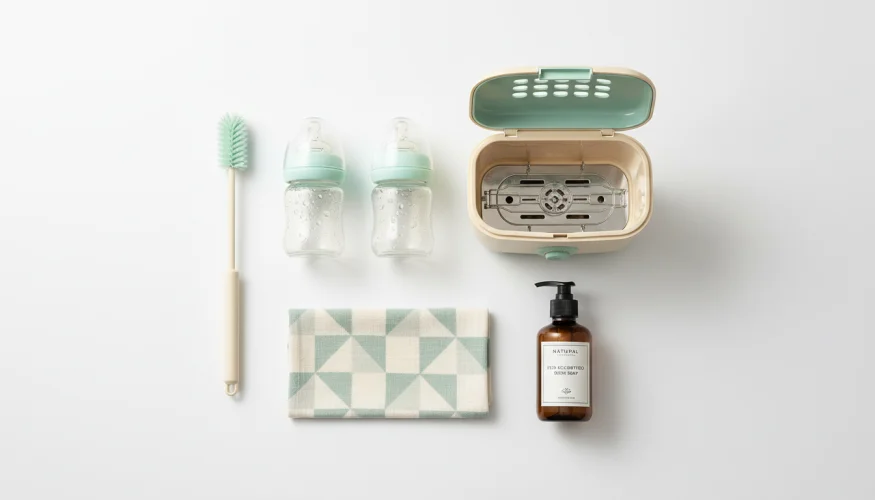
The first step is always rinsing the bottle immediately after each use. The longer milk residue remains in the bottle, the more time bacteria have to form biofilm. Experts from the World Health Organization recommend cleaning bottles as soon as possible after use, ideally within an hour. This is followed by thorough mechanical scrubbing with a brush – and it is important to emphasise here that the brush must reach every corner of the bottle, including the bottom and the neck. Teats and valves must be disassembled and cleaned separately, as this is where biofilm forms most readily.
The choice of washing product also plays a role. Ideally, use preparations free from aggressive synthetic fragrances and dyes, preferably on a natural or ecological basis, which are gentle on the bottle material and on the environment. Strong chemical cleaning agents may kill bacteria, but they also damage the surface of plastic bottles and create micro-cracks where biofilm can take hold even more easily. It is therefore always advisable to choose a product certified as safe for contact with infant feeding equipment.
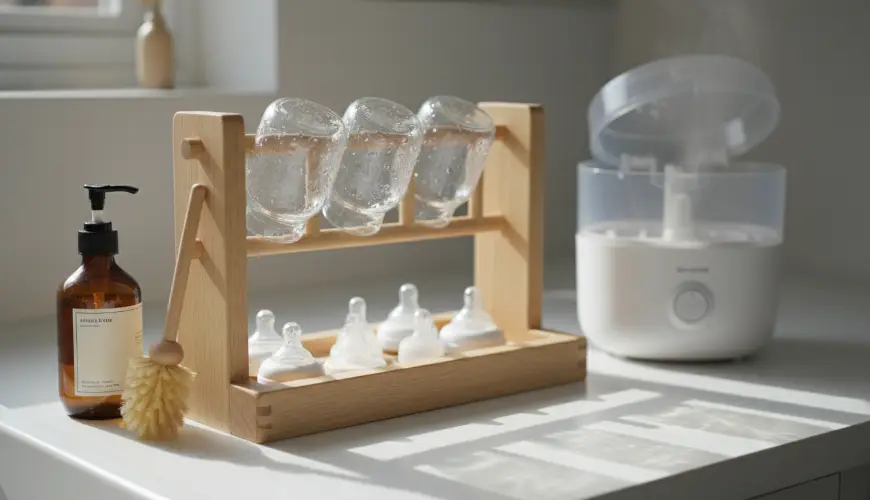
After mechanical washing comes sterilisation. There are several tried-and-tested methods: boiling in water for at least five minutes, steam sterilisation in an electric steriliser, or cold-water sterilisation using specialist preparations. Steam sterilisers are today considered one of the most effective ways to eliminate biofilm and resistant spores, because high-temperature steam penetrates even areas that a brush cannot reach. For parents on the go, there are practical microwave sterilisation bags that are compact and easy to use.
Imagine a situation playing out in thousands of households: a mother named Tereza always carefully washed bottles in the dishwasher and was convinced that this was sufficient. When her son began experiencing recurrent digestive problems, the paediatrician asked, among other things, about how the bottles were cleaned. It turned out that while the dishwasher did wash the bottles, it did not expose them to a sufficiently high temperature for a sufficiently long time. After switching to a combination of manual brushing and steam sterilisation, Tereza's son's problems improved significantly. This story is not an exception – parents around the world share similar experiences.
Another factor that is often overlooked is proper drying. A moist environment is a paradise for microorganisms, and it is therefore essential to allow bottles to dry thoroughly after sterilisation on a clean rack or sterilisation stand – never wipe them with a cloth, which can transfer bacteria. It is equally important to store dry bottles in a clean place, ideally covered, to prevent dust and airborne contaminants from settling on them.
The choice of bottle material itself is a subject in its own right. Glass bottles have a smoother surface than plastic ones, making it harder for biofilm to take hold. They also withstand high temperatures without the risk of releasing chemical substances. If parents prefer plastic options, they should ensure these are made from materials free from bisphenol A (BPA) and other potentially harmful substances. Eco-friendly bottles made from glass or certified BPA-free plastic are significantly safer in this regard, both from the perspective of the child's health and in terms of sustainability.
As microbiologist Philip Tierno of New York University aptly put it: "Biofilm is a microbial city. It has its own architecture, communication, and defence. Ignoring its existence in an environment where we feed infants is a serious mistake." These words serve as a reminder that the problem of biofilm is not exaggerated parental paranoia, but a scientifically substantiated reality that deserves attention.
Teats and dummies also deserve special attention. Their material – most commonly silicone or latex – is porous, and bacteria can burrow deeper into it than into the hard surface of a bottle. Silicone teats are generally considered more hygienic, as silicone is less porous than latex and tolerates repeated sterilisation better. Even so, teats should be replaced regularly – manufacturers generally recommend replacement every four to six weeks, but at the slightest sign of damage, cloudiness, or change in smell, immediate replacement is necessary.
Parents also sometimes ask whether a dishwasher can reliably remove biofilm. The answer is not straightforward. Modern dishwashers with a high-temperature programme can be effective, but only if bottles are loaded correctly – upside down, so that water can circulate freely – and if the programme is actually set to a sufficiently high temperature, generally at least 65 degrees Celsius. However, the dishwasher alone, without prior mechanical cleaning with a brush, is not enough, because residual milk deposits can protect biofilm from the effects of hot water and washing product.
The modern market offers parents a whole range of aids that make bottle cleaning easier and more precise. Specialist brushes with differently shaped heads, UV sterilisers, natural chemical-free washing products, and eco-friendly glass bottles – all of these are tools that help combat biofilm effectively and gently. Investing in quality aids pays off: a child's health is the most precious thing parents can protect, and prevention is always cheaper than treatment.
Caring for the cleanliness of infant feeding equipment is not merely a routine obligation – it is the daily protection of a small organism that is only just learning to face the world. Biofilm is an enemy we cannot see, but whose existence science confirms beyond doubt. Proper cleaning, regular sterilisation, the choice of quality materials, and common sense are the best things parents can do for their child. And at a time when ecological and safe alternatives to conventional products are available on the market, there is no reason not to make use of these options.