

The Food Bank helps where the system fails

Every year, millions of tons of food end up in European bins. At the same time, millions of people don't know what to put on the table for dinner. This paradox is not just a statistic – it is the everyday reality of families, seniors and individuals who find themselves in difficult circumstances. Food banks stand precisely at this intersection: they collect what would otherwise go to waste and pass it on to where it is truly needed. And what may be surprising is that practically anyone can get involved, whether by donating food or donating their own time.
Food banks are nothing new. The first one was established in 1967 in Phoenix, USA, where Bob Wilson came up with the idea of systematically collecting food from supermarkets and redistributing it to those in need. Today, food banks operate all over the world, and in the Czech Republic their network is brought together by the Federation of Food Banks, which currently operates branches in most regions. In 2023 alone, Czech food banks distributed over 8,000 tonnes of food, helping hundreds of thousands of people.
Try our natural products



What a food bank actually does and how it works
Many people imagine a food bank as a warehouse of tinned goods or a stall selling cheap food. The reality, however, is far more complex. Food banks function as a logistics hub between those who have a surplus and those who are in need. They work with retail chains, farmers, food producers and the European Union, which releases funds every year for the purchase of basic foodstuffs for the most vulnerable through the Fund for European Aid to the Most Deprived (FEAD).
The food that arrives at the bank goes through sorting and inspection. Volunteers and staff check its condition, use-by date and suitability for further use. Nothing is handed out blindly – every family or individual who applies for help is registered through social partners such as charities, shelters or low-threshold centres. The system is set up so that food genuinely reaches those who need it, rather than simply accumulating somewhere.
Interestingly, food banks do not only help people in absolute poverty. Increasingly, the so-called "new poor" are appearing among those receiving assistance – people who have lost their jobs, single mothers with children, seniors on minimum pensions or families hit by sudden illness. As Eurostat points out, nearly one in five residents of the European Union is at risk of poverty or social exclusion. In the Czech Republic, this figure is around 11–12% of the population, which in absolute terms represents more than one million people.
Take a specific example: Jana, a forty-five-year-old accountant from Olomouc, lost her job two years ago due to company restructuring. As a single mother with two children, she suddenly found herself in financial difficulty, despite having worked her whole life and never imagining she would need help. It was the local charity that referred her to the food bank. "At first I was ashamed," she admitted in an interview with a regional newspaper. "But then I understood that it was temporary help that would allow me to get through a difficult period." Today Jana is back at work and regularly contributes to the food bank through collection drives in her community.
Stories like Jana's show that a food bank is not a stigma – it is a safety net that works when other systems fail or are too slow.
How to donate food: from a spontaneous collection to regular support
Donating food to a food bank is simpler than most people think. There is no need to wait for a big occasion or organise a complicated collection. The most widespread form of direct help is public collection drives, the largest of which is the annual National Food Collection, which typically takes place in autumn outside supermarkets across the country. All you need to do is add some non-perishable food to your shopping and drop it into the prepared baskets – the volunteers and food bank staff take care of the rest.
In terms of specific food choices, food banks generally welcome:
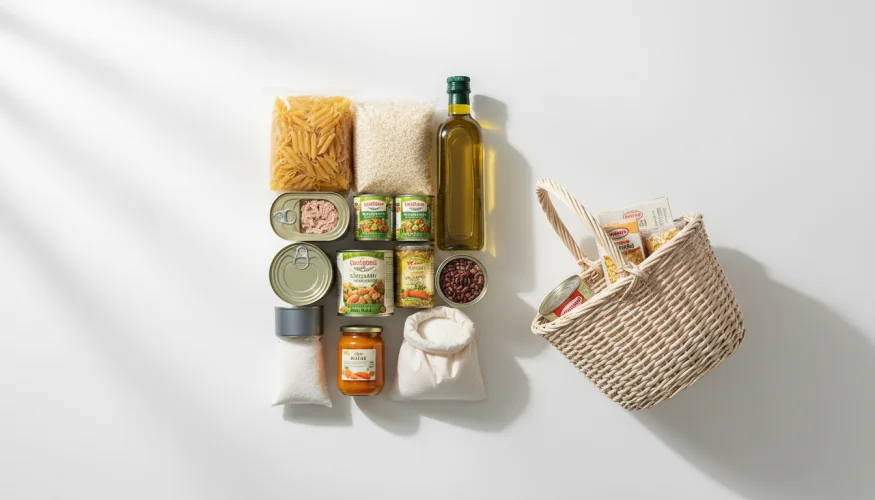
- non-perishable foods such as pasta, rice, pulses, flour and cereals
- tinned goods containing meat, fish, vegetables or fruit
- oils and fats with a long shelf life
- baby food and infant formula
- pantry staples such as sugar, salt or vinegar
Fresh foods tend to be more complicated, as they require rapid logistics and refrigeration capacity. Nevertheless, some food banks work with bakeries or vegetable markets and also accept fresh produce – it is always best to check in advance what your local branch is currently accepting.
Companies and business owners also have the option of donating food directly as a corporate gift, in a tax-advantageous way. Since 2020, a law has been in place in the Czech Republic that allows retailers and food producers to deduct the value of donated food from their tax base. This change significantly increased the amount of food reaching banks from commercial entities. You can find more details on the Federation of Food Banks website, where template donation agreements are also available.
If you would rather donate money than food in kind, this is an equally valid form of support. Financial donations allow food banks to purchase food according to current needs, cover operating costs or invest in better storage equipment. Every crown counts – according to data from the Federation of Food Banks, one hundred crowns can provide several kilograms of food for families in need.
Donating time: volunteering that changes lives – including your own
Perhaps even more valuable than food itself is time. Food banks simply could not function without volunteers. Sorting, packing, distribution, administration – all of this requires human hands and willing hearts. And yet the entry requirements are not particularly demanding: all it takes is goodwill, a degree of physical fitness and a willingness to show up at an agreed time.
Volunteering at a food bank takes several forms. The most common is direct work in the warehouse or distribution – sorting incoming food, packing it into parcels and preparing for handout. This work is not physically demanding, but it does require regularity and reliability. Other volunteers help during collection drives in shops, where they inform customers and oversee the progress of the collection. And then there are specialists – accountants, graphic designers, IT experts or drivers – who can offer their professional skills and significantly ease the running of the entire organisation.
As an old saying goes: "It is not enough to have a good heart – you must also use it." Volunteering at a food bank is precisely that kind of opportunity. Research also repeatedly confirms that voluntary work has a positive impact on the volunteers themselves – it reduces feelings of loneliness, increases a sense of purpose and demonstrably improves psychological wellbeing. According to a study published in BMC Public Health, regular volunteers are on average more satisfied with their lives and less at risk of depression than their non-volunteering peers.
For students, volunteering at a food bank can also be an excellent way to gain practical experience and references for a CV. Many secondary schools and universities also recognise volunteer hours as part of student activities or community placements. You can sign up directly through the websites of individual food banks or via volunteering platforms such as Dobrovolnik.cz.
An interesting option is also corporate volunteering, where an entire team spends half a day or a full day helping out in a food bank warehouse. This trend has grown significantly in recent years – companies not only help in this way, but also strengthen team spirit and build an authentic image as a socially responsible organisation. Unlike team-building activities in the mountains or at adventure parks, corporate volunteering has the added value of making a genuine contribution to the community.
Whether you decide to come once a year to the National Food Collection, regularly contribute non-perishable foods, or spend a few hours each month sorting in the warehouse – every contribution carries weight. A food bank functions like a living organism, which needs a constant flow of energy from all sides: from donors, volunteers, companies and the state. And it is precisely this diversity of sources that makes it such a resilient and effective system of support.
A world in which food is wasted on one side while people go hungry on the other is not inevitable. It is the result of systemic arrangements, but also of individual decisions. The decision whether to add one extra tin to your shopping. Whether to give up a Saturday morning to sort food. Whether to reach out to colleagues and organise a company collection. Each of these decisions is small – but together they change lives. And that is exactly what food banks prove every single day.