

# How to Prepare Matcha Without Lumps and Without a Bamboo Whisk
Green powder rolling around at the bottom of the cup, unpleasant lumps floating on the surface, or foam that simply refuses to form – these are experiences familiar to anyone just getting acquainted with matcha. Preparing this Japanese tea has a reputation as a complex ritual requiring special equipment, and it is precisely this notion that puts many people off before they even begin. Yet smooth, creamy matcha without a single lump is accessible to everyone – even without the traditional bamboo whisk known as a chasen.
Matcha is made from the leaves of the green tea cultivar Camellia sinensis, which are specially grown in the shade to increase the content of chlorophyll and the amino acid L-theanine. After harvesting, the leaves are dried and ground into a fine powder, the quality of which directly affects the resulting flavour and ability to dissolve without lumps. The finer the grind, the better the matcha dissolves – and this is precisely where the entire secret of perfect preparation begins.
Try our natural products

Why do lumps form in the first place?
Before we get into specific preparation methods, it is worth understanding why lumps occur at all. Matcha is a hydrophilic powder, meaning that when it comes into contact with water, its particles tend to clump together before they have a chance to disperse evenly. This phenomenon occurs particularly when the powder comes into contact with water that is too hot, or when it is added all at once to a large quantity of liquid without prior mixing. The ideal water temperature for preparing matcha is between 70 and 80 degrees Celsius – water straight from the boil causes bitterness and, paradoxically, even poorer solubility.
Another factor is the quality of the powder itself. Cheaper varieties intended primarily for cooking – so-called culinary matcha – tend to have a coarser structure and a higher stem content, which contributes to clumping. Ceremonial matcha, the highest quality variety intended for direct consumption as a drink, is ground on granite stones for tens of minutes, and the resulting powder is so fine it almost melts between the fingers. If lumps are a recurring problem for you, the solution may be simple – try a higher-quality product.
The third culprit is moisture. Matcha is extremely sensitive to ambient humidity, and if it is not stored properly in a sealed container in a cool, dark place, it will begin to absorb moisture from the air and form clumps even before it reaches the cup. A good practice is to keep matcha in small airtight containers, ideally in the refrigerator, and to sift it through a fine strainer before each preparation.
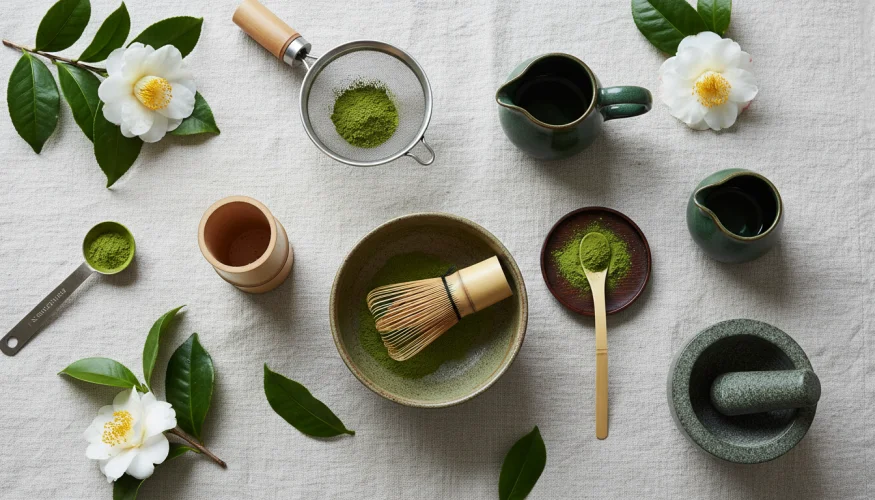
Sifting is one of the simplest yet most effective tricks known to experienced matcha preparers. Simply place a teaspoon of powder into a small sieve and pass it over the cup – mechanically breaking up the clumps before adding water dramatically improves the result. This step takes literally ten seconds, and its benefit is immediately visible.
How to prepare matcha without a bamboo whisk
The chasen, a traditional bamboo whisk with dozens of fine tines, is designed specifically for the "W" or "M" motion in the bowl, which breaks up lumps while simultaneously aerating the drink. It is a beautiful tool with a long history, but it is certainly not the only path to perfect matcha. So what can you use instead?
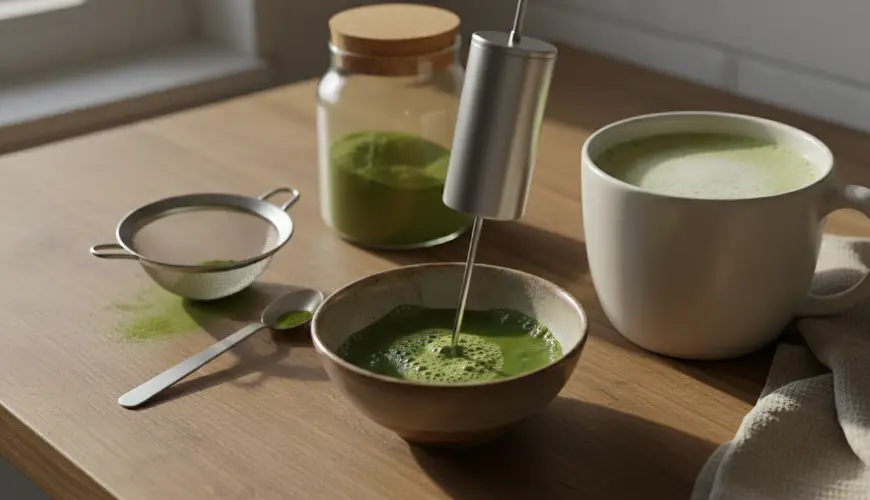
An electric milk frother – a so-called milk frother – is probably the most popular alternative. This small, battery-powered device, which most people know from making cappuccino at home, works excellently for matcha. Simply place the sifted powder in the cup, add a little lukewarm water (about two tablespoons), mix with the frother into a smooth paste, and only then add the remaining water or plant-based milk. The result is smooth, lightly frothed matcha that differs only minimally in texture from that prepared in the traditional way.
Another surprisingly effective tool is a sealable jar or cocktail shaker. This method is particularly popular among those who prepare iced matcha latte – so-called iced matcha. Powder is added to the jar along with a little room-temperature water and shaken vigorously for approximately thirty seconds. The physical principle is the same as with the bamboo whisk – mechanical energy breaks up the clumps – only the means of transferring that energy differs.
For those who have an immersion blender or a standard countertop blender at home, preparation is even easier. A brief burst of blending, literally five to ten seconds, creates smooth matcha with a rich foam. This method is ideal for preparing larger quantities, such as matcha latte for the whole family or a matcha smoothie.
The Japanese tea master Sen no Rikyū, who codified the tea ceremony in the 16th century, would probably raise an eyebrow at these modern methods. Nevertheless, he would have to concede that the resulting drink – if prepared with care and from quality powder – honours the spirit of matcha just as much as the traditional ritual. As the Japanese proverb goes: "Ichi-go ichi-e" – each moment is unique and unrepeatable, whether you experience it with a bamboo whisk or an electric frother.
There is yet another method that is talked about less, but which works surprisingly well: preparation using a French press. The matcha powder is covered with water at the correct temperature, and after brief stirring with a spoon, the plunger is slowly pressed down and pulled up several times. The resulting matcha is smooth, though less frothy than when using a whisk or frother.
Tips for everyday preparation of perfect matcha
Regardless of which tool you choose, there are several universal principles that always apply. The first is the sifting already mentioned – never skip this step, especially if the matcha has been stored for a longer period. The second principle is the so-called paste technique: first mix the powder with a minimal amount of water into a thick paste, and only then add the remaining liquid. This approach prevents the formation of lumps more effectively than any other technique, because the powder is first evenly coated with water in a small volume where control is much easier.
The third key factor is temperature. If you do not have a kettle with adjustable temperature control, simply let boiling water stand for three to five minutes – the temperature will naturally drop into the ideal range. Alternatively, you can pour boiling water into a cup and from there pour it onto the matcha paste, which reduces the temperature by a further few degrees.
Markéta, a thirty-year-old teacher from Brno who became interested in matcha after reading an article about the Japanese diet, describes her experience as follows: at first she struggled with lumps in almost every preparation, even though she had bought a relatively expensive powder. The turning point came when she started sifting the matcha first and preparing the paste using a small electric frother. Since then, her morning matcha has been smooth and creamy, and the entire process takes her no more than three minutes.
It is worth noting that studies published in the Journal of Chromatography confirm that the method of preparing matcha affects not only its flavour but also the bioavailability of its active compounds, particularly catechins and L-theanine. Properly prepared matcha – that is, without overheating and with the powder evenly dispersed – delivers these compounds to the body more efficiently than overheated or poorly mixed drinks.
In recent years, matcha has become part of a much broader range of recipes than just traditional Japanese tea. It is added to smoothies, porridge, yoghurts, baked goods, and protein drinks. In all of these cases, the same rule applies: first create a smooth paste with a small amount of liquid, and only then add the remaining ingredients. This approach works reliably regardless of whether you are preparing a traditional cup of matcha, a matcha latte with oat milk, or a matcha cheesecake.
If you are interested in the health benefits of matcha, the World Health Organization and numerous independent studies have long monitored the effects of green tea on health – and the results are consistently positive. As a concentrated form of green tea, matcha multiplies these benefits, because you are consuming the whole leaf rather than merely an infusion.
In closing, the question arises: do you actually need a bamboo whisk? The answer depends on what you expect from matcha. If you are fascinated by the Japanese tea ceremony as a meditative practice, the chasen is irreplaceable – it is as much a ritual as it is a tool. But if you are looking for an easy way to prepare a quality, nutritious drink every morning without lumps and without investing in specialist equipment, then an electric milk frother, a jar with a lid, or even just a small sieve and a little patience are all you need. Matcha is a more democratic drink than it first appears – and once you have mastered the smooth paste technique, you will never willingly return to a lumpy result.