

# How to Stretch After a Long Drive and Relieve Your Back Long drives can be tough on your body – y
Long hours behind the wheel are a real test for the body. Your back starts to stiffen, your neck aches, your legs feel like wood, and the overall feeling after getting out of the car is more reminiscent of someone who spent the night on a concrete floor than someone who was simply sitting. Yet many drivers accept this discomfort as an inevitable part of travelling and simply ignore it. This is a big mistake, because regular stretching after long drives is not just a matter of comfort – it is the foundation of musculoskeletal care.
The seated position behind the wheel is bad for the body for several reasons. The hips are kept in a bent position for extended periods, which shortens the hip flexors. The back is subjected to static load without any natural change in position. The shoulders and neck carry tension from concentration and any stress from traffic. And the legs – especially the right one, which operates the pedals – work asymmetrically. The result is muscular imbalance, which, if repeatedly ignored, can develop into chronic pain or even injury.
Try our natural products





What happens to the body during long periods of sitting in a car
To understand why stretching after driving is so important, it is worth understanding what actually happens in the body during driving. When sitting, there is increased pressure on the intervertebral discs – according to data from research by the American Academy of Orthopaedic Surgeons, the pressure on the lumbar spine when sitting is significantly higher than when standing or walking. Add to this the vibrations from the engine and road irregularities, which continuously load the spine, and you have a recipe for a back that is genuinely not in good shape upon arrival at your destination.
The muscles that do virtually no work during driving – the gluteal muscles, abdominal muscles, and the middle part of the back – gradually weaken and stop fulfilling their stabilising function. Conversely, the muscles that are constantly under tension, such as the trapezius muscles in the neck and shoulder area or the hip flexors, shorten. This imbalance is the direct cause of that unpleasant feeling of stiffness that every driver knows after a longer journey.
Interestingly, the problem does not begin only after an eight-hour drive across Europe. Research shows that after just 90 minutes of continuous sitting, measurable changes in muscle blood flow begin to occur and tension in the lumbar region increases. This is why experts recommend stopping every two hours – not just for road safety, but also for the health of the musculoskeletal system.
Consider a situation that many people know well: a Friday afternoon, driving from Prague to a cottage in Moravia. Four, maybe five hours in traffic jams, with a stop only at a petrol station to use the toilet and buy a coffee. Upon arrival, the back aches, the neck feels like it's set in concrete, and the first thing the driver sits down on is the sofa – which makes the situation even worse. Yet twenty minutes of stretching outside would be enough for the body to recover considerably more quickly.
Exercises that actually work
Stretching after driving does not need to be complicated or time-consuming. You need no equipment, no special mat, and no knowledge of yoga. All you need is the space around your car and the willingness to give your body a few minutes of attention.
The most important area that deserves attention first is the lumbar spine and hips. A classic forward bend – slow and controlled, letting your arms hang freely downward and releasing the entire spine – is simple yet enormously effective. Hold it for thirty to forty seconds and let gravity do the work for you. Do not overdo it with force; the aim is relaxation, not performance.
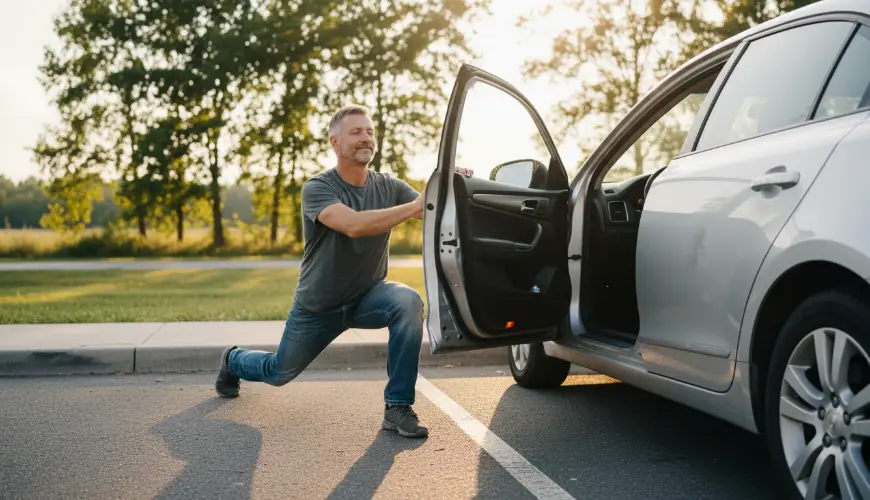
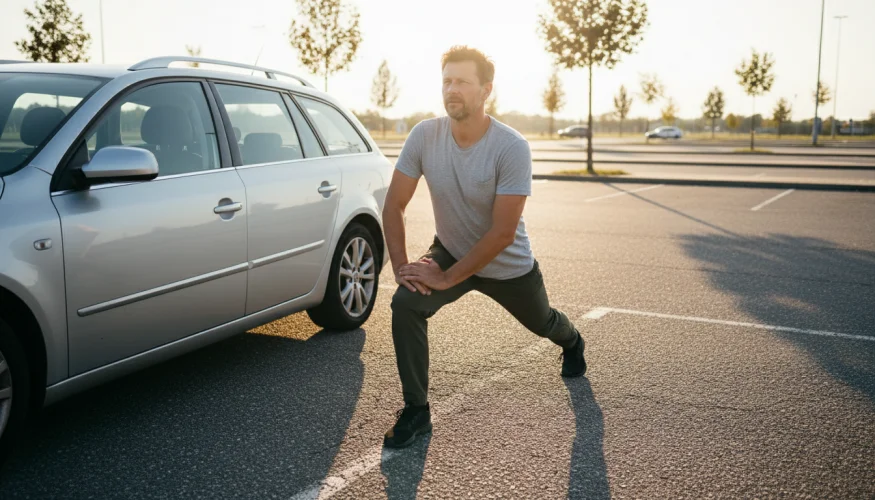
A follow-up exercise is a forward lunge, which targets the hip flexors directly – those muscles that are most shortened after hours of sitting. Stand facing your car, take a large step forward, and bend the front knee to a right angle. The back leg remains extended, with the knee pointing down towards the ground. You will feel a pull in the front of the thigh of the back leg – precisely where you need it most after long driving. Each side should receive at least thirty seconds, trying to deepen the lunge with each exhale.
The neck and shoulders are another area that calls for attention. Slowly tilt your head towards one shoulder and let it rest there for a moment – without jerky movements, without pushing. Then turn your head to the side and look over your shoulder, as if trying to see what is behind you. This simple rotation releases tension in the cervical spine that inevitably builds up during concentrated driving. Slowly roll your shoulders backwards – not forwards, as the shoulders are already pulled too far forward after driving.
Do not forget the thoracic spine, which tends to be chronically overloaded during driving. An excellent exercise is the so-called chest opener: stand straight, clasp your hands behind your back, and lift them slightly upward while pushing your chest forward and tilting your head back gently. You will feel a stretch across the front of your chest and shoulders – exactly where tension accumulates during the long forward lean over the steering wheel.
Calves and ankles are the final piece of the puzzle that drivers most commonly overlook. After hours in one position, circulation in the lower limbs is restricted and the calf muscles are shortened. A simple exercise: stand facing your car, lean against it with your hands, and step one foot back. Bend the front knee, keeping the back leg extended with the heel on the ground. The pull in the calf of the back leg is a signal that the exercise is working. Alternate both sides, giving each at least twenty seconds.
This entire sequence takes a leisurely fifteen to twenty minutes and can significantly change how you feel upon arriving at your destination. As physiotherapist and sports medicine expert Kelly Starrett said: "Sitting is the new smoking – but unlike smoking, it doesn't have to be lethal if you take care of yourself."
How to actually build stretching into your routine
Knowing how to stretch and actually doing it are two different things. Most drivers know they should stop and move around, but in practice they put it off or skip it altogether. The key is to approach stops differently – not as an unwelcome waste of time, but as an investment that will shorten recovery time after arrival.
A practical approach is to plan stops in advance and choose places where there is room to move – rest areas, restaurant car parks, or quieter edges of petrol stations. Every two hours of driving should be followed by a ten-minute movement break. This is not weakness or a waste of time – it is simply musculoskeletal hygiene.
It also helps to set a reminder on your phone or use navigation that alerts you to nearby rest areas. Some drivers have taken to a method where they prepare a short list of four or five exercises before the journey and keep it printed out or saved on their phone – so at a stop they do not have to think about what to do and can simply begin.
For people who regularly drive long distances – sales representatives, lorry drivers, commuters – stretching is a matter of long-term health. Chronic back pain is one of the most common causes of work incapacity in Europe, and in many cases it can be prevented precisely through regular movement and stretching. According to the World Health Organization, up to 80% of the population will experience back pain at some point in their lives, with a sedentary lifestyle being one of the main risk factors.
Alongside stretching itself, it makes sense to think about prevention during the drive itself. Correct seat adjustment – back supported, knees slightly below hip level, steering wheel at a comfortable distance – can significantly reduce the amount of tension that builds up in the muscles. A lumbar support, whether the one built into the seat or an additional one, helps maintain the natural curve of the lumbar spine. And conscious relaxation of the shoulders and jaw while driving – because many people unconsciously clench their jaw and raise their shoulders when concentrating – can prevent headaches and neck pain.
Car travel is part of the daily life of millions of people, and long journeys come with the territory. But the way a person looks after themselves after arrival – or ideally throughout the journey – determines whether a weekend at the cottage begins with rest or with searching for ibuprofen.