
# Fear of Phone Calls and How to Overcome It Step by Step

The phone rings and your stomach immediately tightens. Or worse – you need to call someone, yet your hand won't reach for the receiver for hours. This feeling is far more widespread than it might seem. Phone shyness affects millions of people around the world, across generations and professions. It's not a weakness or an excuse – it's a real psychological phenomenon with its own name, its own causes, and most importantly, its own solutions.
Phone anxiety, referred to in English as phone anxiety, affects approximately 76% of millennials and Generation Z according to surveys, but research shows that older generations struggle with it too, particularly in the workplace. Yet the phone remains one of the fastest and most direct forms of communication. Being able to use it without unnecessary stress is a skill that opens doors – both professionally and personally.
Try our natural products






Why does phone calling make so many people nervous?
The roots of this fear run surprisingly deep. Psychologists point out that a phone call is significantly more demanding than written communication – visual cues, facial expressions, and gestures are all absent. You can't see how the other person is reacting, can't read their expression, and don't have time to think through your response the way you do when writing a message. Everything happens in real time, with no option to delete and rewrite. It is precisely this immediacy of the phone call that creates a sense of vulnerability, which for many people grows into procrastination, avoidance, or outright anxiety.
Added to this is the fear of being misunderstood. What if the other person doesn't hear properly? What if we stumble, forget what we wanted to say, or simply embarrass ourselves? These concerns are natural, but their impact on everyday life can be significantly limiting. Imagine Lucie, a thirty-year-old graphic designer from Brno, who put off calling her insurance company for months about an administrative error on her contract. Instead of a five-minute call, the matter dragged on for an entire year simply because nobody was responding to written emails. She finally called – and everything was resolved within twenty minutes. Looking back, she admits that the biggest obstacle was the fear itself, not the actual call.
It's also important to recognise that the rise of text-based communication – SMS, WhatsApp, emails, social media – paradoxically deepens phone anxiety. The less people call, the more unfamiliar and unnatural it feels. A vicious cycle emerges: avoiding phone calls erodes confidence, and low confidence leads to further avoidance.
Perfectionism also plays a role. People who tend to over-analyse their own performance replay every call afterwards, thinking about what they could have said better, what sounded foolish, where they stumbled. This inner critic then becomes one of the main reasons they try at all costs to avoid the next call. As psychologist Adam Grant noted: "Fear of failure paralyses us at precisely the moment when we should be taking risks and acting." And for many people, making a phone call is exactly that kind of risk – small, everyday, but intensely felt.
Concrete steps to overcome phone shyness
The good news is that phone anxiety is not incurable. Like other forms of social anxiety, it responds very well to gradual exposure to feared situations, preparation, and changes in thinking patterns. The goal isn't to become an extroverted, charming speaker – it's to learn to function in situations that are part of everyday life.
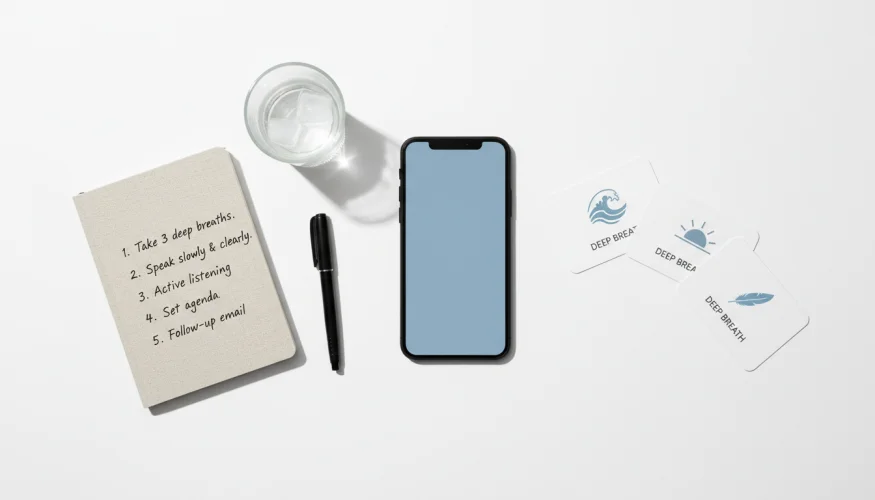
The first and perhaps most important step is preparation before the call. It may sound trivial, but the difference is enormous. Simply jotting down the key points you want to communicate – your name, the reason for calling, specific questions – on paper or in your phone significantly reduces the risk of your thoughts scattering mid-call. It's not about reading from a script like an actor, but having a safety net in case nerves override concentration. Preparation gives a sense of control, and that is crucial when overcoming anxiety.
Another effective tool is gradual exposure to phone calls – psychologists call this graded exposure. You can start with calls that are least stressful: calling a restaurant to reserve a table, checking a shop's opening hours, booking a doctor's appointment. These short, structured calls with a clear goal are ideal training grounds. The brain gradually learns that a phone call doesn't mean catastrophe, and the threshold of anxiety naturally decreases.
Changing your perspective on mistakes during calls also helps enormously. If you stumble over your words, forget a word, or lose your train of thought – it's not the end of the world. In most cases, the other person won't even notice what's happening, because they're focused on the content of the message, not on evaluating how the caller speaks. This thought is liberating: nobody listens to a call as critically as the caller themselves does. Research in social psychology repeatedly confirms that the so-called spotlight effect – the belief that others are watching and judging us far more than they actually are – is one of the most common cognitive biases.
A practical tip recommended by many therapists and coaches is physical preparation before a call. Deep breathing, a short walk, or simply sitting up straight have a demonstrable effect on mental state. Research by Amy Cuddy of Harvard University showed that body posture influences not only how others perceive us, but also how we feel ourselves – and therefore how confidently we speak.
The workplace, where phone calls often cannot be avoided, is a chapter in itself. Here it's useful to establish a routine: set aside dedicated time for phone calls, prepare templates for the most common types of calls, and consciously acknowledge after each successful call that it went well. The brain needs positive feedback to stop associating the phone with threat. If the situation is genuinely serious and phone anxiety is significantly limiting your professional or personal life, it is entirely legitimate to seek help from a psychologist or therapist specialising in cognitive-behavioural therapy, which is highly effective in these cases.
How to begin a call also deserves special attention. Many people simply don't know what to say the moment the other person picks up. Yet the opening of a call doesn't need to be sophisticated at all. Simply stating your name, where you're calling from, and why is sufficient. "Good morning, my name is Jana Nováková, I'm calling regarding my order number..." – simple, direct, functional. Precisely this structure eliminates the first moment of uncertainty, which is typically the psychologically hardest part.
It also helps to remember that the other person wants the call to go smoothly too. Customer support staff, receptionists, officials – all of these people have an interest in communication working well. They're not there to criticise or judge. They're there to help. This reframing of the situation – from evaluative to collaborative – can significantly reduce stress levels.
One of the most underestimated strategies is practising out loud before the actual call. Saying aloud what you want to communicate – even just to yourself in the bathroom or in the car – helps the brain process information differently than merely thinking it through. Words spoken aloud sound more real, and therefore less frightening. You may also notice exactly where your words tend to falter, and prepare those moments more carefully.
One crucial aspect must not be overlooked: what happens after the call. People with phone anxiety tend to dissect the call atom by atom afterwards, searching for everything that could have been better. Instead, it's useful to deliberately focus on what went well – the message was delivered, the matter was resolved, the call happened. That is the outcome that matters. Gradually building a positive association with phone calls is a long-term process, but every successful call is another brick in the foundation of confidence.
The world won't stop even if a call doesn't go perfectly smoothly. Hesitating, correcting yourself mid-sentence, a moment of silence – all of this is part of natural spoken communication. Paradoxically, it is precisely these small imperfections that make a call more human and authentic. Overcoming phone shyness isn't about becoming a perfect communicator – it's about stopping being afraid to be a normal person who sometimes hesitates, but can still say what they need to say. And that is something everyone can do.