
# Immunity During the Cycle and Why We Get Sick Right Before Menstruation

Every woman knows it – a few days before her period arrives, she suddenly feels exhausted, irritable, and on top of everything else, comes down with a runny nose or sore throat. This is no coincidence or mere bad luck. Behind this recurring pattern lies a fascinating and still not fully explored correlation between the menstrual cycle and the functioning of the immune system. In recent years, science has been revealing that the hormones governing the female cycle simultaneously have a significant influence on the body's ability to defend itself against infections – and it is precisely during the premenstrual phase that this defence naturally weakens.
To understand why this happens, we must first look at how the menstrual cycle actually works. Simply put, it is divided into two main parts: the follicular phase, which begins on the first day of menstruation and lasts approximately until ovulation, and the luteal phase, which follows ovulation and ends with the arrival of the next period. Each of these phases is characterised by different hormone levels – and it is precisely these hormones that are the key to understanding immune fluctuations.
Try our natural products
Hormones as conductors of the immune orchestra
Oestrogen and progesterone, the two main sex hormones, are not merely regulators of the reproductive system. They influence the entire body, including immune cells, which carry receptors for these hormones and respond to them directly. Oestrogen generally acts as an immune stimulator – it supports the production of antibodies and the activity of so-called natural killer cells (NK cells), which destroy viruses and tumour cells. This is why women in the first half of their cycle, when oestrogen dominates, are generally more immunologically capable.
The situation changes after ovulation, when the luteal phase begins, bringing with it a sharp rise in progesterone. This hormone has a different, largely suppressive effect on immunity. From an evolutionary perspective, this makes sense – if fertilisation were to occur, the body would need to tolerate the embryo as a "foreign body" and prevent an immune attack against it. Progesterone therefore deliberately dampens certain immune responses so that a potential pregnancy can be maintained. This mechanism is essential for the survival of the species, but for a woman awaiting her period, it means she is temporarily more vulnerable to viruses, bacteria, and inflammatory processes.
Just before menstruation, when the levels of both hormones drop sharply, further immune stress occurs. The decline in oestrogen removes its protective effect, while the body is only just preparing for a new cycle. This hormonal "valley" tends to be the most critical point for many women – and it is no coincidence that colds, cold sores, or the worsening of chronic inflammatory conditions most commonly manifest at this time.
The scientific basis of this phenomenon is confirmed, for example, by research published in the journal Brain, Behavior, and Immunity, which has been mapping the relationship between the neuroendocrine system and immunity over the long term. The results repeatedly show that immune cells are not static – their activity changes depending on the hormonal environment, and therefore on the phase of the menstrual cycle.
It is also interesting that this vulnerability does not only concern infectious diseases. Women suffering from autoimmune conditions such as rheumatoid arthritis or lupus very frequently report a worsening of symptoms precisely during the premenstrual period. Fluctuations in progesterone and oestrogen can destabilise the balance of the immune system to such an extent that chronic conditions become temporarily activated.
Why the premenstrual phase exhausts the body so much
Hormonal changes are only one side of the coin. The premenstrual phase brings with it a whole range of physiological processes that together place extraordinary demands on the body. The body is preparing for menstruation – the uterine lining is being shed, local inflammation occurs, and levels of prostaglandins rise, causing cramps and pain. This inflammatory process is itself energetically demanding and diverts the immune system's attention away from defending against external threats.
Add to this the typical premenstrual complaints – disrupted sleep, increased sensitivity to stress, cravings for sweet and fatty foods that can lead to blood sugar fluctuations. All of these factors further weaken immunity. Sleep is one of the most important pillars of immune function – it is during deep sleep that cytokines are released, proteins that are crucial for fighting infections. If sleep is disrupted, the immune system does not have sufficient opportunity to regenerate.
Stress also plays a key role in this story. Cortisol, the stress hormone, suppresses the immune response – and women in the premenstrual phase are naturally more sensitive to stress, because fluctuating hormones also affect neurotransmitters such as serotonin and dopamine. This creates a vicious cycle: hormonal changes increase sensitivity to stress, stress raises cortisol levels, cortisol suppresses immunity, and the body becomes an easier target for infections.
It is worth noting that this dynamic varies from woman to woman. Some manage the premenstrual period without major difficulties, while others fall ill every month like clockwork. Genetic makeup, overall health, lifestyle, and the degree to which the body is exposed to chronic stress all play a role. A thirty-year-old accountant who works overtime, sleeps poorly, and has no time for physical activity will likely be more susceptible to illness during the premenstrual phase than a woman of the same age who exercises regularly, eats well, and takes care to rest. This is not moralising – it is physiology.
An interesting perspective is also offered by the World Health Organization, which in its materials on reproductive health repeatedly emphasises the connection between a woman's overall health and her hormonal cycle. Caring for one's cycle is therefore not merely a matter of gynaecology – it is part of an overall health strategy.
What can be done about it
Understanding this mechanism is valuable in itself – a woman who knows why she feels worse every month before her period can stop blaming herself or her "weak immunity" and begin to approach her cycle as information. As pioneering women's health researcher Dr. Lara Briden said: "The menstrual cycle is the fifth vital sign – it tells us more about a woman's health than most people realise."
In practical terms, this means that the premenstrual phase deserves conscious care. The point is not to be less productive or to use hormones as an excuse – it is about sensibly adjusting the demands placed on the body to match its current capabilities. The body in the luteal phase needs more rest, warmth, nourishment, and less stress – and if we ignore these needs, we pay for it with reduced resilience.
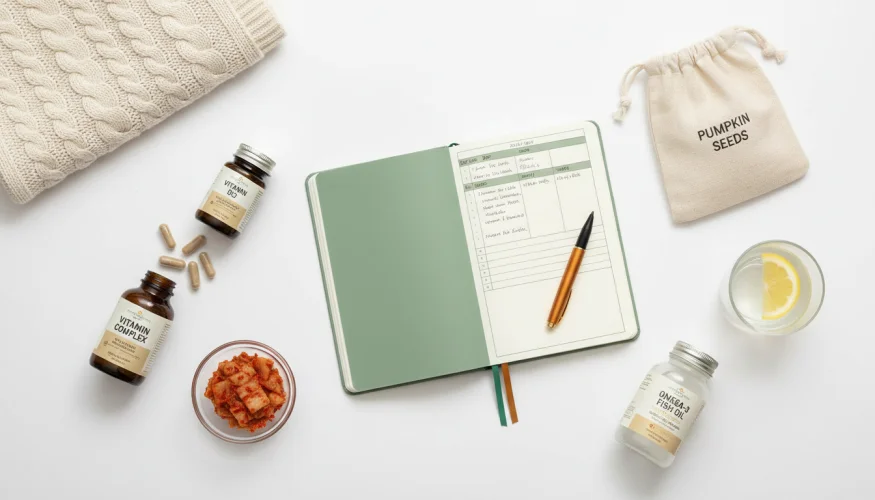
From a nutritional perspective, it appears that adequate intake of zinc, vitamin C, vitamin D, and omega-3 fatty acids plays a key role. These nutrients support immune function in general, but their effect is particularly noticeable during periods of hormonal stress. Zinc, for example, directly influences the maturation of immune cells, and its deficiency is associated with significantly reduced resistance to infections. Excellent sources include pumpkin seeds, legumes, wholegrains, and seafood.
Vitamin D is another player whose deficiency – very widespread in the Czech population, particularly during winter months – directly translates into weakened immunity. If a woman suffers from recurring infections precisely before her period, checking blood vitamin D levels is a simple and inexpensive first step.
Exercise is another powerful tool – but with one important caveat. While regular moderate-intensity exercise demonstrably strengthens immunity, intense physical exertion during the premenstrual phase can have the opposite effect. The body is already in an energy deficit at that time, and adding a demanding training session can further overburden the immune system. Yoga, walks, or light stretching exercises are a wiser choice during this period than intense interval training.
Care for the gut microbiome also plays a significant role. Science in recent years has been making it increasingly clear that a healthy gut is the foundation of a healthy immune system – approximately 70% of immune cells reside in the digestive tract. Fermented foods such as kefir, kimchi, or fermented vegetables, adequate fibre intake, and limiting industrially processed foods can have a surprisingly large impact on immune resilience throughout the entire cycle.
Tracking one's own cycle – whether using an app or a paper diary – can help women recognise recurring patterns and anticipate more vulnerable periods. If you know that every month on the Thursday and Friday before your period you come down with a cold, you can prepare for these days: reduce social obligations, increase vitamin intake, get more sleep, and avoid high-stress situations. These seemingly simple measures can have a real impact on whether an illness develops fully or remains only in its early stages.
The menstrual cycle is a natural part of a woman's life – with all its fluctuations, phases, and paradoxes. The fact that the body deliberately dampens its defences at certain moments is not a flaw of evolution, but a sophisticated compromise between fertility and immunity. Understanding this mechanism allows us to be kinder to ourselves while also being smarter about how we care for our health – not in opposition to our bodies, but in harmony with them.