

# Fermented Rice Drink Amazake and Its Health Benefits
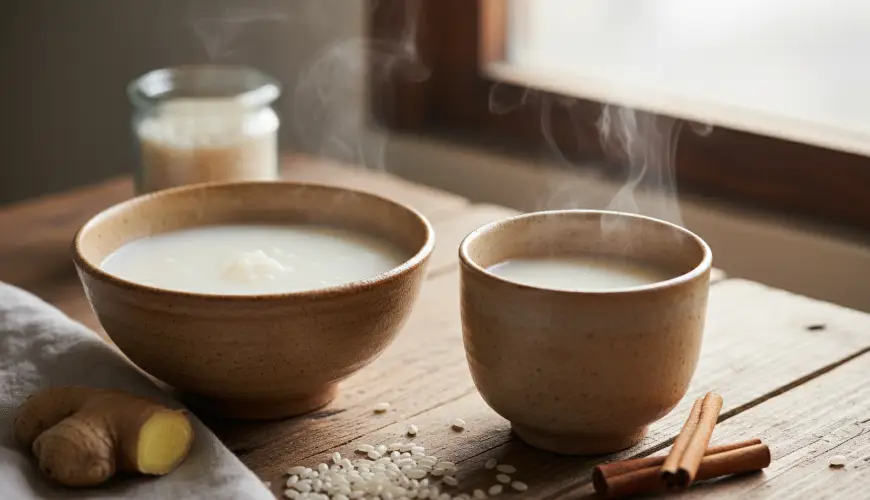
There are drinks that transcend mere refreshment. Amazake is one of them – a quiet witness to Japanese history, passed down from generation to generation over centuries, and today once again finding its place on the tables of people seeking a natural path to health. The fermented rice drink amazake is not a fashionable invention of the food industry, but a living tradition over a thousand years old, whose magic the Western world is only now beginning to fully appreciate.
The word "amazake" consists of two Japanese characters: "ama" means sweet and "sake" refers to a rice drink or alcohol. Although the name shares part of its designation with the famous Japanese rice wine, amazake in its most widespread form is completely alcohol-free or contains only trace amounts. It is produced through the fermentation of cooked rice using a mould called koji (Aspergillus oryzae), which breaks down starches into simple sugars and gives the drink its characteristic natural sweetness. No added sugar, no artificial flavourings – just the magic of fermentation.
Try our natural products





A Thousand-Year Tradition in the Modern World
Amazake first appears in Japanese historical sources as early as the Kofun period, approximately the 3rd to 7th century AD. For centuries it was considered a drink for nobility and priests, served at temple festivals and rituals. It was not until the Edo period (1603–1868) that it became accessible to ordinary people, and amazake vendors became an inseparable part of the streets of Japanese cities. Mobile carts with hot amazake were as common a sight in winter as stalls with hot tea or cocoa at European Christmas markets today.
This historical rootedness is no coincidence. The Japanese knew long before science confirmed it that amazake is an exceptionally nutritious drink capable of providing energy, warming the body and supporting overall wellbeing. It is even called a "drinkable IV drip" because it contains glucose, amino acids, B vitamins and enzymes in a form that the body can absorb almost immediately. It is no wonder that it was traditionally given to the sick, breastfeeding mothers or people recovering from demanding work.
As Japanese cultural anthropologist Naomichi Ishige noted, "fermented foods are a mirror of civilisation – they reflect the ability of people to work with nature rather than fight against it." Amazake is precisely this mirror: a product of harmony between humans, grain and microorganisms that silently and warmly transform simple ingredients into something exceptional.
Today, amazake is experiencing a genuine renaissance. In Japan, it can be found in modern health bars, supermarkets and premium restaurants, where chefs use it as a natural sweetener or as a base for sauces. In Europe and North America, interest in this drink is growing alongside general interest in fermented foods – kefir, kimchi, kombucha and miso. The fermented rice drink amazake is thus finding its place alongside these well-established products and gradually building its own community of enthusiasts.
What Actually Happens During Fermentation and Why It Matters
To fully appreciate amazake, it is worth briefly looking into the process of its creation. Everything begins with so-called koji rice – cooked rice on which the mould Aspergillus oryzae is cultivated. This mould produces enzymes that break down the starches contained in the rice into simple sugars, primarily glucose. The result is a thick, creamy drink with natural sweetness that requires no added sugars.
The fermentation process takes place at a temperature of approximately 55–60 °C for 8 to 12 hours. This relatively low temperature is crucial – the enzymes are active at this temperature while avoiding denaturation. The resulting product is therefore alive and enzymatically active if it has not been pasteurised. This is where one of the important differences lies between industrially produced amazake available in shops and the home-made or artisanally produced version: unpasteurised amazake contains live enzymes and beneficial microorganisms, while pasteurised amazake has a longer shelf life but loses some of its nutritional benefits.
Scientific interest in koji and fermentation in general has grown significantly in recent years. Research published in journals such as the Journal of Bioscience and Bioengineering shows that enzymes produced by the mould Aspergillus oryzae have a positive effect on digestion and may contribute to the health of the gut microbiome. The World Health Organization has long emphasised that gut health is closely linked to the overall immune system and mental wellbeing – and fermented foods are a natural way to support the microbiome.
Amazake also contains ferulic acid, a natural antioxidant with anti-inflammatory properties, and ergothioneine, a substance that is the subject of intensive scientific research for its potential neuroprotective effects. It is therefore not merely a pleasant drink with a historical story, but a product with a solid biochemical basis for its claims of health benefits.
It is interesting how differently amazake can taste depending on the length of fermentation, the variety of rice used and the preparation conditions. Shorter fermentation yields a more delicate, less sweet flavour with more pronounced rice notes. Longer fermentation creates a fuller, sweeter profile that some compare to rice pudding or hot rice porridge. The serving temperature then transforms the entire experience: cold amazake is a refreshing summer drink, while hot amazake with a little fresh ginger becomes the perfect winter warmer.
Take Markéta, a thirty-year-old mother from the Central Bohemian region, who began preparing amazake at home after her interest in Japanese culture and fermentation led her to it. "I tasted it for the first time at a Japanese festival in Prague and couldn't believe how something so simple could be so good," she says. Today she regularly serves it to her children as an alternative to industrially produced sweet drinks and also uses it in baking as a substitute for sugar. Her experience is not unique – similar stories are multiplying across Europe as amazake becomes more accessible.
How to Use Amazake in Everyday Life
One of amazake's greatest strengths is its versatility. It does not have to be consumed solely as a drink on its own – its potential in the kitchen is surprisingly broad. Japanese chefs have traditionally used it as a natural sweetener in marinades, salad dressings or when preparing meat, where the enzymes also help to tenderise proteins. In modern gastronomy, it serves as a smoothie base, an ingredient in ice cream or a component of fermented cocktails for those seeking an alternative to alcohol.
For those who wish to incorporate amazake into their diet more systematically, the following overview of the most common ways to use it may be helpful:
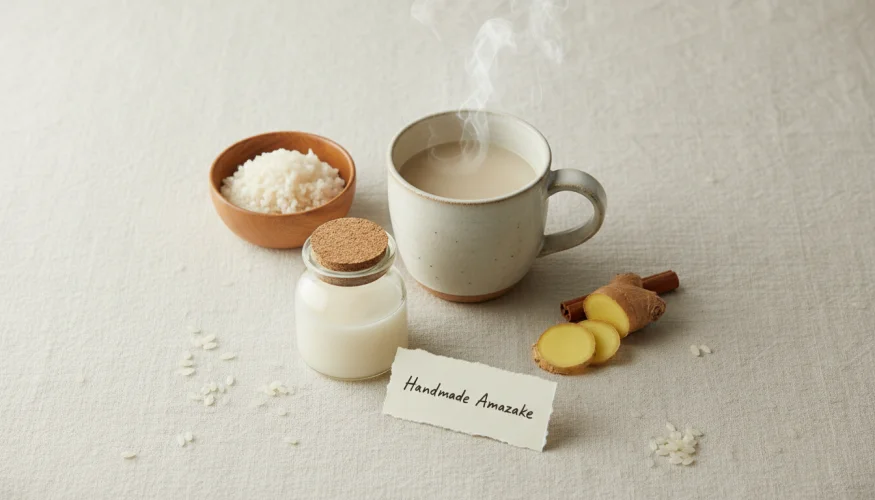
- Warm drink – heated amazake with a little grated ginger and a pinch of cinnamon as a morning or evening ritual
- Smoothie base – blended with fruit, plant-based milk or yoghurt as a nutritious breakfast
- Natural sweetener – a substitute for sugar or honey in baking, while also adding interesting flavour depth
- Marinade – the enzymes in amazake help to tenderise meat while also imparting a gentle sweetness
- Dressing – diluted amazake with rice vinegar and soy sauce as a light Asian dressing
As for availability, the situation in the Czech Republic has improved significantly in recent years. Amazake can be purchased in health food shops, Asian grocery stores or online, both in liquid form and as a concentrate that is diluted with water. An increasing number of people are also preparing it at home – all that is needed is koji rice (available online), cooked rice and a little patience. The entire process is surprisingly simple and requires no special equipment, just a reliable thermometer and a container that maintains a stable temperature – a thermos flask or yoghurt maker will suffice.
It is also worth mentioning that amazake is naturally gluten-free when prepared from rice, making it suitable for people with coeliac disease or gluten sensitivity. Versions prepared from other grains, such as oats or barley, may contain gluten, so it is advisable to check the ingredients when purchasing ready-made products. The drink is also vegan, contains no animal products and its production is environmentally friendly – rice is one of the least processing-intensive crops and fermentation requires no chemical additives.
The world of fermented drinks is rich, and amazake occupies a completely unique place within it. While kombucha is distinctly acidic and kefir is dairy-based, amazake offers natural sweetness and a creamy texture that makes it accessible even to those who do not ordinarily enjoy fermented products. It is a drink that does not intimidate but invites – through its taste, its story and its potential to become an everyday ally on the path to a balanced and mindful lifestyle.
The Japanese tradition has yet another poetic name for amazake: bijin drink, meaning "beauty drink". It refers to the belief that regular consumption of amazake contributes to healthy skin, lustrous hair and overall vitality – and modern research focused on the role of the gut microbiome in skin health is giving this belief an increasingly solid scientific foundation. Studies published in the journal Frontiers in Microbiology confirm the connection between gut health and skin condition, lending traditional Japanese wisdom an entirely new dimension.
Amazake is therefore much more than a fashionable trend or an exotic curiosity. It is a living legacy of a thousand-year culture of fermentation, a natural product with scientifically supported benefits and at the same time a drink that tastes good and makes sense – in a food world full of artificial additives and industrial processing, this is a combination that deserves attention.