

Try sweet quinoa porridge with baked pears
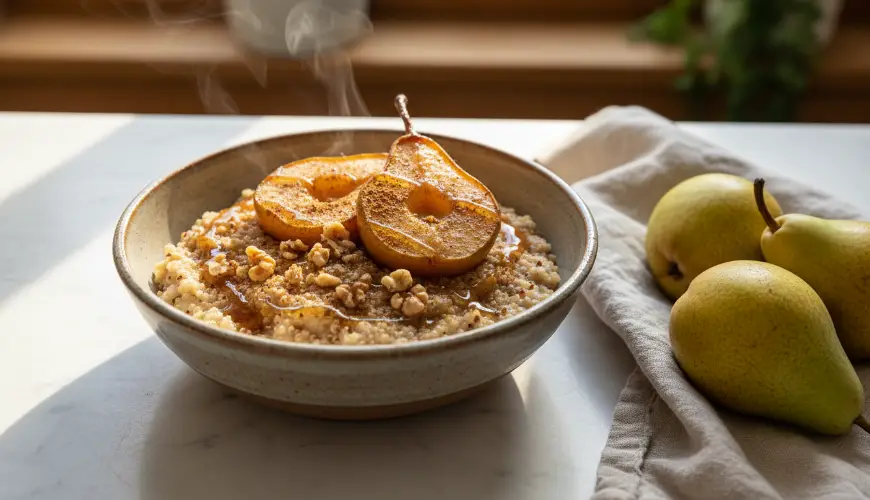
Breakfast is the foundation of the day – everyone knows that. Yet many people make do with a slice of toast and butter, or skip it altogether. But what if we offered an alternative that is not only nutritious and filling, but also so delicious that you start looking forward to it before you even get out of bed? Sweet quinoa porridge with roasted pears is exactly that kind of breakfast – simple to prepare, packed with nutrients, and beautifully fragrant thanks to cinnamon and caramelised fruit.
Quinoa (pronounced "keen-wah") originates from the Andes and has served as a staple food of Incan civilisations for thousands of years. It is no coincidence that the Incas called it "the mother of all grains". Today it is beloved by nutritionists, athletes, and people who simply want to eat better. Quinoa is classified as a so-called complete protein – it contains all essential amino acids, which is an absolute rarity among plant-based foods. According to the United States Department of Agriculture (USDA) nutrient database, 100 grams of cooked quinoa contains approximately 4 grams of protein, 2.5 grams of fibre, and a range of minerals including magnesium, iron, and zinc.
Quinoa porridge is not at all complicated to make. It is essentially just as accessible a dish as oatmeal, but with a significantly better nutritional profile and a more interesting texture. Once cooked, quinoa has a mildly nutty flavour and a slightly crunchy texture thanks to the small germ that separates from the grain during cooking. It is precisely this texture that makes quinoa porridge so enjoyable – it is neither gluey nor heavy, yet it keeps you satisfied for several hours.
Try our natural products




Why pears, and what roasting does to make them magical
Many types of fruit pair wonderfully with quinoa porridge, but roasted pears are truly exceptional in this regard. The pear is a fruit that tends to be somewhat underappreciated in cooking – we usually eat it raw or in compote, but heat treatment can draw out an entirely different dimension of flavour. During roasting, the natural sugars in the pear caramelise, the flesh softens to a silky consistency, and the fruity aroma intensifies. The result is something reminiscent of the best part of a fruit tart – without the need to bake an actual tart.
Pears are also nutritionally very interesting. They are among the fruits with a high fibre content, much of which is in the form of pectin – a soluble fibre that has a beneficial effect on digestion and helps regulate blood sugar levels. According to expert sources such as the Harvard T.H. Chan School of Public Health, regular consumption of pears may contribute to a reduced risk of heart disease and type 2 diabetes. And that is a pretty good reason to have them for breakfast, isn't it?
The combination of quinoa and pear is not only nutritionally smart – it is also a flavour combination that works surprisingly harmoniously. The subtle nutty flavour of quinoa complements the sweetness of caramelised pear beautifully, and with a touch of cinnamon, cardamom, or vanilla, the result is a breakfast that smells like an autumn afternoon by the fireplace.
Take Lucia, a thirty-three-year-old graphic designer from Brno, as an example. She switched to a plant-based diet and spent a long time looking for a breakfast that would keep her satisfied all morning without feeling heavy. Oatmeal eventually bored her, and smoothies left her hungry. Then she discovered quinoa porridge with roasted pears. "At first it seemed strange to cook quinoa as something sweet," she says, "but from the very first spoonful I knew this was it. It's warm, fragrant, and keeps me going comfortably right through to lunch."
How to make sweet quinoa porridge with roasted pears at home
Preparing this dish is surprisingly easy, even if it may seem complicated at first. The most important step is cooking the quinoa properly – and that means rinsing it first under cold water to remove the natural bitter coating (known as saponins). This is a step many people skip, and then wonder why their quinoa tastes bitter. Simply rinse the grains in a sieve under running water for a minute or two, and the result is completely different.
Quinoa is then cooked in a ratio of 1 part quinoa to 2 parts liquid. For a sweet porridge, it is ideal to use plant-based milk instead of water – almond, oat, or coconut milk. Coconut milk gives the porridge a creaminess and a subtle exotic flavour that pairs wonderfully with cinnamon and pears. Quinoa cooks for approximately 15 minutes over a low heat until all the liquid has been absorbed and the germ has separated from the grains. Then simply stir, add a pinch of salt, a teaspoon of honey or maple syrup, and season with spices to taste.
While the quinoa is cooking, prepare the roasted pears. Cut the pears into quarters or slices, drizzle with a little coconut oil, sprinkle with cinnamon and optionally a little brown sugar, and place in an oven preheated to 180 degrees Celsius for approximately 15 to 20 minutes. The pears should be soft, lightly golden, and beautifully fragrant. For even more intense caramelisation, you can switch on the grill or increase the temperature for the last few minutes.
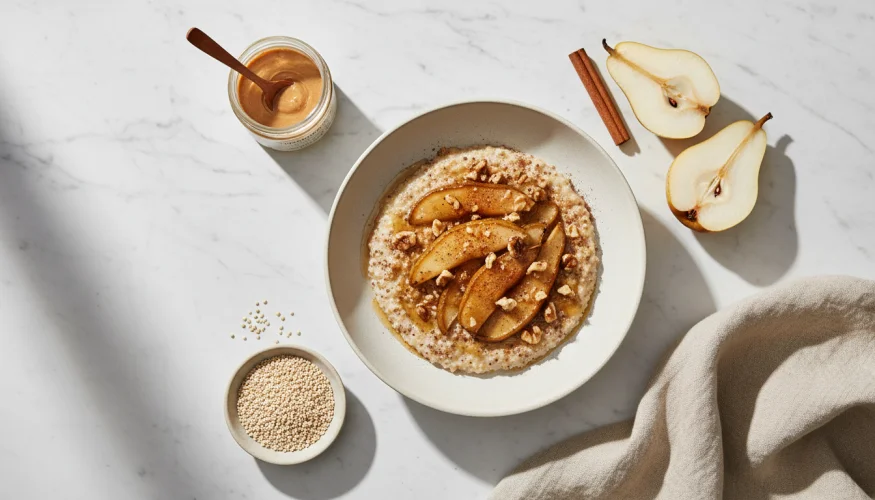
Pour the finished porridge into a bowl, place the roasted pears on top, and garnish to taste:
- crushed walnuts or almonds for extra crunch and healthy fats
- a spoonful of tahini or almond butter for protein and a creamy texture
- granola for a contrast in textures
- fresh mint or lemon zest for freshness
- cacao nibs for a slightly bitter note that balances the sweetness
The entire preparation takes approximately 25 minutes, with the quinoa and pears being prepared simultaneously. This means that this nutritious breakfast is genuinely achievable even on a weekday morning.
Quinoa as part of a sustainable and healthy diet
Quinoa has become a symbol of healthy eating in recent years, but it also deserves attention from another angle – the perspective of sustainability. Quinoa is naturally gluten-free, making it an excellent choice for people with coeliac disease or gluten sensitivity. It is also a complete source of protein for vegans and vegetarians looking for alternatives to meat.
It is true that quinoa cultivation in Peru and Bolivia has its environmental context – the sharp surge in demand from the West over the past decade caused certain social and ecological tensions in the regions of origin. The situation has gradually stabilised, however, and today there are certified products bearing fair trade labels that ensure fair conditions for growers. When buying quinoa, it is therefore worth looking for organic and fair trade certification, which guarantees not only the quality of the product but also its ethical origins.
From a nutritional standpoint, quinoa is exceptional in one further respect – it has a low glycaemic index. This means that after a breakfast of quinoa porridge, there is no sharp spike in blood sugar levels followed by the feeling of hunger or fatigue that many people experience after a breakfast of sugary cereals or white bread. Energy is released gradually and steadily, allowing both body and mind to function better throughout the entire morning.
Sweet quinoa porridge with roasted pears is just one of many ways to incorporate this versatile pseudocereal into everyday eating. Quinoa works equally well in savoury bowls, as a base for vegetarian burgers, or as a side dish in place of rice. But it is in its sweet form – warm, fragrant with cinnamon, and crowned with juicy caramelised pears – that quinoa shows its most welcoming face: the face of a comforting, warming dish that is equally good for the body and the soul.
Autumn and winter are the ideal seasons for this recipe, as pears are then in season and warm porridge is a natural response to cold mornings. In summer, the pears can be replaced with peaches, apricots, or raspberries – the principle is the same, only the resulting flavour differs. The flexibility of this recipe is one of its greatest strengths: the basic technique remains the same, but the result changes according to what is available and what you feel like eating.
Healthy eating does not have to be dull, ascetic, or complicated. Sometimes all it takes is one recipe that shows how nutrition and the pleasure of eating can go hand in hand – and sweet quinoa porridge with roasted pears is precisely that kind of proof.