

Stop Chronic Apologizing and Live with Confidence

There is a habit that many people don't even perceive as a problem – yet it complicates their relationships every day, undermines their self-confidence, and sends signals to those around them that they don't want to send at all. It is chronic apologizing – the compulsive need to say "sorry" for things one is not actually responsible for, or for situations that don't require any apology at all. "Sorry for asking, but…" "Sorry to bother you…" "Sorry for having a different opinion…" Does that sound familiar?
This behavioral pattern is surprisingly widespread in modern society. It is particularly noticeable in women, in people raised in environments that placed great emphasis on modesty and not standing out, and in those who have experienced criticism or rejection in the past. This is not about politeness or empathy – it is a deeply rooted mechanism that protects a person from conflict and rejection, while at the same time robbing them of the ability to act with confidence and authenticity.
Try our natural products




Where does the need to constantly apologize come from?
In order to change chronic apologizing, it is important to first understand where it comes from. Psychologists agree that the roots of this behavior most often reach back to childhood. Children who grew up in environments where their needs were considered bothersome, or where parental love was conditional on being quiet and compliant, learned very early on that existing "too loudly" was dangerous. Apologizing became a survival tool – a way to avoid conflict or maintain the affection of those around them.
In adulthood, this mechanism persists even when the original danger has long since disappeared. The brain operates on learned patterns, and if the pattern of "apologize and things will calm down" was rewarded for years with short-term relief from anxiety, it is not easy to simply switch it off. Research in behavioral psychology shows that such behaviors are reinforced by negative reinforcement – that is, by avoiding an unpleasant feeling rather than achieving a reward. This is, among other things, why they are so persistent.
Culture also contributes to excessive apologizing. In some societies, including Czech society, modesty is a virtue and assertiveness can be perceived as arrogance. A person who openly holds their own opinion or refuses a request without apologizing is sometimes labeled as rude – and it is precisely this social pressure that fuels the need to constantly justify oneself. Ironically, people who apologize the most are in many cases among the most considerate – they have simply learned that their presence, opinions, and needs are a burden to others.
Low self-esteem also plays an important role. A person who deeply believes in themselves does not need to apologize for taking up space in the world. On the other hand, someone who feels inferior or unwelcome is constantly seeking reassurance that their presence is acceptable – and an apology is a quick, if temporary, way to seek that reassurance.
Let us imagine a specific situation: Jana works in an open-plan office. Every time she needs information from a colleague for a project, she begins her question with "Sorry to interrupt, but…" – even when the colleague is paid for collaboration and the question is a completely legitimate part of the work process. Jana doesn't even realize that in doing so, she is not only diminishing her own authority, but also unconsciously signaling to her colleague that her needs are less important than his peace and quiet. Over time, her colleagues begin to overlook her, even though she does excellent work.
Why stop: what chronic apologizing actually causes
At first glance, frequent apologizing may seem like a harmless bad habit rather than a serious problem. The opposite is true. Excessive apologizing has measurable impacts on the quality of relationships, career development, and mental health.
One of the most significant impacts is loss of credibility. When someone apologizes for every little thing, others stop taking their apologies seriously – and as a result, even apologies that are truly warranted lose their weight. Psychological research published in the journal Frontiers in Psychology showed that people who apologize too frequently are perceived by others as less competent and less confident than those who use apologies sparingly and purposefully.
Another impact is chronic fatigue and emotional exhaustion. Constantly monitoring oneself, anticipating possible transgressions, and searching for the right wording for an apology is mentally demanding. People with this behavioral pattern tend to be significantly more prone to anxiety and burnout, because their inner dialogue is permanently occupied with questions like "Did I do something wrong? Did I offend someone? Should I have kept quiet instead?"
Chronic apologizing also reinforces a negative self-image. Every unnecessary apology is, in fact, an unconscious message to one's own brain: "I did something wrong." Even if the person doesn't consciously believe this, repeating this pattern gradually deepens the conviction that they are constantly somehow "in the wrong." As writer and psychotherapist Nathaniel Branden aptly noted: "Self-esteem is not a luxury – it is a necessary condition for a normal and healthy life." And chronic apologizing is a direct attack on that self-esteem.
How to stop chronic apologizing
The good news is that this is a learned behavior – and learned behavior can be unlearned. It doesn't require any dramatic personality changes or years of therapy, although therapy can be very helpful. What it primarily requires is conscious attention, patience, and a willingness to be honest with oneself.
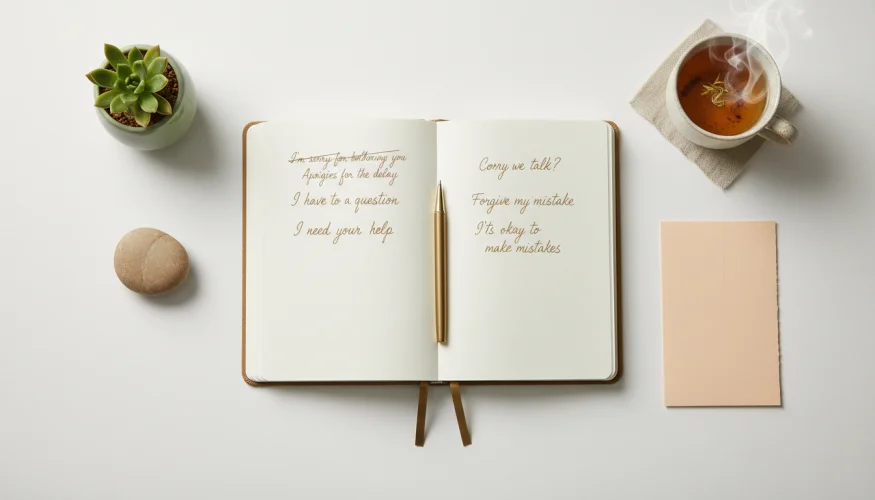
The first step is becoming aware of your own patterns. Many people apologize completely automatically, without even noticing. It therefore helps to spend one week tracking when and what they apologize for. One can keep a short journal or simply recall three situations at the end of the day in which "sorry" was said. It will quickly become apparent whether it was a genuine mistake or merely a reflex.
The next step is replacing the apology with another expression that better fits the situation. Instead of "Sorry for asking," one can say "I have a question for you." Instead of "Sorry to bother you," a simple "I need your help" will do. Instead of "Sorry for having a different opinion," one can say "I see it a bit differently." These formulations are equally polite, but they don't send a signal of inferiority. They are direct, clear, and respectful of both the speaker and the listener.
It is also very useful to learn to distinguish between a genuine and a reflexive apology. A genuine apology is appropriate when a person has truly hurt someone, failed to fulfill a commitment, or acted inappropriately. In such a case, an apology is an expression of integrity and carries great value. A reflexive apology, on the other hand, comes automatically, without any specific wrongdoing – simply as a way to ease imaginary tension or avoid imaginary conflict.
Working with physical responses is also helpful. Chronic apologizing is closely linked to anxiety, which manifests physically – as tightness in the chest, tension in the shoulders, or quickened breathing. Learning to recognize these signals and consciously slow down one's reaction creates space for choice: Am I actually apologizing for something? Is it necessary? Techniques such as conscious breathing or a brief pause before responding can make a surprisingly large difference in this regard.
For those seeking a deeper understanding of their own patterns, working with a therapist or a self-development coach can be very beneficial. The American Psychological Association has repeatedly emphasized that cognitive-behavioral therapy is one of the most effective methods for changing automatic thought patterns – and chronic apologizing is precisely such a pattern.
It is also important to cultivate a healthy relationship with making mistakes. A large part of chronic apologizing stems from the belief that making a mistake is unacceptable – and an apology is a way to quickly "undo" it. In reality, mistakes are a natural part of human functioning. Accepting this fact does not mean being indifferent or irresponsible. It simply means stopping punishing oneself for being human.
It is worth noting that changing this behavioral pattern may initially cause discomfort – not only for the person themselves, but also for those around them. People who were accustomed to constant compliance and apologizing may be surprised by the new directness and react to it in unexpected ways. This does not mean the change is wrong. On the contrary – healthy relationships are those in which both parties have the space to express themselves without constant justification.
Chronic apologizing is not an expression of politeness – it is an expression of fear. And fear, however understandable and deeply human, is not a good guide when building a confident and fulfilling life. Stopping apologizing for one's existence, for one's questions, for one's needs, and for one's place in the world is one of the most important steps toward genuine self-esteem. And self-esteem – as those who have built it well know – returns to every area of life: to relationships, to work, to health, and to everyday well-being.