

# How to Manage Aquatic Plant and Aquarium Maintenance Without Chemicals ## Why Avoid Chemistry in
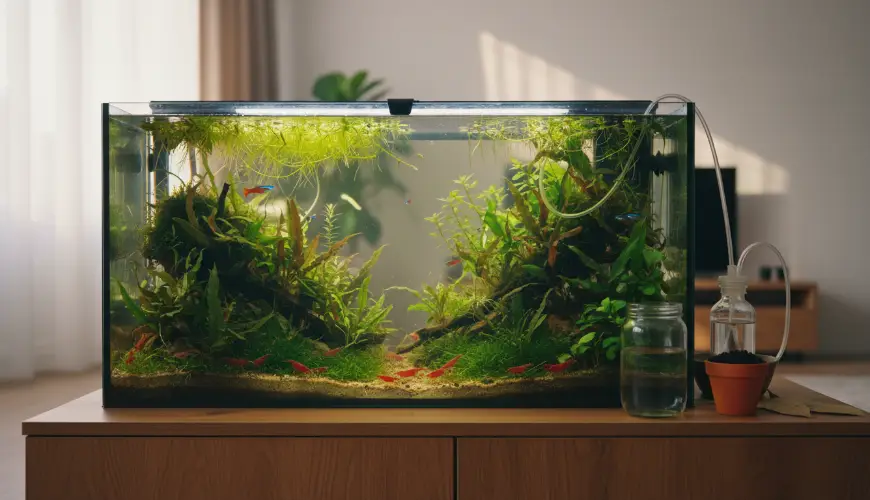
Anyone who has ever stood before a glass tank full of green plants, swaying fish, and crystal-clear water knows exactly what we're talking about. An aquarium in your home or a garden pond isn't just decoration – it's a living ecosystem that breathes, grows, and changes every day. And that's precisely why caring for it is such a fascinating yet demanding discipline. Most beginner aquarists reach for chemical products at the first sign of algae or cloudy water. But there is another way – natural aquarium and aquatic plant maintenance without chemicals – one that not only works, but works better in the long run.
Chemical products available in aquarium shops promise quick solutions: clean water in 24 hours, algae elimination over a weekend, pH stabilisation with a single dropper. The problem is that these substances frequently disrupt the delicate biological balance that nature takes weeks to build. They may kill unwanted organisms, but in doing so they also damage beneficial bacteria, microorganisms, and in worse cases, the plants or fish themselves. It's a bit like taking antibiotics for every cold – helpful in the short term, harmful in the long run.
Try our natural products


The secret of a healthy aquarium lies in biological balance
A healthy aquarium functions like a miniature natural environment. The key isn't sterility, but balance between producers, consumers, and decomposers. Plants produce oxygen and absorb nitrates, fish and other creatures produce waste, which bacteria convert into substances that plants can use again. This cycle, known as the nitrogen cycle, is the foundation of every healthy aquatic environment – and it is precisely its disruption by chemicals that is the cause of most problems aquarists face.
Biological filtration is absolutely essential in this regard. A properly stocked filter with sufficient surface area for bacterial colonisation can handle the breakdown of organic matter without any chemical assistance. It's important to rinse the filter regularly – but be careful never to do so under running tap water. The chlorine in tap water would destroy the very bacterial cultures that keep the entire system running. Instead, simply rinse the filter media in water taken directly from the aquarium.
Gardeners who care for garden ponds think along similar lines. Take Mrs. Markéta from the South Bohemian Region, who years ago stopped using chemical algae treatments and instead planted water lilies, pondweed, and duckweed in her pond. "The first summer it looked chaotic, but then the water settled on its own and today it's clearer than ever," she says. Her experience is not exceptional – it is precisely the process that experts call natural ecosystem succession.
Choosing the right aquatic plants plays a key role in the whole process. Fast-growing species such as Elodea canadensis (Canadian waterweed), Ceratophyllum demersum (rigid hornwort), and various species of Hygrophila are excellent natural filters. They actively absorb nitrates and phosphates – the nutrients that would otherwise feed algae. The more plants, the less space and nutrients for unwanted organisms. This principle is so simple that nature has been using it for millions of years.
Lighting also plays an important role. Excessive light is one of the main causes of algae overgrowth, yet many aquarists overlook this and prefer to reach for algaecides. Yet it is enough to reduce the lighting period to 8 to 10 hours per day and ensure the light is not too intense for the type of tank. Natural daylight from a window can be beautiful, but direct sunlight tends to be problematic for aquariums – it heats the water and triggers uncontrollable algae growth.
Natural methods that actually work
One of the most effective and natural methods of combating algae is introducing natural algae consumers into the tank. There are a whole range of creatures that feed directly on algae and can keep their population at an acceptable level. Among the most popular are various species of Neritina snails, Caridina and Neocaridina shrimp, the Siamese algae eater (Crossocheilus siamensis), and bristlenose plecos – catfish that can clean the tank glass of green film without a single drop of chemicals.
This method is appealing not only for its effectiveness, but also because it adds new elements of life and natural behaviour to the aquarium. Watching shrimp carefully picking algae from every leaf is in itself a fascinating experience. The prerequisite, of course, is that the chosen creatures are compatible with the other tank inhabitants and have sufficient space.
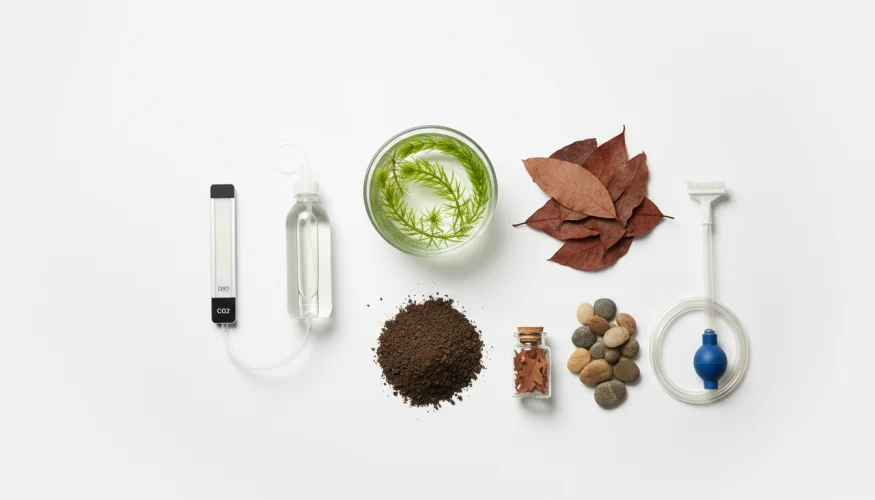
Another natural approach is regular mechanical maintenance. A weekly water change of approximately 20 to 30 percent is one of the basic rituals of every responsible aquarist and replaces a whole range of chemical treatments. Fresh water dilutes the concentration of nitrates, phosphates, and other substances without the need to reach for any product. It is also advisable to regularly remove dead plant matter, food remnants, and organic sediment from the substrate using a special siphon – known as a gravel vacuum or mulm sucker. This simple tool is one of the most important aids in natural aquarium care.
The quality of water we add to the aquarium has a fundamental impact on the overall health of the ecosystem. Chlorine and chloramine found in ordinary tap water are dangerous to bacteria and sensitive fish. Instead of chemical dechlorinators, several natural alternatives can be used: let the water stand in an open container for 24 hours (the chlorine will evaporate), use filtered water, or water from a home filter with activated carbon. The World Health Organization confirms that chlorine naturally dissipates from water upon contact with air, so this simple method genuinely works.
An interesting and increasingly popular method is also the use of peat extracts or wood roots as natural water conditioners. Indian almond leaves (Terminalia catappa) or oak leaves release tannins and humic acids into the water, which naturally lower pH, have antibacterial properties, and create conditions similar to the natural habitat of many tropical fish. They also give the water a characteristic golden tint, which some aquarists refer to as the "blackwater" effect. This approach is particularly popular among keepers of fish from the Amazon basin or Southeast Asia, where the water is naturally acidic and soft.
Caring for aquatic plants themselves without chemicals rests on several basic principles. Plants need light, CO₂, and nutrients above all else – and in the right ratio – for healthy growth. A deficiency in any of these factors leads to stunted plants, yellowing leaves, or their death. Instead of chemical fertilisers, natural alternatives can be successfully used: substrate enriched with clay or laterite, which naturally supplies plant roots with mineral nutrients, or natural fertilisation through fish waste in a well-stocked tank.
Natural CO₂ injection through yeast fermentation is another popular solution that requires no chemicals whatsoever. All it takes is a simple homemade apparatus made from a bottle, yeast, and sugar – fermentation naturally produces carbon dioxide, which is fed into the tank and promotes plant growth. This method is less precise than professional CO₂ systems, but for smaller tanks and beginner aquarists it is perfectly adequate and entirely natural.
How can we sum all this up? As the renowned German aquarist Takashi Amano, whose approach to natural aquariums inspired an entire generation of enthusiasts, once said: "Nature is the best designer – our task is only to understand its principles and not to intervene where it is not necessary." This philosophical approach, which Amano called the natural style, is today a globally recognised method of aquarium keeping and is built on precisely the principles we have been discussing – balance, patience, and minimal intervention.
Natural aquarium and aquatic plant maintenance is therefore not about giving up care or stopping to address problems. It is about understanding how an ecosystem works and working with it, not against it. Chemical shortcuts can be tempting, especially for beginners who want quick results. But an aquarium that has been built patiently, with an emphasis on biological balance and natural processes, is more resilient, more stable, and ultimately more beautiful. Nature always finds a way – and our task is to help it do so, not to replace it.
For those who want to learn more about the natural approach to aquarium keeping, inspiration can be found at Aquatic Plant Central, one of the world's largest communities dedicated to planted aquariums, where experienced aquarists share their methods and experiences without chemical shortcuts. The journey to the perfect aquarium is, after all, just as interesting as the destination itself.