

Why a shopping mall causes anxiety and overloads the senses
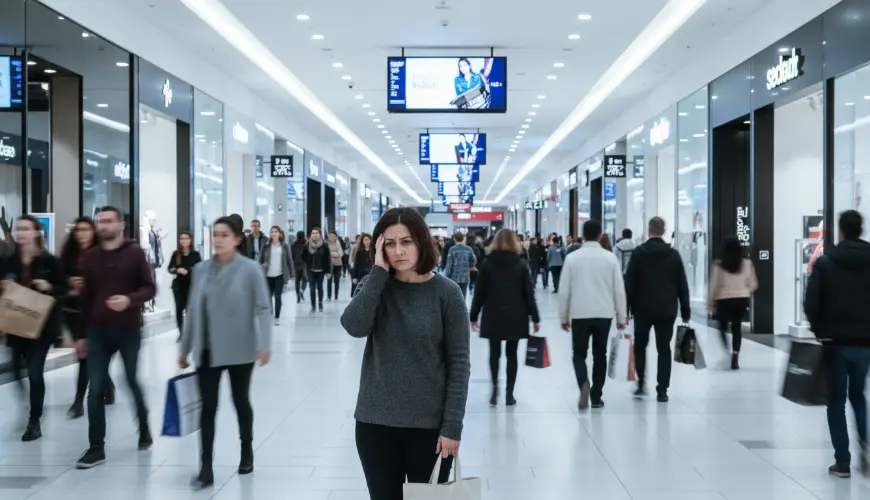
Just entering a large shopping mall on a Friday afternoon is enough to bring on, within minutes, a feeling that many people know very well – a slight disorientation, tension in the shoulders, an urge to find what we need as quickly as possible and disappear. Some attribute it to fatigue or a bad mood. Others tell themselves they're simply "the introverted type." In reality, something far more concrete and physiologically well-described lies behind it: sensory overload combined with an environment that was designed to keep us inside as long as possible – regardless of how we feel in the process.
Shopping malls are not neutral places. They are carefully designed ecosystems in which every detail – from the layout of shops to the intensity of lighting and the temperature of the air – serves a single goal: to maximise the time spent shopping and minimise the chance that a customer will leave before opening their wallet. This approach has its commercial logic, of course, but for the human nervous system it represents a considerable burden that is rarely talked about.
Try our natural products


What happens in our brains amid crowds and noise
The human brain is evolutionarily calibrated for a relatively calm, clear environment with unambiguous spatial orientation. When it suddenly finds itself in a space where music, voices, the scent of a bakery mingling with perfume from a drugstore, flashing displays, and the movement of hundreds of people stream in from all directions, it must process an enormous number of stimuli simultaneously. The brain cannot simply "switch off" perceptions that it does not evaluate as relevant – it must first register them, then suppress them, and only then focus on what it actually needs.
This process is called selective attention, and its capacity is limited. Psychologists and neurologists describe it as a mental resource that becomes depleted with intensive use – much like a muscle after a long workout. Once this capacity is exhausted, symptoms appear that people commonly describe as fatigue, irritability, or an inability to make decisions. In reality, this is a natural defence mechanism of an overloaded nervous system.
Research in the field of environmental psychology has long shown that noise is one of the most significant stressors in enclosed public spaces. The average noise level in a shopping mall ranges between 70 and 85 decibels – roughly equivalent to a noisy restaurant or a busy street. With prolonged exposure to such noise, the body automatically activates a stress response: cortisol levels rise, heart rate increases, and muscles tense up. A person may not be aware of this at all, yet it happens nonetheless.
Consider an example from everyday life: Jana, a thirty-four-year-old teacher from Brno, used to go shopping every Saturday at a large shopping mall. She always came home feeling completely exhausted, even though she had done nothing physically demanding. It took her hours to "recover" and be able to spend time with her family or pursue her hobbies. It was only when she started shopping online or in smaller local stores that she discovered Saturday afternoons could be pleasant rather than devastating. Her experience is not exceptional – it is shared by a vast number of people who have simply never explicitly named the cause of their exhaustion.
Artificial lighting also plays a role. Shopping malls use intense, mostly cool-white light that suppresses melatonin production and keeps the brain in a state of wakefulness and alertness. This effect is intentional – a tired but alert customer shops more impulsively. For the nervous system, however, this means additional strain, as the body's natural rhythms are disrupted and the brain receives contradictory signals.
It is not just noise and light, either. Scent may be the most underestimated tool of sensory overload. Major retail chains invest considerable resources in so-called scent marketing – the deliberate fragrancing of spaces with specific aromas designed to evoke pleasant emotions and increase willingness to buy. The bakery near the entrance is no accident, nor is the smell of fresh coffee near the café in the middle of the mall. When these scents mix with perfumes from the drugstore, cleaning products, and the perspiration of hundreds of people, an olfactory cocktail is created that the brain must constantly sort and interpret.
Who is most at risk of sensory overload
Although sensory overload in shopping malls is experienced to some degree by everyone, there are groups of people for whom this experience is significantly more intense and harder to manage. People with anxiety disorders, ADHD, autism, or heightened sensitivity of the nervous system – professionally referred to as high sensitivity (HSP, Highly Sensitive Person) – may experience genuine panic attacks or anxiety states in such environments that are invisible to those around them but very real to the individual concerned.
According to estimates by psychologist Elaine Aron, who first systematically described the phenomenon of high sensitivity, approximately 15 to 20 percent of the population are highly sensitive individuals. These people process sensory stimuli more deeply and intensely than others, which has many advantages in a calm environment but becomes a source of significant stress in a noisy and crowded space.
Children are in a similar position, as their nervous systems are still developing and their capacity for processing stimuli is naturally lower than that of adults. Parents of young children are well acquainted with scenes in which a child suddenly bursts into tears or begins to behave uncontrollably in a shopping mall – in many cases this is not a matter of being spoiled, but of an overloaded nervous system seeking an escape.
Older adults form another group that is more vulnerable to sensory overload. With age, the brain's ability to filter out irrelevant stimuli and process multiple pieces of information simultaneously slows down. What a young person manages with a certain degree of effort can represent a genuinely exhausting experience for an older person.
It is important to emphasise that anxiety arising from an overloaded environment is not a weakness or an exaggerated sensitivity – it is a legitimate physiological response to an environment that was designed without regard for human needs. As architect and environmental theorist Jan Gehl noted in his book Cities for People: "The human body and senses are the yardstick by which we should design spaces – not the other way around."
An awareness of this mechanism can in itself bring relief. Many people feel ashamed of their intolerance of crowded places or regard it as irrational. Yet it is an entirely understandable reaction of the nervous system to an environment that significantly exceeds its natural capacities.
How to protect your nervous system and shop more mindfully
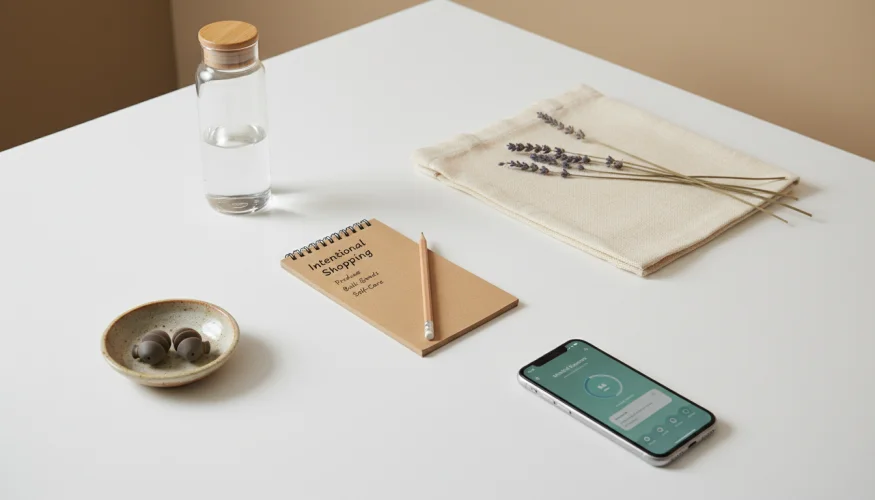
Understanding why shopping malls cause us stress naturally leads to the question of what can be done about it. The answer is not necessarily complete avoidance of these places – which, in modern life, is not always realistic – but rather conscious management of one's own nervous system and a considered approach to shopping as such.
One of the most effective strategies is planning shopping trips outside peak hours – that is, during the morning hours on weekdays, when malls are considerably less crowded and noise levels are significantly lower. The difference in subjective experience can be surprisingly large. It also helps to have a clear list of what we need prepared in advance, so that the brain does not have to simultaneously process stimuli and think through decisions in a crowded space.
A short-term relief can also come from deliberately "anchoring" one's attention – focusing on the breath, walking slowly, or taking a brief pause in a less frequented spot. These techniques are rooted in the principles of mindfulness, and their effectiveness in managing acute stress is well supported by research, including that published by the American Psychological Association.
Many people today, however, are choosing an even more fundamental change: they are moving a large portion of their shopping to environments that are more conducive to their nervous system. Online shopping offers calm, clarity, and the ability to make decisions without time pressure or sensory bombardment. Local markets, smaller specialist shops, or ecologically focused online stores offer similar advantages – with the added benefit that customers have greater insight into the origin of products and can shop more consciously and sustainably.
The choice of environment in which we shop is not merely a matter of comfort – it is a matter of caring for one's own mental health. At a time when mental wellbeing and sustainable lifestyles are increasingly discussed, it is worth reconsidering even something as seemingly trivial as the way we shop. An overcrowded shopping mall full of impulse purchases does not have to be the only option – and for many people it is certainly not the best one.
Mindful shopping, whether it means choosing a calmer environment, smaller shops, or products from ethical producers, is one of many steps by which everyday life can be tailored to genuine needs – one's own needs, rather than those that the design of a shopping mall seeks to inscribe in us. And that, ultimately, is the most fundamental freedom we have as consumers.