

These exercises will release stiff shoulders after a day of sitting
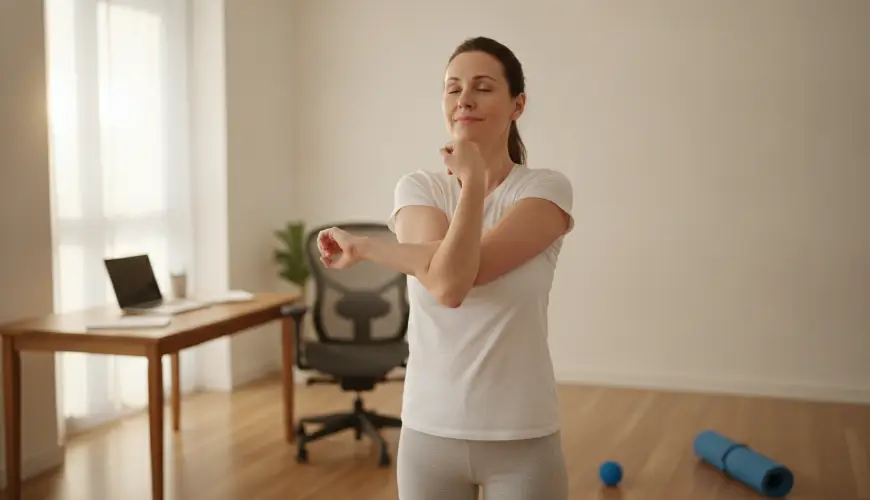
Everyone who spends most of their working day at a monitor knows it well. In the afternoon, they get up from their desk, try to turn their head, and are met with an unpleasant stiffness in the neck, pressure in the shoulders, and a dull ache that runs from the neck down to the shoulder blades. This is neither coincidence nor weakness – it is a natural response of the body to hours spent in one position, during which muscles lose blood flow, shorten, and begin to protest. The good news is that there are simple exercises that can effectively relieve stiff shoulders after a day at the computer, and neither a gym nor a personal trainer is required.
According to the World Health Organization, more than 1.4 billion adults worldwide suffer from insufficient physical activity. Office work contributes significantly to this figure – and the shoulders are among the most frequently affected areas of the body. The problem lies not only in the pain itself. Chronically tense muscles in the shoulder and neck area can lead to headaches, impaired concentration, and, in the long term, structural problems of the spine.
Try our natural products





Why shoulders suffer so much from sitting at a computer
To understand how exercise helps, it is useful to know what is actually happening in the body. In a typical office posture – head tilted forward over the keyboard, shoulders pulled slightly forward, back curved into an arc – the muscles in the front of the chest are constantly shortened. Conversely, the muscles between the shoulder blades and at the back of the shoulders are overstretched and fatigued from trying to keep the body in balance. This imbalance gradually deepens, and the result is the characteristic "rounded posture" that we see in many people working from home and in open-plan offices.
Physiotherapists describe this phenomenon as the so-called "upper crossed syndrome" – a condition in which certain muscle groups are chronically overloaded while others are weakened. As the Cleveland Clinic notes, this is a very widespread problem of modern times that can be significantly alleviated or completely eliminated with regular care. And targeted stretching and strengthening of the right muscle groups is the most accessible form of this care.
Take Martina, for example, a project manager from Brno who has been working from home for three years. At first, shoulder pain bothered her only occasionally, but gradually what had been occasional discomfort became an everyday occurrence. It was only when she started incorporating a short series of exercises in the evenings – lasting less than twenty minutes in total – that she felt genuine relief for the first time. Today, these exercises are part of her daily routine, just like brushing her teeth or her morning coffee.
Exercises that actually work
Let us move on to practice. The following exercises are designed to target the areas most commonly overloaded in people who work at computers – namely the front of the chest, the trapezius muscles, the neck, and the shoulder blade area. All of them can be performed at home without any equipment, ideally on a mat or carpet.
Chest stretching in a doorframe is one of the most effective exercises for people who spend all day sitting with their shoulders pulled forward. Simply stand in a doorframe, rest your forearms against its sides so that the arms form a right angle, and then slowly step forward with one foot. You will feel a pleasant pull across the entire chest and the front of the shoulders. Holding this position for 20 to 30 seconds, repeated three times, is enough to begin releasing the shortened muscles.
Another excellent exercise is the so-called "Eagle arms" – a movement inspired by yoga that deeply stretches the muscles between the shoulder blades. Extend your arms in front of the body, then cross them at the elbows so that the right elbow is under the left, and try to bring the palms together. Hold the position for 30 seconds, then switch sides. This exercise is particularly effective for those who feel tension deep between the shoulder blades or in the area between the shoulders.
Shoulder rolls are among the simplest yet most underrated exercises. Slowly rolling the shoulders backwards – not forwards, as many people intuitively do – helps activate the muscles of the upper back while simultaneously releasing tension in the trapezius. Ten slow circles backwards, then a pause, then another ten. The sound of cracking or clicking that many people hear during this exercise is completely normal and generally harmless – it is the release of air bubbles from the joint fluid.
A very popular exercise among physiotherapists is also the "W-T-Y" stretch, named after the shapes the arms form during the exercise. It is performed lying face down or standing with a forward lean. In the "W" position, the arms are bent at the elbows, palms facing down, and the entire arm forms the shape of the letter W. In the "T" position, the arms are extended to the sides, and in the "Y" position, they are raised diagonally upward. Each position only needs to be held for a few seconds, but regular repetition strengthens the deep stabilisers of the shoulder joint and significantly improves posture.
We must not forget neck and cervical stretching, which is closely connected to the shoulders. A slow lateral tilt of the head – with the ear moving towards the shoulder, not the chin towards the chest – stretches the lateral neck muscles. For a more intense version, you can gently press the head downward with your hand, but always with care and without jerking. Each side should be stretched for at least 30 seconds.
An interesting addition is the so-called "thread the needle" – a yoga exercise performed on all fours. From the starting position on hands and knees, one arm is slid under the body along the mat, so that the shoulder and temple touch the mat. You feel a deep stretch in the area of the shoulder blade and upper back. This exercise is particularly pleasant after a long day, and many describe it as providing immediate relief.
As leading American physiotherapist and movement medicine populariser Kelly Starrett said: "Mobility is not just about flexibility – it's about having control over your body's full range of motion." This thought precisely captures why passive stretching alone is not enough – it is also important to activate the right muscles so that the body does not remain dependent on compensatory patterns.
In addition to stretching, it is therefore advisable to include simple strengthening exercises for the shoulder blade area. An excellent choice is the so-called "shoulder blade squeezes". Standing or sitting, draw both shoulder blades together as if trying to squeeze a pencil between them, and hold the position for three to five seconds. Repeating this ten to fifteen times daily helps strengthen the weakened muscles of the upper back, which are key to good posture.

How to incorporate exercise into everyday life
Knowing the exercises is one thing – performing them regularly is another. One of the most effective ways to build a new movement habit is so-called habit stacking, which means linking a new activity to something you already do automatically. Shoulder exercises can easily be incorporated, for example, immediately after coming home from work, after dinner, or as part of a morning routine before turning on the computer.
Research shows that just 10 to 15 minutes of daily stretching is sufficient to relieve muscle tension and improve circulation, provided it is done regularly. Harvard Health Publishing emphasises that regular stretching not only reduces pain but also improves range of motion, reduces the risk of injury, and contributes to overall psychological wellbeing – muscles released from tension send signals of calm to the brain.
In addition to the exercises themselves, workplace ergonomics plays an important role. The monitor should be at eye level so that the head is not permanently tilted downward. The keyboard and mouse should be positioned so that the arms can rest freely alongside the body and the shoulders are not pulled upward. Regular breaks every 45 to 60 minutes – even just a short walk around the room or a few shoulder rolls – can significantly reduce the accumulation of tension throughout the day.
An interesting aid for those who want to care for their shoulders passively as well may be ergonomic accessories such as massage balls, fascial rollers, or heat patches for muscle relief. These products are not a substitute for movement, but as a supplement they can help release myofascial tension and prepare the muscles for stretching. Similar products focused on a healthy lifestyle and physical wellbeing can be found, for example, in the range offered by the online shop Ferwer, which specialises in products supporting a healthy and sustainable way of life.
Stiff shoulders after a day at the computer are not an inevitable fate of modern people. With a little regularity and the right exercises, this everyday problem can be significantly alleviated or prevented altogether. The body remembers every movement we give it – and it equally remembers every hour of immobility. The choice is ultimately always ours.