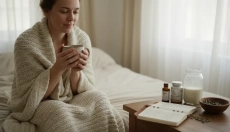

Stretching in the happy baby position before sleep will release stiff hips
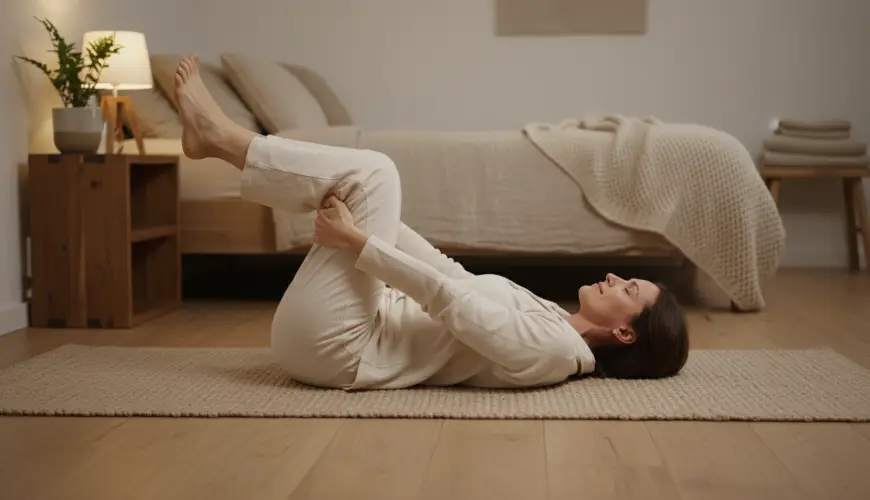
There is a position that every healthy child masters intuitively and without thinking – lying on their back, holding their feet, calmly rocking from side to side with complete ease. Most adults have forgotten it. Yet this simple position, known in yoga as "happy baby" (ananda balasana), is among the most effective ways to release overworked hips, ease tension in the lower back, and prepare both body and mind for deep, restorative sleep.
The modern lifestyle is not kind to hips. The average person spends six to eight hours a day sitting at work, in a car, or in front of a screen six to eight hours a day, yet the hip joint is built for movement. Prolonged sitting shortens the hip flexors, overloads the deep rotators, and creates chronic tension that spreads further – into the lower back, the glutes, and sometimes all the way to the knees or calves. The result is a feeling of stiffness that many people experience particularly in the morning after waking, or conversely in the evening before sleep, when the body needs to relax as much as possible.
Try our natural products
Why hips determine the quality of your sleep
The connection between hip tension and sleep quality is no coincidence or mere feeling. The hip area is one of the largest joint groups in the body and is surrounded by a dense network of muscles, tendons, and fascia. When these structures are chronically shortened or overloaded, the nervous system remains on alert – the body does not perceive that it is time to rest. Moreover, as research published in the Journal of Bodywork and Movement Therapies points out, physical tension in the muscles directly influences the activity of the sympathetic nervous system – the part that controls the "fight or flight" response. As long as muscle tension persists, the body remains physiologically aroused and falling asleep becomes more difficult.
This is precisely where pre-sleep stretching comes in. Gentle, slow, and mindful movements activate the parasympathetic nervous system – switching the body into rest and recovery mode. And the happy baby position is exceptionally effective in this regard, because it simultaneously works the external hip rotators, the adductors of the inner thighs, the lumbar spine, and the sacral area. In other words, with a single movement it targets exactly those areas that modern life strains the most.
Consider Martina, a thirty-year-old graphic designer who spends most of her working day at a computer. In the evenings she struggles to fall asleep despite being tired – she lies in bed but feels an uncomfortable pulling in her hips and restlessness in her legs. After incorporating five minutes of stretching in the happy baby position into her evening routine, she began reporting that she falls asleep faster and wakes up less often during the night. Her experience is not exceptional – thousands of people share similar stories of discovering the power of targeted hip stretching as part of their sleep hygiene.
How do you get into the position correctly? Simply lie on your back on a mat or directly on a bed with a firmer mattress. Bend both knees and lift your feet off the surface. Then grasp the outer edges of your feet – or your calves if you cannot reach your feet – and draw your knees toward your armpits. The knees should be approximately shoulder-width apart or slightly wider, with the shins perpendicular to the floor. In this position, gently rock from side to side, as if the body were massaging the entire lumbar area against the surface. Breath is key throughout the position – each exhale is an opportunity for deeper release, each inhale a space for conscious awareness of your own body.
How long to hold the position depends on individual needs, but the general recommendation is to stay for one to three minutes. The transition from the happy baby position into sleep can be literally seamless – there is no need to get up from the bed at all.
Variations and modifications for everyone
One of the greatest advantages of this position is its accessibility. It is not intended only for flexible yogis or athletes – on the contrary, it can be especially beneficial for people with tighter hips or lower back problems, provided it is performed with awareness of one's own body and without forcing.
For those who cannot reach their feet, it is perfectly fine to hold the calves or thighs instead. If pressure on the back is uncomfortable, a folded towel or thin pillow can be placed under the lumbar spine. The one-sided variation – working with only one leg at a time while the other lies extended on the surface – is ideal for people with sensitive knees or following orthopaedic surgery. The body should never be forced into pain – a mild pull or an intense stretching sensation is desirable, while sharp pain is a signal to stop.
An interesting variation is also the so-called half happy baby, where one leg is held in position while the other remains bent with the foot on the surface. This asymmetric position allows greater control over the intensity of the stretch and tends to be a suitable first step for beginners. Gradually, as the hips loosen and flexibility increases, one can progress to the full version with both legs at once.
Beyond the position itself, the environment also plays a role. Pre-sleep stretching should take place in a calm, darkened space, ideally without a phone or television. As leading global sleep expert Matthew Walker says: "Sleep is not a passive state – it is an active, complex biological process that requires preparation." The stretching ritual is precisely such preparation – a signal to the brain that the day is ending and the time for recovery has come.
A natural complement to the happy baby position consists of several other simple positions that can be incorporated into an evening routine. Child's pose (balasana) stretches the back and hips. Reclined butterfly with feet together and knees spread to the sides works the adductors and inner thighs. A simple lying twist – where bent knees rotate to one side and the head turns to the other – releases the thoracic and lumbar spine. The entire sequence can take less than ten minutes and yet have a significant impact on how quickly and how deeply a person falls asleep.
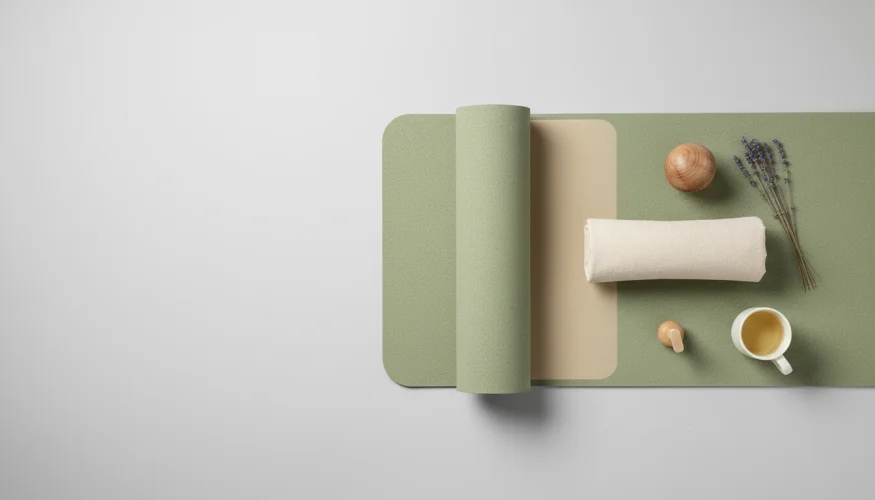
For those looking for a quality mat or accessories for home stretching and yoga, the Ferwer online shop, for example, offers a selection of ecological yoga mats and props made from natural materials that support mindful movement and a sustainable approach to self-care.
It is also important to mention what the happy baby position cannot do – and that is replace professional care for serious orthopaedic or neurological conditions. People diagnosed with disc herniation, severe hip joint arthrosis, or who have recently undergone surgery should consult their doctor or physiotherapist before beginning any stretching exercise. For the vast majority of healthy adults, however, this position is safe, gentle, and delivers results relatively quickly.
Scientific interest in the connection between movement, stretching, and sleep quality is growing. A 2019 study published in the journal Mental Health and Physical Activity showed that regular exercise and pre-sleep stretching significantly shortens sleep onset time and reduces the number of nocturnal awakenings in adults suffering from mild insomnia. Although the happy baby position was not the only element examined in that study, the results confirm what many yoga practitioners and physiotherapists have long been saying: movement and sleep are communicating vessels.
Furthermore, in many traditional approaches to the body – whether in yoga, Chinese medicine, or somatic therapy – the hips symbolise an area where unresolved emotional tension accumulates. Whether one accepts or rejects this idea, the practical experience of deep hip stretching is often surprisingly intense for many people – sometimes accompanied by a sense of relief that extends beyond the purely physical. Perhaps that is why the position is called "happy baby" – it returns the body to a state in which natural release was the norm, not the exception.
Incorporating five minutes of mindful stretching before sleep is not a major change. But for hips overloaded by a full day of sitting, for a nervous system trapped in constant alertness, and for a mind that needs a clear signal to transition into rest, this small change may be precisely what determines whether you wake up refreshed in the morning – or tired once again.