

# Release your shoulders with a broom handle and improve mobility
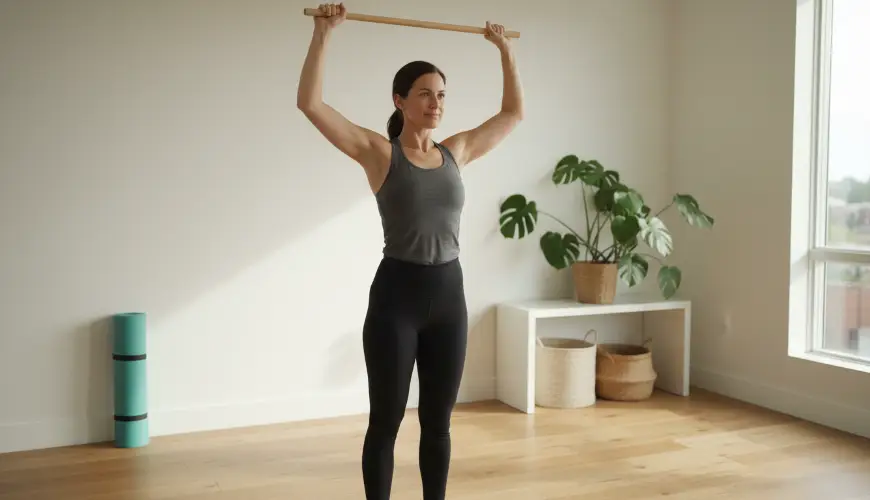
Shoulders are among the most complex joints in the human body. They offer an enormous range of motion – we can rotate them, raise our arms overhead, reach behind our backs and in front of our bodies. Yet this very versatility is also their greatest weakness. The modern lifestyle, in which we spend hours hunched over a keyboard, behind a steering wheel, or with a phone in hand, gradually curtails the natural range of shoulder motion without us even realising it. And then comes the day when we try to pull a jumper over our head or reach for something on the top shelf, and we suddenly discover it doesn't come as easily as it once did.
The good news is that improving shoulder mobility requires no expensive equipment or gym membership. All you need is one thing that almost everyone has at home: a broomstick, a mop handle, or any similar straight rod of appropriate length. This simple tool, when used regularly, can literally transform the way your shoulders move.
Try our natural products

Why shoulders lose mobility and what to do about it
The human body is designed for movement. When we don't provide enough of it, muscles shorten, fascia stiffen, and joints lose their natural range of motion. In shoulders, this happens very easily, because most everyday activities take place in front of the body – we cook, type, drive, and carry bags. The rear portion of the shoulder girdle, comprising muscles such as the trapezius, rhomboids, and the posterior deltoid, remains insufficiently engaged and gradually weakens. The front portion, by contrast, tends to be overloaded and shortened.
The result is the typical "forward" shoulder position that physiotherapists refer to as protraction. The shoulders are pulled forward and downward, the chest closes off, and overall posture suffers. According to research published in the Journal of Physical Therapy Science, this pattern has a direct connection with neck pain, upper back pain, and chronic headaches. In other words, limited shoulder mobility is not merely an aesthetic problem – it has a real impact on everyday wellbeing and health.
Take Markéta, a thirty-year-old accountant who works from home, as an example. She sits in front of a monitor for eight hours a day, cooks after work, and relaxes with a tablet in the evening. Her shoulders are permanently pulled forward, her neck is tense, and she is occasionally troubled by pain between her shoulder blades. No injury, no diagnosis – just the gradual restriction of movement caused by the way she lives. Exercises with a stick are designed precisely for cases like hers.
Physiotherapist and movement educator Kelly Starrett captured it beautifully: "Mobility is not a luxury. It is basic body maintenance, just like brushing your teeth." And stick-based exercises are one of the most accessible forms of that maintenance.
Stick exercises: how to do them correctly
Before you begin, it is important to understand why a stick works better than exercising without a prop. The key lies in bilateral movement guidance – both hands grip the stick simultaneously, so the stronger or more mobile side cannot compensate for the more restricted side. The stick also extends the lever arm and allows a greater range of motion than would be possible without it. And because you are holding it in your hands throughout, it provides sensory feedback about exactly where your arms and shoulders are in space.
The length of the stick should be approximately equal to your shoulder width or slightly longer – a standard broomstick is typically around 120–140 centimetres, which is ideal for most people. The material is not particularly important; what matters is that the stick is straight and rigid.
One of the fundamental exercises is the shoulder pass-through. You stand upright, holding the stick in front of you with an overhand grip, hands wider than shoulder-width apart. You slowly raise your arms in front of your body, then continue smoothly in an arc over your head and behind your back until the stick touches your buttocks or thighs. The movement should be slow, controlled, and free of any swinging momentum. If you feel significant tension or pain, widen your grip – the wider the grip, the easier the movement. Over time, as mobility improves, you can bring your hands closer together.
Another popular exercise is shoulder rotation with the stick behind the back. You hold the stick behind your back, with one hand gripping it from above (over the shoulder) and the other from below (from the side). You gently pull with both hands – the upper hand pulls the stick upward while the lower hand pulls it downward – creating traction in the shoulder joint and stretching both the front and rear portions of the shoulder girdle simultaneously. After a few seconds, you switch sides. This exercise is particularly effective for people who have difficulty reaching behind their back, for example when fastening clothing.
A third exercise worth mentioning is circular movements with the stick overhead. You hold the stick above your head with hands approximately shoulder-width apart or slightly wider. You perform small circular movements in the shoulder joints – first forwards, then backwards. This exercise activates the shoulder joint stabilisers and improves coordination throughout the entire girdle.
Consistency is crucial when training mobility. Training intensively once a week is not enough – shorter but daily practice yields far better results. Five to ten minutes a day with the stick will produce noticeably better results after a few weeks than an hour-long session once in a while. Physiotherapists generally recommend incorporating these exercises in the morning as part of a morning routine, or before other sporting activities as a warm-up.
What to watch out for and when to seek professional help
Stick exercises are safe and gentle for most people, but there are several principles worth bearing in mind here as well. Pain is not the goal. A pleasant sense of tension during stretching is normal and desirable, but sharp, stabbing, or radiating pain is a signal that something is wrong. In such a case, the exercise should be stopped immediately.
People with a diagnosed rotator cuff injury, frozen shoulder (adhesive capsulitis), or those who have undergone shoulder surgery should consult a physiotherapist or orthopaedic specialist before starting any exercise programme. Stick exercises may form part of rehabilitation, but performing them without professional supervision during the acute phase of an injury can worsen the condition.
Frozen shoulder, medically known as adhesive capsulitis, is a condition in which the joint capsule becomes inflamed and thickened, significantly restricting mobility. According to the Mayo Clinic, it affects approximately two percent of the population and most commonly occurs in people between the ages of forty and sixty. Stick exercises can be part of the treatment when properly guided, but always under the supervision of a specialist.
Alongside physical pain, another warning sign is asymmetry of movement. If the difference between the right and left sides is very pronounced – for example, one arm moves smoothly overhead while the other stops halfway through the arc – this may indicate a structural problem that warrants the attention of a specialist.
For healthy individuals without acute complaints, however, stick exercises are an absolutely ideal form of prevention. They are particularly beneficial for athletes who practise asymmetric sports such as tennis, volleyball, or swimming, where the shoulder girdle is subjected to prolonged asymmetric loading. Regular mobility practice helps to balance these imbalances and reduces the risk of overuse injuries.
It is worth noting that improving shoulder mobility also has implications for other areas of movement. The shoulders are anatomically connected to the thoracic spine, neck, and lumbar region through fascia – connective tissues that envelop and interconnect muscles throughout the body. When the shoulder girdle releases, thoracic spine mobility very often improves naturally as well, tension in the neck decreases, and overall posture straightens. This interconnectedness is why physiotherapists and movement coaches place such strong emphasis on working with mobility as a whole, rather than as isolated exercise of a specific joint.
Simplicity is one of the greatest strengths of the entire approach. You don't need to buy anything, download anything, or travel anywhere. All you need to do is open the cupboard where you keep your cleaning supplies, pick up the broomstick, and devote a few minutes each day to your shoulders. At a time when fitness trends are becoming ever more complex and expensive, this simplicity is almost revolutionary. And the results? They speak for themselves – people who incorporate stick exercises into their daily routine very often report not only greater mobility, but also less pain, improved posture, and an overall more comfortable feeling in their bodies.
Perhaps it is time to stop thinking of a broom as merely a cleaning tool.