
# Squinting in Toddlers and When It's Time to See an Eye Doctor
Every parent knows that moment when they look at their baby or toddler and suddenly notice something unusual – one little eye seems to drift slightly sideways, the gaze doesn't look quite symmetrical, or the child squints one eyelid when concentrating. The question immediately arises: is this normal, or is there reason for concern? Squinting in young children is among the topics that worry parents perhaps more frequently than any other eye problem. And yet not every crossed gaze automatically means there's a problem – but some of its forms do genuinely require prompt medical intervention.
Understanding the difference between what is natural and what requires specialist attention can be of absolutely fundamental importance for a child's future vision. Eye development takes place intensively during the first years of life, and any problems that are neglected during this period can leave permanent marks.
Try our natural products



What actually happens when a child squints
Squinting, medically known as strabismus, is a condition in which both eyes do not point at the same spot at the same moment. The brain normally processes images from both eyes and merges them into a single three-dimensional perception. But if the eyes do not cooperate properly, the brain begins to struggle – and in young children, it deals with this in its own way. To avoid double vision, it begins to suppress signals from one eye. This is where the greatest risk begins: an eye whose signals are ignored over a long period stops functioning properly. This gives rise to amblyopia, commonly known as a "lazy eye", which without timely treatment can lead to a permanent reduction in visual acuity.
It is important, however, to distinguish between different types of squinting. Newborns and infants up to four months of age squint completely normally – their eye muscles are still developing and the brain is learning to coordinate the movements of both eyes. A newborn's gaze tends to be unstable, the eyes may deviate and jump around in various ways. This is entirely physiological and parents should not worry about it. The situation changes, however, as the child grows older.
Around the third to fourth month, eye movements should begin to become more coordinated. The child should be able to follow a moving object or a parent's face with both eyes simultaneously. If this does not happen, or if parents notice that one eye significantly and persistently deviates in a different direction, it is time to visit a paediatric ophthalmologist. The sooner a potential problem is identified, the greater the chance of successful treatment.
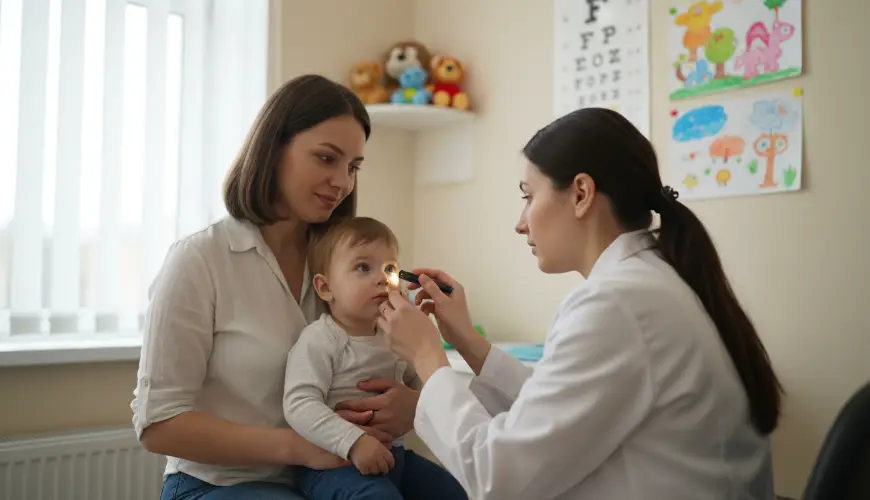
A special category is so-called pseudostrabismus, which very often frightens parents entirely unnecessarily. Many infants and toddlers have a fairly flat nasal bridge and prominent skin folds at the inner corners of their eyes. Because of this, their gaze may appear crossed even though squinting is not actually present at all. This optical illusion disappears on its own as the child's face develops and the nose takes shape. A paediatrician or ophthalmologist can reliably distinguish pseudostrabismus from true strabismus with a simple torch test.
When it's time to call the doctor
Parents should take notice and seek specialist advice in several specific situations. If squinting persists beyond the child's fourth month of age, if it appears suddenly in a child who had previously been seeing normally, or if parents notice that the child tilts or turns their head into unusual positions when looking at objects – all of these are signals that deserve attention. Similarly, alarm bells should ring if the child squints one eye in sunlight or when looking at distant objects.
There are also less obvious signs that can go unnoticed. A child who avoids activities requiring focused close-up vision, or who shows no interest in tracking moving objects, may have an eye problem. An older toddler who trips, bumps into furniture, or has difficulty judging distances may have impaired spatial vision as a direct result of uncorrected strabismus.
As a practical example: imagine a family where a mother notices during bath time that her two-year-old son's right eye turns slightly inward when he looks at a toy. The father reassures her that it's just a trick of the light. But when visiting grandmother, she notices the same thing. The family eventually visits an ophthalmologist, who diagnoses convergent strabismus – and thanks to early initiation of treatment, the problem is successfully managed without the need for surgery. Had they waited another year or two before making an appointment, the outcome could have been entirely different.
The World Health Organisation and leading ophthalmological societies recommend that every child undergoes a basic vision examination by the age of three at the latest, but ideally earlier. The Czech Ophthalmological Society points out that early detection of eye defects in pre-school age is key to preventing permanent vision damage.
How squinting treatment works and what parents can do
The good news for parents whose child has been diagnosed with strabismus is that modern medicine offers a whole range of effective treatment approaches. The choice of a specific method depends on the type of squinting, its cause, and the child's age.
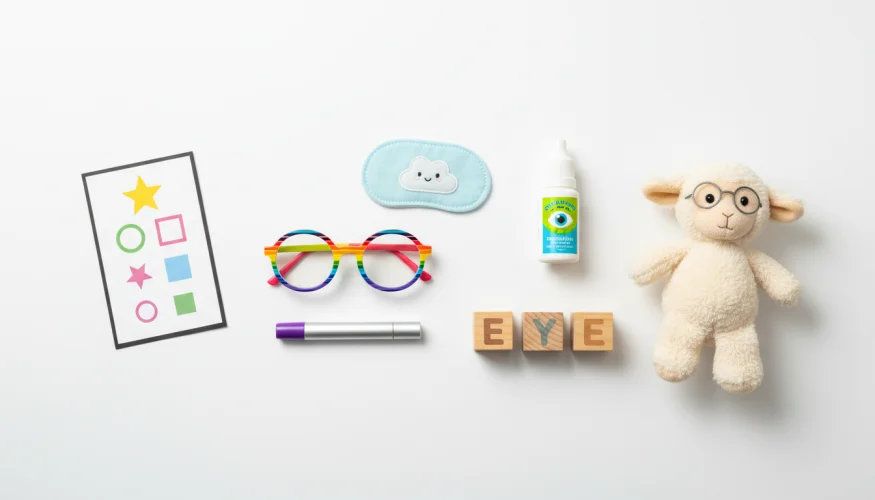
Treatment most commonly begins with glasses. A surprisingly high proportion of cases of strabismus in children is caused by uncorrected long-sightedness – the eye strains excessively when focusing and, as a side effect, turns inward. The right glasses interrupt this mechanism, and in some children the squinting disappears entirely or improves significantly. Many parents are surprised by how willingly young children wear glasses once they get used to them – the world suddenly looks much better and sharper to them.
Another tool in the doctors' arsenal is covering the stronger eye using an occluder – a patch over the lens of the glasses or directly over the eye. This forces the weaker eye to work and the brain relearns to process its signals. This method requires patience from both parents and child, but when followed consistently it produces excellent results. The key to success is regularity and consistency – even a few hours a day without the occluder can significantly slow down treatment.
In some cases, doctors proceed with the application of special eye drops that temporarily worsen the vision in the stronger eye, thereby achieving a similar effect to the occluder. This method may be more acceptable to some children than a patch. And finally, if conservative treatment is insufficient, surgical intervention on the eye muscles may be considered. The operation is relatively safe and routine, performed under general anaesthesia, and its aim is to mechanically adjust the pull of the muscles so that the eyes once again point in the right direction.
As American ophthalmologist and pioneer in the treatment of childhood strabismus David Guyton once said: "Strabismus is not just a cosmetic problem – it is a problem of the brain that must learn to see." This thought precisely captures why treatment is so time-sensitive. A child's brain is extraordinarily plastic and capable of adaptation in the first years of life – but this window of opportunity closes with age.
Parents can contribute at home to supporting healthy visual development in several ways. Sufficient natural daylight plays an absolutely fundamental role in the development of a child's visual system – research published in journals such as Ophthalmology shows that children who spend more time outdoors have a lower risk of developing short-sightedness and other eye problems. Limiting screen time, especially for children under two, and offering a variety of visual stimuli in the form of toys, picture books, and movement through space – all of this benefits healthy eye development.
Regular preventive check-ups with a paediatrician are a matter of course, but parents should not rely solely on these. A children's doctor carries out a basic orientation vision examination, but a specialist ophthalmologist has the tools and experience to detect even more subtle problems. If a parent has any doubts about how their child sees or how their eyes look, it is always better to ask. No visit to the doctor is unnecessary if it brings peace of mind or – in the worst case – an early diagnosis.
Squinting in toddlers is a topic that deserves to be freed from both unnecessary fear and unnecessary dismissiveness at the same time. The majority of minor deviations in the gaze of young children are entirely natural and resolve on their own. But where true strabismus persists, a simple equation applies: the earlier treatment begins, the better the outcomes. Parents who listen to their instincts and are not afraid to ask questions are doing the very best they can for their child's vision.