
# How to Move Safely When You Have Back Pain
Back pain is one of the most common causes of sick leave in the Czech Republic and simultaneously one of the most widespread reasons why people reduce their physical activity to an absolute minimum. All it takes is a single sentence from a doctor – "take it easy," "rest," "don't lift anything heavy" – and most of us interpret this as permission (or even an order) to lie down on the sofa and stop moving altogether. Yet this may be the biggest mistake we can make when dealing with back pain.
Modern medicine has undergone a significant reassessment of its approach to spinal pain treatment over the past twenty years. As recently as the 1990s, bed rest was the standard recommendation from orthopaedic surgeons and general practitioners alike. Today we know better. Research repeatedly shows that prolonged bed rest worsens the condition of most patients with back pain, rather than improving it. Muscles weaken, intervertebral discs are deprived of the nutrition that reaches them through movement, and the mind suffers from inactivity just as much as the body does.
Try our natural products





Why movement hurts, and yet is essential
To be clear – this is not about ignoring pain or pushing through it. Pain is a signal the body sends for good reason, and it is certainly not wise to disregard it. The key is to understand the difference between pain that warns of damage and pain that arises from tension, inflammation or muscle spasm – and it is precisely this second category that accounts for the vast majority of both acute and chronic back pain.
Imagine a very typical situation: a person turns over awkwardly in bed in the morning, feels a sharp twinge in their lower back and is suddenly afraid to take a single step. The natural reaction is to freeze, bend into a position of relief and move as little as possible. Yet muscles that are in spasm need blood flow. Blood flow comes with movement. Without movement, the spasm lasts longer, the pain is prolonged and the psychological stress of immobility makes the situation even worse. A vicious cycle develops that becomes increasingly difficult to break out of.
The World Health Organization and leading orthopaedic societies now agree that mild physical activity adapted to the patient's current condition is more beneficial for most types of back pain than complete rest. This obviously does not mean heading out to a tennis court or moving furniture – but conscious, gentle movement, yes.
Dr Ondřej Šebek, a physiotherapist specialising in vertebrogenic disorders, puts it simply: "The spine is not made of glass. It is a dynamic structure that needs movement just as the heart needs a heartbeat."
What movement is safe when your back is troubling you
This is where a practical question arises that troubles anyone whose back is currently giving them grief: what specifically should you do to avoid making things worse, while also avoiding inactivity? The answer depends on the type and intensity of the pain, but there are general principles that apply to the vast majority of cases of uncomplicated back pain.
Walking comes first. It is a movement that loads the spine naturally and evenly, activates the deep stabilising muscles and requires no special equipment or preparation. Even five minutes of slow walking several times a day is better than spending the entire day lying down. The duration of walks can gradually be increased according to how the body responds. Walking on a flat surface in comfortable shoes with good arch support is truly one of the best choices for an aching back.
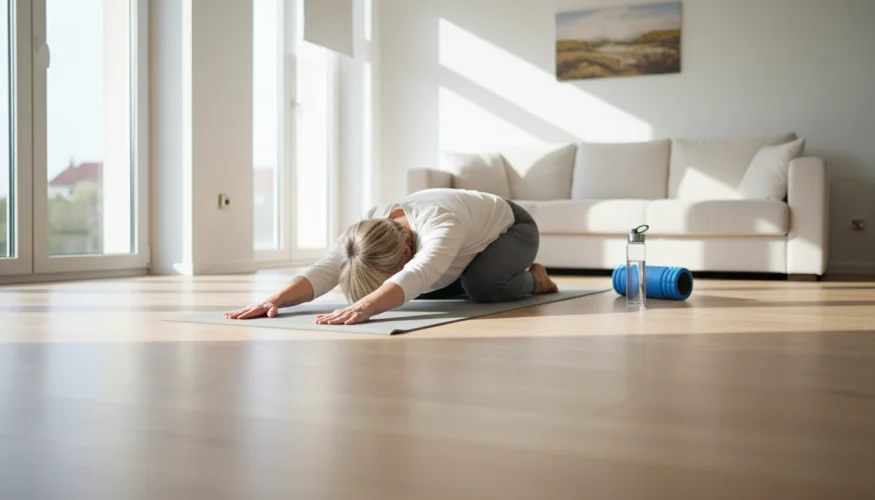
Next come gentle stretching exercises that focus on releasing the muscles around the spine rather than loading them with strength. The classic yoga "child's pose" – kneeling back onto the heels, leaning the torso forward and stretching the arms out in front – provides relief for many people with lower back pain. Similarly effective is slowly pulling the knees to the chest while lying on your back, which gently stretches the muscles of the lower back. These exercises are so undemanding that even someone in the acute phase of pain can manage them – provided, of course, that they are performed slowly, mindfully and without forcing anything.
Swimming or movement in water is among the activities most favoured by physiotherapists for patients with spinal pain. Water relieves the body, reduces the load on joints and the spine, and at the same time allows relatively free movement. There is no need to race up and down a pool – slow swimming or simply walking in water is sufficient. Hydrotherapy – exercising in water under the guidance of a specialist – is today a recognised method of rehabilitating spinal problems.
Conversely, there are movements and activities that are genuinely better avoided when your back is painful, or at least significantly reduced. These include deep forward bends with straight legs, sudden trunk rotations, lifting heavy objects with a bent back, sit-ups in the classic form, and activities involving significant spinal impact such as running on hard surfaces. This is not a permanent ban – simply a sensible pause during the time when the back needs gentle treatment.
Ergonomics and everyday movement as the foundation of prevention
Movement for back pain does not end with exercises and walks, however. Equally important – perhaps even more so – is how a person moves during everyday activities. How they get out of bed, how they sit at a computer, how they pick up shopping bags, how they stand at the stove. These "invisible" movements account for the vast majority of the load the spine bears throughout the day, and it is precisely here that the causes and solutions to problems are most often hidden.
Getting out of bed deserves special attention, because the back is most vulnerable in the morning – intervertebral discs are full of fluid after a night's sleep and significantly more sensitive to load. The correct procedure is to first roll onto your side, then lower your legs from the bed, and only then push yourself up with your hands and straighten your torso. This seemingly trivial ritual can significantly reduce morning pain and prevent the recurrence of acute twinges.
Sitting is another critical point. The average Czech person spends eight to ten hours a day sitting in front of a screen, and this is an enormous burden on the spine – particularly if the sitting posture is poor. The back should be supported by the backrest, the feet flat on the floor, the screen at eye level. Every thirty to forty minutes it is advisable to stand up, walk around the room or do a few simple movements. A number of studies confirm that interrupted sitting is significantly less harmful to the spine than uninterrupted static sitting, even if the latter is in an "ideal" position.
Lifting objects from the floor should always be done with bent knees and a straight back – almost everyone knows this rule, but in practice very few people follow it. Yet this very movement is one of the most frequent triggers of acute pain and more serious disc injuries. It is worth consciously practising it until it becomes automatic.
For those who work from home or in remote offices, ergonomic workplace equipment is also a helpful aid. A quality lumbar cushion, an ergonomic mouse pad or a laptop stand that raises the screen to the correct height are not unnecessary luxuries – they are investments in spinal health that pay off in the form of fewer painful days. Practical recommendations for ergonomic workplace arrangements can be found on the website of the National Institute of Public Health, which are freely available and presented in an accessible manner.
There is one more aspect of movement in back pain that tends to be overlooked: breathing. Deep diaphragmatic breathing activates the deep stabilising muscles of the spine – precisely those that hold it in the correct position and protect it from overload. Many people with chronic back pain breathe shallowly, using the chest, and thereby deprive the spine of the natural stabilisation that correct breathing provides. Consciously practising diaphragmatic breathing – even just five minutes in the morning and evening – can be a surprisingly effective complement to other measures.
Taking all of this together, a fairly clear picture emerges: back pain is not a reason for immobility, but a call for a different kind of movement – more conscious, more gentle and more considered. The body needs movement like air. The spine needs movement in order to be nourished, to regenerate and to remain supple. And the mind needs movement so as not to be worn down by the anxiety and helplessness that chronic pain brings.
If the pain persists for more than a few days, worsens, or is accompanied by other symptoms such as tingling in the legs, weakness or problems with urination, it is essential to see a doctor. These symptoms may indicate a more serious problem that requires specialist examination. But for the vast majority of common back pain – the kind that comes after overexertion, a clumsy movement or prolonged sitting – the best medicine is precisely sensible, regular and conscious movement. A little walking, a little stretching, a little attention to how we sit and get up. Nothing dramatic – just consistent care for the body that carries us every single day.