

# Functional System for Papers and Receipts Step by Step
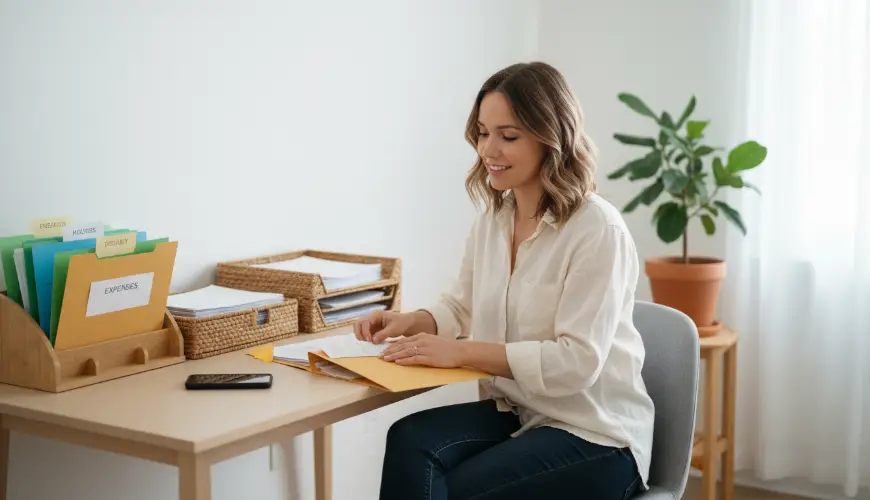
Everyone knows it. A drawer full of crumpled papers, a warranty repair receipt you can't find, a pile of documents on the corner of the desk growing faster than you can keep up. Paper chaos is one of the most widespread problems in modern households – and yet it's something that can be solved surprisingly elegantly, if you approach the problem correctly. It's not just about buying some binders and hoping for the best. It's about creating a functional system for papers and receipts that actually lasts – even six months later, even during stressful periods, even when you don't feel like sorting.
Why do most attempts at organising papers fail? The answer is simple: people look for a quick fix, not a system. They buy a few ring binders, enthusiastically label them, things work great for the first three weeks – and then one busy week arrives and everything reverts to the old ways. A truly resilient system must be designed to be as easy to maintain as possible, visually clear and tailored to the specific needs of the household or office.
Try our natural products




Why organising papers matters more than it seems
At first glance, paper clutter might look like a cosmetic problem. In reality, however, it has genuine impacts on everyday life. Lost warranty documentation means you'll miss out on a free repair when an appliance breaks down. Missing tax receipts can cause problems when filing a tax return. And constantly searching through piles of papers costs time – according to various surveys, the average person spends several hundred hours a year searching for things both at home and at work.
But there's another dimension that gets less attention: paper chaos creates psychological stress. The awareness that "somewhere there's a pile of things I should deal with" weighs on the mind even in moments when you're trying to rest. Psychologists call this phenomenon "open loops" – unfinished tasks that constantly demand attention. A tidy and well-organised paper system therefore brings not only practical benefits, but also a sense of calm and control over your own life.
Take a specific example: Jana, an accountant from Brno, finally created a document sorting system at home after years of putting it off. She says the biggest change wasn't that she finds things more easily – but that she stopped having that vague sense of anxiety every time she came home and saw a desk full of papers. "I didn't know how much it was weighing on me until it was gone," she described her experience.
How to build a system that survives even chaos
The foundation of any functional system is understanding that papers are not all the same. Different documents have different lifespans, different levels of importance and different frequencies of use. Mixing warranty cards with advertising leaflets and tax returns is precisely the approach that leads to chaos. The first step is therefore categorisation – and a realistic one, not an idealistic one.
In practice, dividing papers into three basic layers has proven effective. The first layer consists of documents that are accessed regularly or require prompt action – invoices to be paid, forms to be filled in, meeting invitations. These papers should be literally within arm's reach, ideally in an open storage spot at the work desk or in the kitchen. The second layer consists of medium-term documents – warranty cards, contracts, insurance policies, medical reports. These aren't needed daily, but must be quickly findable when the need arises. The third layer consists of archives – old tax records, historical contracts, documents that may never be used but need to be kept by law or out of caution.
The key is to design the system to be as undemanding as possible in terms of daily maintenance. The more steps a person has to take to file a paper correctly, the greater the chance they'll simply put it on the "I'll deal with it later" pile. The ideal system should work on the principle of a single movement – a paper comes into your hands, you immediately decide where it belongs, and that's where it ends up.
An excellent aid is the so-called "inbox" – one specific place where all new papers go. It can be a basket, a tray or a simple box. The important thing is that there is exactly one such place, not five different surfaces around the flat. Once a week, a "mini-sort" takes place – the inbox is cleared and each paper goes to the appropriate category or straight into the bin. This routine, if kept up regularly, takes an average of ten to fifteen minutes and prevents accumulation.
When choosing physical tools, it's worth considering not only functionality but also the materials they're made from. On the market there are organisers and binders made from recycled cardboard, natural bamboo or recycled plastic, which are aesthetically pleasing and at the same time more environmentally friendly. Such a choice is in line with the general trend towards a more sustainable household – and besides, a good-looking system motivates you to maintain it far more than a grey plastic binder.
Receipts as a special chapter
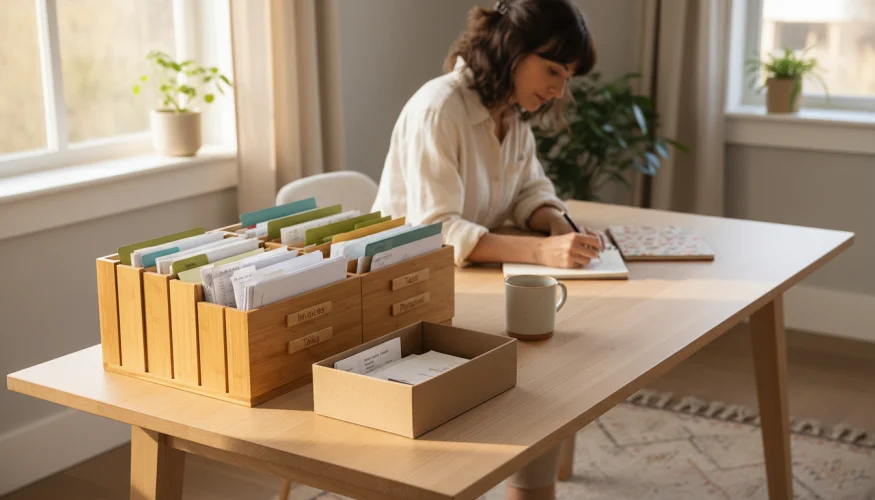
Receipts are a specific problem because they arrive in large quantities, are small, easily lost, and yet can be absolutely crucial in certain situations. Warranty claims, tax deductions, expense overviews – all of this depends on whether the relevant receipt exists and whether it can be found.
One of the most effective approaches is immediate sorting at source. Right at the point of payment, or at the latest upon arriving home, a receipt is either thrown away (if the purchase carries no warranty and no tax implications) or filed. Many people are fond of a simple envelope method: one envelope per month, into which all receipts for that period go. At the end of the year, the envelopes are archived or shredded as needed.
For those who want to go even further, digitisation offers a truly elegant solution. Apps such as Evernote, Google Drive or specialised document management tools allow you to photograph a receipt with your phone and save it to a well-organised digital structure. The paper original can then go in the bin, if the law or the specific situation permits. A digital archive is searchable, takes up no physical space and is not at risk of damage from water or fire.
It is important to mention, however, that digitisation requires its own discipline and system. A "miscellaneous" folder on your phone or computer can be just as chaotic as a physical pile of papers. A digital archive also needs a logical structure – for example by year, category (warranties, healthcare, taxes, insurance) and possibly by supplier as well.
As productivity expert David Allen once noted: "Your mind is for having ideas, not holding them." This principle applies perfectly to paper documents too – the less mental energy their management consumes, the more remains for the things that truly matter.
Another practical trick is colour coding. Different categories of documents are assigned different colours – green for finances, blue for healthcare, yellow for household matters, red for urgent issues. Coloured tabs, labels or binders then allow immediate visual orientation without reading every heading. This approach is particularly useful for households where documents are managed by more than one person and everyone needs to quickly understand the system without lengthy explanation.
It's also worth mentioning how long various documents need to be kept. Tax records and invoices in the Czech Republic are typically archived for ten years, warranty cards for the duration of the warranty plus a reasonable buffer, and medical reports according to personal judgement. A guide to recommended archiving periods will help you decide what genuinely needs to stay and what can be safely shredded. Regular shredding – ideally once a year – is just as important a part of the system as the sorting itself. Without it, even the best-designed archive will gradually become overloaded and lose its clarity.
The sustainability of a system over time depends on one seemingly trivial thing: it must be simple enough to follow even on days when you don't feel like it. Overly complicated systems with dozens of subcategories, colours, labels and digital copies of every paper look great in planning, but in practice collapse at the first busy spell. A good system is one that survives a holiday, illness or heavy workload – and upon returning to normal allows you to quickly catch up without the feeling that you're starting from scratch.
The result of a well-established system is not just a tidy drawer. It's knowing where every important document is, the confidence that you won't have to frantically search the entire flat when making a warranty claim or filing a tax return, and not least that pleasant feeling that this part of everyday life is under control. And that's worth the few hours invested in setting it up once and for all.