

# How borrowing and sharing things in the neighborhood works Borrowing and sharing items between ne

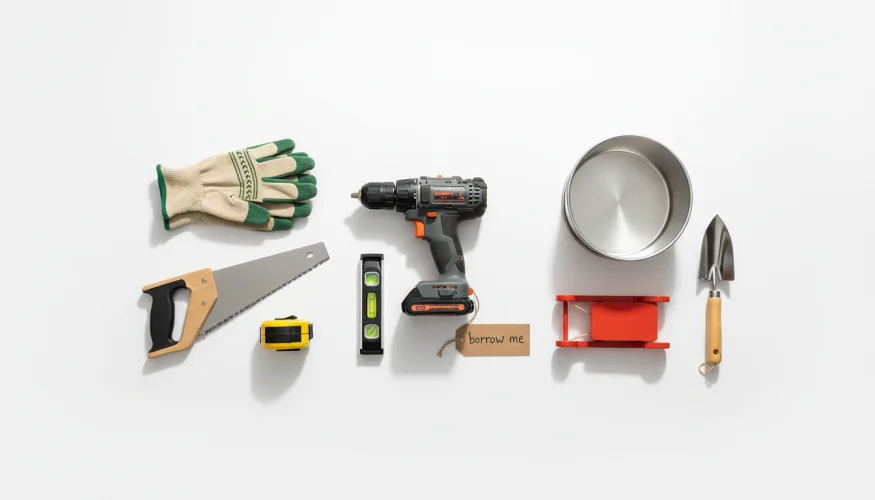
Imagine a situation that almost everyone knows: you need to drill a hole in the wall, but the last time you owned a drill was sometime in 2019 and you haven't seen it since. Or you want to bake a cake and discover you don't have the right tin. Or winter arrives and you realise that the sledge you bought for the children is gathering dust in the cellar, while the neighbour across the street is desperately looking for something to take his kids down the hill. These everyday situations are a perfect illustration of what economists call the "problem of underutilised resources" – things we own that we use for only a fraction of their potential lifespan, while others keep buying them again and again.
This is precisely where a concept that has been gaining momentum across Europe and the world in recent years comes into play: borrowing and sharing things in the neighbourhood. It is not truly revolutionary in the strict sense – people have always lent each other things. What is new, however, is the way this practice is acquiring an organised form, modern infrastructure and social recognition. And perhaps most importantly, it is beginning to be seen as part of a responsible, sustainable way of life.
Try our natural products






Why own when sharing is enough?
The sharing economy, or "sharing economy" as it is sometimes called, is not just a fashionable term from Silicon Valley. It is a response to a very real problem: the surplus of things people own but do not use. According to various estimates, the average household in the Western world owns more than three hundred items that are used less than once a year. The drill we mentioned at the beginning is a classic example – on average, over its entire lifetime, it is actually used for just twelve to thirteen minutes. Yet millions of households buy it, store it and eventually throw it away.
Neighbourhood sharing solves this paradox in a more elegant way than large commercial platforms offer. While services like Airbnb or Uber are essentially businesses built on sharing, neighbourhood borrowing operates on the principle of reciprocity and trust – without the need to pay fees, without the anonymity of the internet and without transport costs. Neighbour Tom lends his lawn mower to neighbour Hannah because he knows that next time he will need something from her. It is a system that worked in villages for centuries and is now returning to cities.
This return is not coincidental. Research shows that the level of mutual trust between neighbours in European cities has declined significantly in recent decades. According to Eurostat surveys, feelings of isolation and a lack of community ties are among the most frequently cited problems of urban life. Sharing things is therefore not only a practical solution to consumer surplus, but also a tool for building social capital – that hard-to-grasp yet enormously valuable sense of belonging to a place and the people around us.
It is no coincidence that American sociologist Robert Putnam, in his famous book Bowling Alone, pointed out that "communities in which people help and trust one another are not only happier, but also economically more productive." Neighbourhood sharing is one of the most straightforward paths to building such a community.
How neighbourhood sharing works in practice
The specific forms that sharing things in the neighbourhood can take are surprisingly numerous. At the simplest level, it involves informal arrangements between people who know each other – you lend me a ladder, I give you a jar of homemade jam. Such an exchange requires no infrastructure, only basic interpersonal trust. Yet it is precisely this trust that tends to be the weakest link in the anonymous environment of the modern city.
This is why more structured forms of neighbourhood sharing have emerged. One of the most widespread are so-called libraries of things – physical locations where people can borrow everyday items for free or for a nominal fee. Such initiatives operate in Berlin, Amsterdam, London and Vienna, for example, and their offerings are often surprisingly varied: from tools to kitchen appliances, sports equipment and children's toys. In the Czech Republic, similar projects are still developing, but the first pioneers already exist – community centres in Prague and Brno, for instance, are beginning to fulfil this function at least in part.
Alongside physical locations, digital platforms also exist that focus specifically on neighbourhood sharing. Apps such as Nextdoor, which is widespread mainly in the English-speaking world, and their European equivalents allow people in a specific district or street to communicate, offer items for loan or search for what they currently need. The advantage of digital mediation is clarity and accessibility – you do not have to wait until you bump into a neighbour in the corridor; a message is enough. The disadvantage can paradoxically be the loss of personal contact, which is otherwise one of the greatest benefits of the entire concept.
An interesting middle ground is provided by neighbourhood groups on social networks – Facebook groups for specific streets, districts or municipalities, where people offer items for loan, give away surplus produce from their gardens or look for help with minor repairs. These groups work surprisingly well in the Czech Republic and their activity has grown significantly in recent years, partly as a result of the pandemic, which paradoxically strengthened interest in local communities.
The ecological dimension of the whole matter cannot be overlooked. Every item that is borrowed instead of someone buying it new represents a saving in raw materials, energy and emissions associated with production. Sharing one lawn mower among ten households is incomparably more efficient in terms of carbon footprint than ten mowers sitting in ten garages. It is precisely this logic that underpins the growing interest in shared consumption as part of broader ecological awareness – and it applies equally to large items as to small everyday objects.
The challenges that sharing brings
It would be naive to claim that neighbourhood sharing is without problems. The greatest obstacle is often the very thing that also drives it: trust. What if a neighbour returns the drill broken? Who pays for the damage if someone borrows a bicycle and rides it into a ditch? These are legitimate questions, and ignoring them would condemn the entire concept to failure.
Experience shows that the best-functioning neighbourhood networks address these problems through a combination of clear rules and personal responsibility. Where people know each other by name and face, violating the unwritten code of reciprocity carries a social cost – and it is precisely this social control that replaces what contracts and insurance policies provide in the commercial world. Some initiatives therefore deliberately organise meetings, picnics or community events that strengthen personal ties and thereby increase willingness to respect shared rules.
Another real problem is logistics. Who keeps track of what has been borrowed and by whom? How is handover arranged? Physical libraries of things address this professionally, but require volunteers or funding. Informal networks, on the other hand, depend on the willingness of specific individuals to coordinate things – and this willingness naturally has its limits.
Nevertheless, where sharing works well, the results are remarkable. Communities that have introduced neighbourhood borrowing systems report not only financial savings and reduced consumption, but also a significantly greater sense of belonging and security. People who lend each other things also look after each other's homes, help with children and care for elderly neighbours. Sharing things is thus merely the visible tip of a much deeper iceberg of community solidarity.
It is actually logical when you think about it: trust is built gradually, in small steps. And lending a neighbour a drill is precisely such a small step that can be the beginning of something much greater.
For those who want to live more sustainably while also contributing to the quality of their surroundings, neighbourhood sharing is one of the most accessible options available. It requires neither large investments nor a radical change of lifestyle – all it takes is a start. Offer something that is lying unused. Ask a neighbour if they need anything. Join a local group. This is exactly what small revolutions that change the world look like – not in a grand gesture, but in thousands of small everyday decisions that together form a different way of being in the world.
Who knows – perhaps that drill in the cellar is simply waiting to finally find its purpose.